

Japan’s capital is undergoing a fundamental shift in its tourism fiscal policy. The Tokyo Metropolitan Government has officially announced a sweeping reform of its accommodation tax system, moving away from a static, flat-fee structure to a dynamic, percentage-based model. This pivot, set to take effect in April 2027, marks a significant milestone in how Japan’s most prominent destination manages the financial burden of a record-breaking influx of international and domestic travelers.
As municipalities across the Japanese archipelago grapple with the pressures of overtourism and the escalating costs of infrastructure maintenance, the move by Tokyo is both a signal of changing times and a blueprint for other regions to follow.
The Shift: From Flat Fees to Percentage-Based Revenue
Under the current, long-standing regulatory framework, Tokyo’s accommodation tax is relatively straightforward and modest. Guests staying in rooms priced between ¥10,000 and ¥14,999 are charged a flat fee of ¥100, while those booking rooms at ¥15,000 or above pay a flat ¥200. This system has remained largely unchanged for years, failing to keep pace with the dramatic rise in hotel room rates and the surging demand for tourism services.
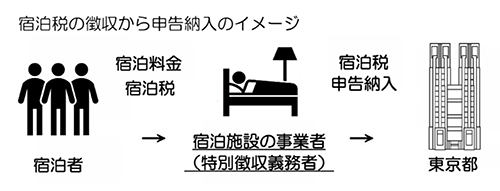
Starting in April 2027, the Tokyo Metropolitan Government will replace this with a 3 percent tax based on the nightly room rate. Notably, the tax will be expanded to include private lodgings—commonly known as minpaku—which have become a staple for many international travelers. Furthermore, the exemption threshold for low-cost accommodations will be raised to ¥13,000, ensuring that budget travelers remain shielded from the new levy.
The Financial Impact for Travelers
For the average visitor, the changes may appear negligible, but for those opting for premium or luxury stays, the fiscal impact will be pronounced. Under the new rules, a guest in a ¥15,000 room will see their nightly tax increase from ¥200 to ¥450. The difference becomes more striking at the higher end of the market:
- ¥50,000 room: The tax jumps to ¥1,500.
- ¥100,000 room: The tax climbs to ¥3,000.
These figures illustrate the Tokyo Metropolitan Government’s intent: to tie tourism revenue more closely to the luxury spending segment, which arguably benefits most from the city’s high-end infrastructure and services.

A Chronology of Japan’s Evolving Tourism Funding
To understand the significance of this shift, one must look at the historical trajectory of tourism taxes in Japan.
The Early Days (2002–2017)
Tokyo was a pioneer in 2002, becoming the first municipality in Japan to introduce a lodging tax. For over a decade, this was the exception rather than the rule. The Japanese tourism model largely operated on the assumption that tourism would pay for itself through increased consumption taxes and general economic activity.
The Post-2017 Acceleration
The landscape began to shift in 2017 when Osaka implemented its own accommodation tax, followed closely by Kyoto in 2018. These were early indicators that major tourism hubs were starting to feel the strain of concentrated visitor numbers. However, the COVID-19 pandemic acted as a massive accelerant. As the country reopened and visitor numbers hit unprecedented, record-shattering levels in 2024 and 2025, the strain on municipal resources—ranging from sanitation and waste management to emergency services and public transit—reached a breaking point.
The Current Wave
Today, we are witnessing a country-wide adoption of these taxes. From the snowy peaks of Hokkaido’s Niseko to the historic streets of Kyoto, local governments are no longer asking if they should tax visitors, but how they can do so most effectively.
Supporting Data: The Infrastructure-Revenue Gap
The motivation behind Tokyo’s reform is rooted in cold, hard data. According to the Tokyo Metropolitan Government, the existing tax structure generates approximately ¥6.9 billion annually. However, in the 2025 fiscal year, tourism-related expenditures—the costs of keeping the city running for both residents and visitors—exceeded ¥30 billion.
The new, 3 percent ad valorem (value-based) tax is projected to bridge this gap significantly, generating an estimated ¥19 billion annually. This nearly threefold increase in revenue is intended to be ring-fenced for projects that directly sustain the tourism ecosystem, including the expansion of multilingual signage, the development of smart-tourism transportation, and the enhancement of public safety and disaster preparedness measures.
Regional Approaches: A Patchwork of Policies
Japan’s decentralized governance has allowed for a diverse array of tax models, reflecting the unique priorities of each region.
The Kyoto Model: Progressive Brackets
Unlike Tokyo, which has opted for a percentage-based approach, Kyoto has chosen to double down on a tiered, fixed-rate system. Kyoto’s latest revisions include a tax of up to ¥10,000 per person per night for high-end luxury stays costing over ¥100,000. This is currently the highest accommodation tax in Japan. It serves as a deterrent to the "over-consumption" of luxury services in a city struggling with the preservation of its fragile cultural heritage.
The Niseko Model: Seasonal Elasticity
Niseko, Japan’s premier international ski destination, represents the "resort model." In 2024, the town introduced an accommodation tax that is currently transitioning to a percentage-based system. Because Niseko’s room rates fluctuate wildly between the high-demand winter ski season and the quiet summer months, a percentage-based tax allows the municipality to capture maximum revenue during peak tourism periods when the local infrastructure is under the most stress.
The Hakone Proposal: General Purpose Funding
Hakone, famous for its hot springs and proximity to Mt. Fuji, is currently deliberating a new tax for 2028. Unlike Tokyo or Kyoto, which earmark these funds for tourism-specific projects, Hakone is considering classifying the levy as an "ordinary local tax." If successful, this would allow the revenue to be used for general municipal services, such as healthcare or education for local residents, potentially setting a new precedent for how municipalities view the relationship between tourists and the local community.
Official Responses and Strategic Implications
The Internal Affairs Ministry, led by Minister Hayashi Yoshimasa, has signaled its approval of these revisions, recognizing that local governments are currently at the front lines of managing the "overtourism" phenomenon.
Shifting the Burden
The overarching philosophy behind these changes is a transition from viewing the tourist as a purely economic benefit to recognizing the tourist as a consumer of public services. By shifting the financial burden away from local taxpayers—who often bear the brunt of traffic congestion, increased waste, and the inflation of daily goods—municipalities are attempting to foster a more sustainable model of "coexistence" between residents and visitors.
The Future of Japanese Tourism
For the global traveler, these changes represent the "new normal" of visiting Japan. As these taxes become more common, they will likely be integrated into the final booking price of hotels and, increasingly, Airbnb-style minpaku listings.
The long-term implication is a more professionalized tourism infrastructure. If successful, the extra revenue will lead to cleaner public spaces, better-staffed tourist information centers, and more robust emergency response systems. However, there is a risk: as taxes rise, Japan may lose some of its competitive edge as a "value" destination.
Conclusion
The decision by the Tokyo Metropolitan Government to modernize its tax system is not merely a bureaucratic adjustment; it is a profound acknowledgment of the new reality of global travel. Japan is no longer a hidden gem struggling to attract visitors; it is a global epicenter of tourism that must manage the footprint of millions.
As the 2027 implementation date approaches, the eyes of the nation will be on Tokyo. If this percentage-based model proves effective in balancing the books without discouraging high-spending visitors, it is highly probable that the rest of the country will follow suit, cementing the era of the "sustainably-funded" Japanese tourism destination. The message to the international community is clear: Japan welcomes you, but the cost of maintaining the high standard of service and infrastructure you expect is now being shared by those who use it most.











