

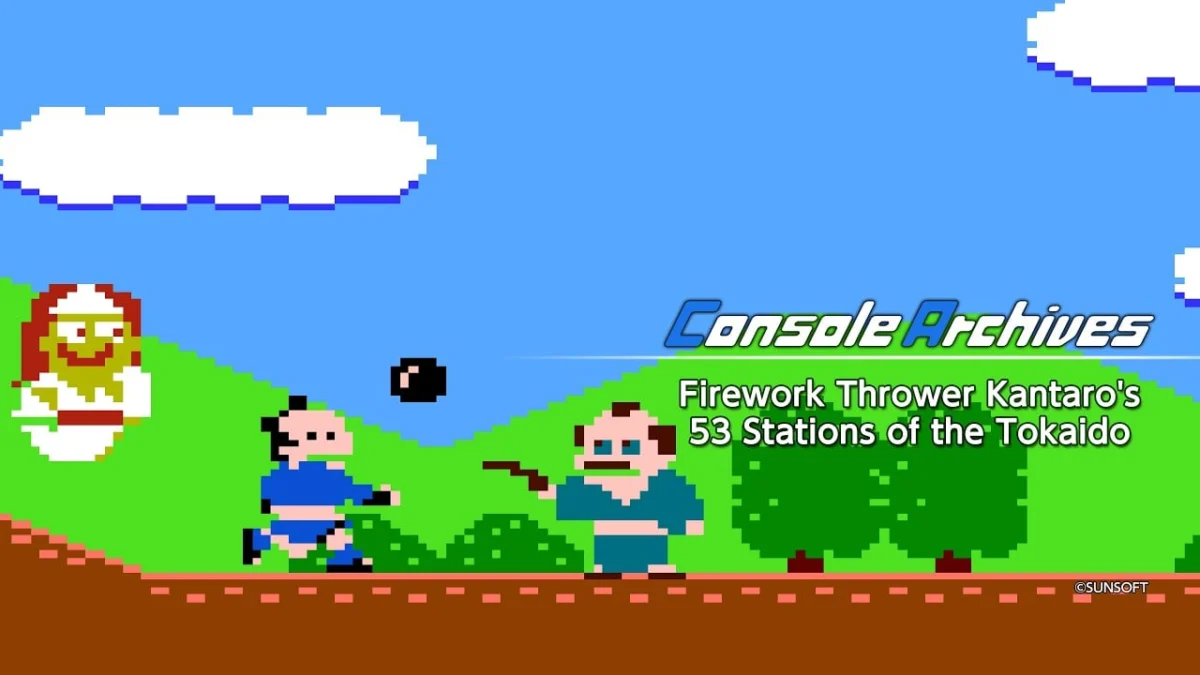
Tokyo, Japan – May 28, 2024 – Gaming historians and enthusiasts alike are set to embark on a nostalgic journey as Hamster Corporation, renowned for its meticulous preservation efforts, announces the imminent re-release of SUNSOFT’s 1986 classic, Firework Thrower Kantaro’s 53 Stations of the Tokaido. Part of the burgeoning Console Archives series, this retro action title will launch on June 4 for PlayStation 5 and, notably, the yet-to-be-fully-unveiled "Switch 2," priced at an accessible $7.99 USD / 800 yen.
The re-release offers a unique blend of historical authenticity and modern convenience, bringing an obscure yet charming piece of Japanese gaming history to a global audience. While the original game content remains in its native Japanese, Hamster has ensured that the user interface and manual are fully localized into English, providing a crucial bridge for international players eager to experience Kantaro’s vibrant adventure. This strategic approach highlights Hamster’s commitment not only to archiving games but also to making them playable and understandable for contemporary audiences, even as it preserves the original artistic and linguistic integrity of the game’s core experience.
Main Facts: A Journey Rekindled
The official announcement from Hamster Corporation confirms the digital release of Console Archives Firework Thrower Kantaro’s 53 Stations of the Tokaido. This 8-bit action game, originally developed and published by SUNSOFT in 1986 exclusively for the Japanese home console market, tasks players with guiding the titular fireworks thrower, Kantaro, on an arduous journey. His mission: to reach Edo (modern-day Tokyo) and launch fireworks over the Sumida River, where his beloved fiancée, Momoko-chan, eagerly awaits. Along the perilous path, Kantaro must fend off a variety of enemies using his unique firework-throwing abilities.
The re-release is positioned as the latest entry in Hamster’s Console Archives series, a dedicated initiative focused on resurrecting classic games from home consoles for modern platforms. This particular title will be available on both PlayStation 5 and the forthcoming "Switch 2," making it one of the earliest confirmed titles for Nintendo’s next-generation console, a detail that has sparked considerable discussion and speculation within the gaming community. The pricing strategy of $7.99 / 800 yen aims to make this historical artifact accessible to a broad demographic, from seasoned retro gamers to new players curious about the origins of action gaming.
Crucially, Hamster has integrated a suite of modern quality-of-life features into the Console Archives version. These include customizable button layouts, rapid-fire settings, multiple save points, and a rewind function for certain titles – all designed to mitigate the often punishing difficulty of 8-bit games and allow players to experience the content at their own pace. Visual customization options, such as screen layout adjustments and filters that emulate the nostalgic glow of CRT televisions, further enhance the player’s ability to tailor their retro experience. This dual approach of faithful preservation and thoughtful modernization underscores Hamster’s philosophy: to honor gaming’s past while making it palatable for its present and future.
Chronology: A Blast from the Past
The journey of Firework Thrower Kantaro’s 53 Stations of the Tokaido spans nearly four decades, from its initial conception during the golden age of 8-bit gaming to its modern revival. Understanding this timeline provides crucial context for appreciating the significance of its re-release.
The 1986 Original: SUNSOFT’s Vision
The year 1986 was a pivotal period in the video game industry, particularly in Japan. Nintendo’s Famicom (known as the NES in Western markets) was in full swing, dominating the home console landscape and fostering an explosion of creativity among developers. Amidst this vibrant ecosystem, SUNSOFT, an Osaka-based developer and publisher, made its mark. While perhaps not as globally recognized as some of its contemporaries like Nintendo or Capcom, SUNSOFT cultivated a reputation for producing high-quality, often challenging, and visually distinct games. Titles such as Blaster Master, Journey to Silius, Batman: The Video Game, and Famicom World (later Wacky Worlds in the West) showcased their talent for innovative gameplay and memorable soundtracks.
Firework Thrower Kantaro’s 53 Stations of the Tokaido emerged from this creative hotbed. Released exclusively in Japan, it drew inspiration from deep wells of Japanese culture and history. The "53 Stations of the Tokaido" refers to the historic road connecting Edo (present-day Tokyo) and Kyoto, famously immortalized in ukiyo-e woodblock prints by artists like Hiroshige. This backdrop provided a rich tapestry for Kantaro’s adventure, infusing the game with a sense of geographical and historical authenticity, even within its fantastical action framework. The premise itself, involving fireworks over the Sumida River, taps into a beloved Japanese tradition – the summer fireworks festivals, particularly the historic Sumida River Fireworks Festival, which dates back to the Edo period.
As an 8-bit action game, Kantaro likely featured sprite-based graphics, chiptune music, and challenging platforming and combat mechanics characteristic of its era. Players would have navigated Kantaro through various stages representing different "stations" along the Tokaido, engaging enemies with his unique firework projectile. The narrative, simple yet effective, revolved around a romantic quest, adding a layer of emotional drive to the otherwise action-oriented gameplay. For its time, it would have been a quintessential example of Japanese game design, often prioritizing challenging gameplay and a distinctive aesthetic over intricate storytelling. The game’s obscurity outside of Japan is primarily due to its original exclusive release, making this re-release a true uncovering of a hidden gem for many international players.
Hamster’s Console Archives: Preserving Gaming History
Fast forward nearly four decades, and Hamster Corporation steps into the spotlight as the torchbearer for preserving and reintroducing these forgotten treasures. Hamster has long been a stalwart in the retro gaming scene, particularly celebrated for its Arcade Archives series. This initiative has brought hundreds of classic arcade games, from Pac-Man to Donkey Kong, to modern consoles, often with pixel-perfect emulation and a wealth of customization options. The Console Archives series represents a logical and vital expansion of this mission, shifting focus from coin-op cabinets to the home console titles that shaped generations of players.
The philosophy behind Console Archives is deeply rooted in game preservation. Many 8-bit and 16-bit console games are increasingly difficult to play legally on original hardware due to aging components, physical media degradation, and compatibility issues with modern displays. Digital re-releases like those offered by Hamster provide a vital service, ensuring these games remain accessible and playable for future generations. More than just simple ports, Hamster’s approach involves meticulous emulation, often working with the original developers or rights holders, to deliver experiences that are as authentic as possible to their initial release, while simultaneously enhancing them for modern player sensibilities.
As Hamster states, the Console Archives series is "designed to bring classic games originally released on home consoles to modern gaming platforms." This mission extends beyond mere availability; it’s about making these classics enjoyable in a contemporary context. By integrating features that address common frustrations of older games – such as relentless difficulty, lack of save points, and rigid controls – Hamster aims to bridge the gap between retro charm and modern expectations. This commitment to accessibility and historical accuracy positions Hamster as a crucial guardian of video game heritage, ensuring that titles like Firework Thrower Kantaro can find a new audience and solidify their place in the annals of gaming history.
Supporting Data: Modern Enhancements for a Retro Experience
The re-release of Firework Thrower Kantaro’s 53 Stations of the Tokaido is not merely a direct port of its 1986 counterpart. Hamster Corporation, through its Console Archives framework, has integrated a comprehensive suite of features designed to enhance the player experience, balancing historical authenticity with modern playability. These additions are crucial for making an almost 40-year-old, niche Japanese title appealing to a diverse global audience.
Bridging Generations: Accessibility Features
One of the primary challenges of re-releasing retro games is their inherent difficulty and often unforgiving design, which can deter modern players accustomed to more lenient systems. Hamster directly addresses this through several key accessibility features:
- Customizable Button Layouts: Many older games had fixed, sometimes counter-intuitive, control schemes. The ability to remap buttons allows players to tailor the controls to their personal preference, making the game feel more natural and responsive, reducing frustration stemming from awkward inputs.
- Rapid-Fire Settings: A common feature in classic action games, rapid-fire (or autofire) can significantly reduce finger fatigue and make intense sections more manageable. For games like Kantaro that likely involve continuous projectile throwing, this can be a game-changer, allowing players to focus more on dodging and strategy rather than mashing buttons.
- Multiple Save Points: Perhaps the most impactful modern addition for retro titles, save states fundamentally alter the difficulty curve. Unlike the original 8-bit experience, where players might face a "game over" after losing all lives and be forced to restart entire levels or even the whole game, save points allow for progress to be preserved at critical junctures. This enables players to experiment, learn from mistakes without severe penalty, and ultimately see the game through to completion, a luxury often denied by the original design.
- Rewind Function (for some titles): While not explicitly confirmed for Kantaro, the Console Archives series mentions a rewind function for "some titles." This feature, if present, is a powerful tool for learning and overcoming difficult sections. It allows players to undo mistakes instantly, providing an immediate feedback loop and encouraging perseverance without the tedium of replaying long segments. This is particularly beneficial for pixel-perfect platforming or boss battles that require precise timing.
These features collectively transform the experience from a potentially punishing retro challenge into a more accessible and enjoyable journey. They don’t remove the original difficulty but offer players tools to manage it, making the game approachable for newcomers while still respecting the core gameplay.
Visual Fidelity and Nostalgia: Tailoring the Aesthetics
Beyond gameplay mechanics, Hamster also provides robust options for customizing the visual presentation, catering to both purists and those seeking a modernized look:
- Screen Layout Adjustments: Original 8-bit games were designed for specific aspect ratios (typically 4:3) on CRT televisions. Playing them on modern widescreen displays often results in stretching or unsightly black bars. Hamster’s adjustments allow players to choose between various aspect ratios, apply borders, or even stretch the image if they prefer, ensuring the game fits comfortably on any screen. This flexibility prevents visual distortion and allows players to prioritize either authenticity or screen real estate.
- Filters that Recreate the Nostalgic Atmosphere of CRT TVs: This is a beloved feature for retro enthusiasts. CRT (Cathode Ray Tube) televisions had distinct visual characteristics, including scanlines, pixel bloom, and color bleed, which were integral to the intended look of many 8-bit games. Emulating these effects with digital filters can significantly enhance the nostalgic experience, making the game look "correct" as it would have appeared on original hardware. These filters are not merely cosmetic; they contribute to the authentic feel and can even soften sharp pixel edges, mimicking the visual properties of older displays.
The ability to "customize the visual experience to their preference" aligns perfectly with Hamster’s "enjoy the game your way" philosophy. Whether a player wants a crisp, pixel-perfect image on a modern screen or a warm, fuzzy, scanline-laden recreation of a 1980s television, the Console Archives series provides the tools to achieve it.
The Localization Paradox: Bridging Language Barriers (Partially)
A critical aspect of Firework Thrower Kantaro’s 53 Stations of the Tokaido‘s re-release is its approach to localization. Hamster has explicitly stated: "(This title was originally released exclusively in Japan. While the user interface and manual are available in English, the game content is available in Japanese only.)" This presents a nuanced situation with both advantages and disadvantages for the global audience.
-
Advantages of Partial Localization:
- Accessibility of Core Functions: English UI and manuals make navigating menus, understanding options, and grasping basic gameplay mechanics straightforward for non-Japanese speakers. This removes a significant barrier to entry.
- Preservation of Original Intent: Keeping the in-game text and dialogue (if any beyond basic prompts) in Japanese ensures that the original narrative, cultural nuances, and artistic intent are preserved exactly as SUNSOFT intended. This is crucial for game preservation purists.
- Cost-Effectiveness: Full localization, especially for older games with potentially complex text, can be expensive and time-consuming. This partial approach allows Hamster to bring more obscure titles to market more quickly and affordably.
-
Disadvantages and Implications for Players:
- Narrative Barriers: If Kantaro contains significant in-game text, character interactions, or plot developments beyond the basic premise, non-Japanese speakers will miss out on these details. While the core action gameplay might be understandable, the richer narrative context could be lost.
- Cultural Context: Certain jokes, puns, or cultural references embedded in Japanese text might be inaccessible, diminishing the overall immersion for some players.
- Reliance on External Resources: Players deeply invested in the story might need to consult fan translations or online guides to fully understand the game’s narrative.
Despite the language barrier for in-game content, Hamster’s decision reflects a pragmatic approach. It prioritizes making the game playable and manageable for a global audience while maintaining the original, often culturally specific, content. For a game where the primary appeal lies in its action gameplay and historical significance, this balance may be acceptable for many, especially given the game’s relative obscurity. It also encourages a form of cultural immersion, inviting players to experience the game as it was originally presented, with only the essential modern aids to guide them.
Official Responses and Statements
Hamster Corporation’s announcement serves as the primary official response regarding the re-release of Firework Thrower Kantaro’s 53 Stations of the Tokaido. The company’s consistent messaging through its Console Archives series underscores a clear strategic intent: to rescue and reintroduce console classics to modern gamers.
The overview provided by Hamster offers a concise summary of the game’s premise, directly quoting: "Wait for me, Momoko-chan." This simple, evocative line immediately establishes the romantic motivation behind Kantaro’s perilous journey. It highlights the game as an "action game where Kantaro, a fireworks thrower, travels to Edo to launch fireworks over the Sumida River, where his fiancée, Momoko-chan, is waiting, while fending off enemies along the way." This concise synopsis effectively communicates the core gameplay loop and narrative hook to potential players.
The company’s commitment to quality-of-life enhancements is also explicitly stated, positioning these features not as mere additions, but as fundamental tools to "support players in completing these classics." This indicates a player-centric design philosophy, aiming to reduce the barriers to entry that often accompany older, more challenging titles. The inclusion of "customizable button layouts, rapid-fire settings, multiple save points, and for some titles, a rewind function" are direct responses to common player feedback and modern gaming expectations.
Furthermore, the emphasis on visual customization, including "screen layout adjustments and filters that recreate the nostalgic atmosphere of CRT TVs," demonstrates an understanding of the diverse preferences within the retro gaming community. Hamster acknowledges that some players seek a pristine, modernized look, while others crave the authentic, slightly blurry aesthetic of a bygone era. By offering these choices, Hamster empowers players to "customize the visual experience to their preference," reinforcing the overarching theme of enjoying the game "your way."
The official trailers, available in both English and Japanese, serve as crucial marketing tools. They provide the first visual glimpse of the game in its re-released form, showcasing the emulation quality and the integration of the new features. These trailers are essential for generating excitement and demonstrating the faithful recreation of the 8-bit aesthetics. The availability of separate language trailers also caters to Hamster’s diverse target markets, ensuring clear communication with both domestic Japanese audiences and the wider international gaming community.
Overall, Hamster’s official communication paints a picture of a company deeply invested in game preservation, not just for the sake of archiving, but for the purpose of making these historical artifacts genuinely enjoyable and accessible to a new generation of players, as well as those looking to revisit their past. Their transparent approach to localization and feature implementation builds trust and sets clear expectations for what players can anticipate from Console Archives titles.
Implications: The Future of Retro Gaming and Preservation
The re-release of Firework Thrower Kantaro’s 53 Stations of the Tokaido carries significant implications, not only for Hamster Corporation and retro gaming enthusiasts but also for the broader video game industry, particularly concerning console hardware and the philosophy of game preservation.
The "Switch 2" Factor
Perhaps the most striking detail in Hamster’s announcement is the explicit mention of "Switch 2" as a launch platform. As of this writing, Nintendo has not officially unveiled a successor to the highly successful Nintendo Switch, although industry speculation and rumors have been rampant. Hamster’s announcement, therefore, serves as one of the first official third-party confirmations, or at least a strong indication, of Nintendo’s next-generation console.
This has several key implications:
- Early Developer Support: Hamster’s willingness to announce a title for "Switch 2" suggests that developers are already being briefed on the new hardware, or at the very least, are confident enough in its impending arrival to list it as a target platform. This implies a relatively smooth transition for developers and potentially a robust launch lineup.
- Future-Proofing Retro Releases: By launching on "Switch 2" alongside PlayStation 5, Hamster is future-proofing its Console Archives series. It ensures that these preserved classics will be available on the latest hardware from both Sony and Nintendo, maximizing their longevity and accessibility for years to come.
- Strategic Marketing: For Hamster, being among the first to announce a title for an unreleased console generates significant buzz, drawing attention not only to Firework Thrower Kantaro but also to the Console Archives series as a whole. It positions Hamster as a forward-thinking publisher within the retro space.
- Confirmation or Placeholder? While exciting, it’s worth noting that "Switch 2" might be a placeholder term used by developers before an official name is revealed. However, the explicit mention suggests more than just generic "next-gen Nintendo console" planning; it points to specific communication between Hamster and Nintendo regarding future hardware. This detail will undoubtedly be scrutinized by industry analysts and Nintendo fans alike, seeking any shred of information about the successor to the Switch.
The Value of Digital Re-releases
The Console Archives series, exemplified by Kantaro‘s re-release, underscores the vital role of digital storefronts and dedicated preservation initiatives in safeguarding video game history. Many classic games, particularly those from the 8-bit and 16-bit eras, exist on physical media that degrades over time, or on proprietary cartridges requiring specific hardware that is increasingly rare and expensive.
Digital re-releases offer:
- Accessibility: They make obscure and historically significant titles available to a global audience with just a few clicks, removing geographical and financial barriers.
- Longevity: Digital distribution ensures that these games can continue to be played for decades, independent of the condition of original hardware or cartridges.
- Educational Value: For students of game design, historians, and cultural anthropologists, these re-releases provide crucial artifacts for studying the evolution of interactive entertainment.
- Economic Model: They create a sustainable economic model for preservation, allowing companies like Hamster to invest in emulation, licensing, and development, ensuring that this work can continue.
In an era where physical media is becoming less dominant, digital archives are becoming the primary custodians of our collective gaming heritage.
Market Reception and Niche Appeal
Firework Thrower Kantaro’s 53 Stations of the Tokaido is undeniably a niche title. Its original Japan-exclusive release, its age, and the partial localization all contribute to a focused target audience.
- Retro Enthusiasts and Historians: This group will be the primary demographic, eager to explore a previously inaccessible piece of SUNSOFT history. The promise of accurate emulation combined with modern conveniences makes it an attractive proposition.
- Curious Gamers: The accessible price point ($7.99) might entice some casual players or those simply curious about what 8-bit Japanese gaming was like. The unique cultural backdrop and quirky premise could also draw in some.
- The Localization Debate: The Japanese-only in-game content will inevitably be a point of discussion. While some will appreciate the purist approach, others may lament the lost opportunity for full cultural immersion. This ongoing debate highlights the tension between preserving original artistic intent and making content universally accessible. However, for a game where the primary appeal lies in its action mechanics, this compromise might be more readily accepted.
SUNSOFT’s Legacy and Modern Relevance
The re-release also shines a spotlight on SUNSOFT, a developer that, while impactful in its time, has had a fluctuating presence in the modern industry. Initiatives like Console Archives help to keep the legacy of such studios alive, introducing their past works to new generations who might then seek out their more famous titles or support any future endeavors. It serves as a reminder that gaming history is rich and diverse, extending far beyond the most globally successful franchises. For SUNSOFT, it’s an opportunity to have one of its lesser-known works rediscovered and appreciated on a global stage.
Conclusion
The impending launch of Console Archives Firework Thrower Kantaro’s 53 Stations of the Tokaido on June 4 marks a significant moment for retro gaming. Hamster Corporation continues its commendable work in digital game preservation, bringing a charming yet obscure 1986 SUNSOFT title to modern platforms, including the intriguing "Switch 2."
This release exemplifies a thoughtful approach to retro gaming: one that respects the historical authenticity of the original while thoughtfully integrating modern enhancements to ensure accessibility and enjoyment for a contemporary audience. From customizable controls and save states to nostalgic CRT filters, players are empowered to experience Kantaro’s journey to Edo "their way." While the Japanese-only in-game content presents a minor linguistic barrier, the English UI and manual provide sufficient guidance for most.
More than just a game re-release, Kantaro‘s arrival on current and future consoles underscores the enduring value of digital archives, the importance of cultural preservation in video games, and the exciting prospect of new hardware on the horizon. As players prepare to join Kantaro on his quest to reunite with Momoko-chan and light up the Sumida River, they are not just playing a game; they are engaging with a vibrant piece of gaming history, rekindled for a new era.











No comments yet. Be the first to join the conversation!