Asro
Asro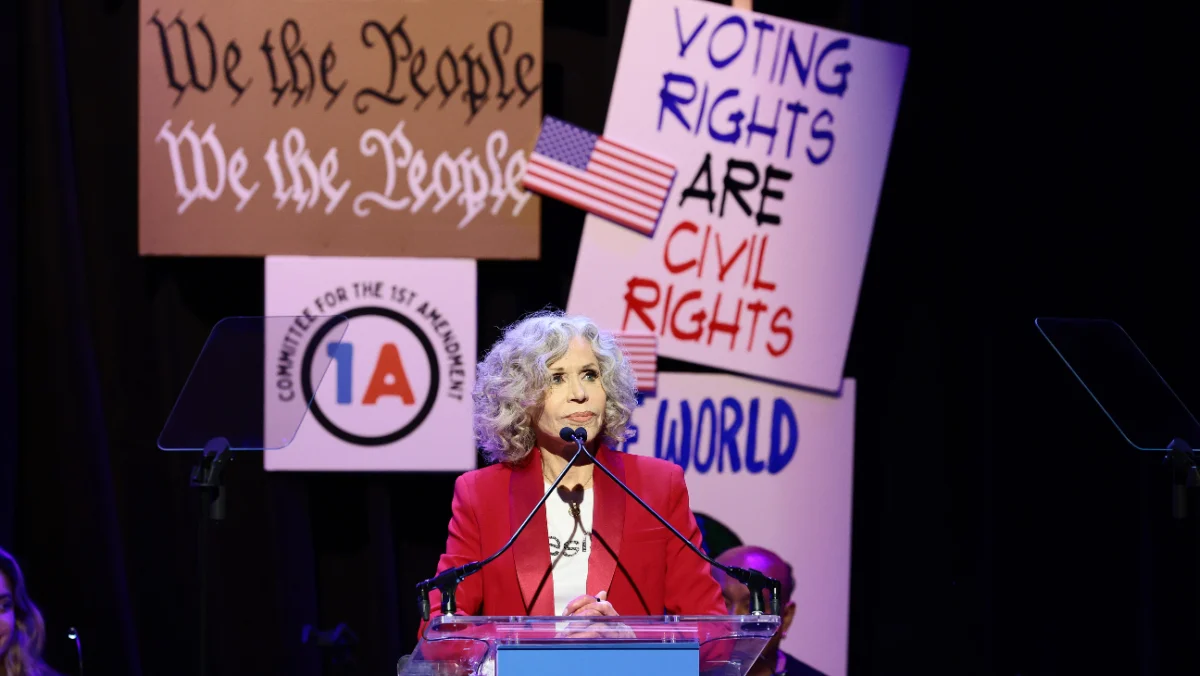
By [Your Name/Journalist Desk]
In a powerful display of solidarity that bridged the gap between Hollywood’s golden age and its modern-day political landscape, legendary actress and activist Jane Fonda took to the stage at New York’s historic Town Hall this past Sunday. The event, titled Rise Up, Sing Out: A Concert for the First Amendment, served as a high-profile relaunch of the Committee for the First Amendment—an organization originally forged in the fires of the 1940s McCarthy-era "Red Scare."
Fonda, flanked by an eclectic and formidable roster of stars, issued a searing indictment of what she characterized as a systematic erosion of free expression in America. The evening was more than a concert; it was a rallying cry for the entertainment industry to reject "anticipatory obedience" and stand firm against increasing political pressure.
The Historical Context: From the Blacklist to Today
To understand the weight of the evening, one must look back to 1947. During the height of the House Un-American Activities Committee (HUAC) investigations, Hollywood found itself under siege. As the government sought to root out perceived communist influence, the entertainment industry became a primary target for censorship and blacklisting.
It was during this period of intense paranoia that the original Committee for the First Amendment was formed. Among its founding luminaries were figures like Henry Fonda, Humphrey Bogart, Lauren Bacall, and Danny Kaye. They stood against the tide of political intimidation, arguing that the suppression of dissenting voices was a fundamental violation of the U.S. Constitution.
Jane Fonda’s decision to revive this organization last October was not a casual nod to nostalgia. She frames the current political environment as a mirror—and perhaps a more insidious version—of that dark chapter.
"The committee was relaunched last October to bring together the entertainment industry at this moment, when our democracy is in peril," Fonda told the packed audience. "In the face of what’s happening, we need our industry to be unified, activated and unwilling to engage in anticipatory obedience. We stand together in defense of our right to free expression. They come for one of us, by God, they come for all of us."
A Searing Indictment of Current Censorship
The core of Fonda’s address was a catalog of grievances regarding how free speech is currently being curtailed across the United States. She drew a direct line between government policy and the complicity of private corporations.
"Right now, the government and its cronies are routinely violating the First Amendment to silence artists," Fonda asserted. She highlighted the shuttering of cultural institutions like the Kennedy Center, the defunding of the National Endowment of the Arts (NEA), the proliferation of book bans in public schools, and the removal of television hosts who deviate from approved narratives.
Fonda’s criticism extended beyond the halls of government and directly into the boardrooms of major media conglomerates. She described a climate of fear, noting, "It’s being allowed by cowardly corporations. I’m not going to name names right now. But I am honored to pass the mic to artists and activists who continue to speak up and sing out so that we might be inspired to rise up."
This concept of "anticipatory obedience"—a term borrowed from the study of totalitarian regimes—refers to the phenomenon where individuals or companies censor themselves before they are even told to do so, out of fear of retribution or financial loss. Fonda warned that this behavior is currently the most significant threat to the American creative spirit.
The Cross-Partisan Call to Action
One of the most striking aspects of the evening was Fonda’s insistence that the protection of the First Amendment must transcend the current, hyper-polarized political climate. She cautioned against viewing the issue through a purely partisan lens.
"Those rights are for everyone," she emphasized. "We must defend them for everyone. Even if we don’t agree with them. You know, it’s not about Democrat or Republican, or left or right. It’s about right or wrong. And it is wrong. It is wrong for people to be attacked and called terrorists for exercising their rights and freedoms."
This appeal for unity was aimed at a broad spectrum of Americans. Fonda’s rhetoric suggests that she views the current state of free expression as a national crisis that threatens the foundation of democratic participation. She urged citizens to move beyond tribal politics, warning that the failure to protect the rights of political opponents eventually leads to the forfeiture of one’s own rights.
"It’s time for Americans all across the country, all across the political spectrum, who care about these freedoms, to stand up, creatively, nonviolently, to defend these rights, while we can," she urged. "And we must do this now. Because if we don’t, we’re not going to have any rights to defend."
Supporting Data and the Cultural Climate
The committee’s website, which serves as the hub for this revived initiative, explicitly states its mission: to "defend free expression against government repression, industry complicity and intimidation."
The data surrounding these concerns is varied but pointed. According to recent reports from PEN America, a non-profit organization that tracks book bans, the number of instances where books were removed from school libraries in the U.S. has reached record highs in the last three years. Simultaneously, legislative efforts at the state level to restrict "divisive concepts" in educational settings have created a "chilling effect" on curriculum and classroom discourse.
Furthermore, the National Endowment of the Arts (NEA) has faced repeated threats of budget cuts and existential challenges in recent federal budget cycles. For artists, these aren’t just budgetary line items; they represent a withdrawal of institutional support for work that may be considered "unfavorable" by certain political factions.
Fonda’s event served as a manifestation of the "industry complicity" she decries. By bringing together some of the most influential names in entertainment, she is attempting to shift the cost-benefit analysis for corporations. If the most recognizable faces in the world demand protection for speech, it becomes significantly harder for corporate entities to quietly purge content or silence talent to appease political pressure groups.
A Star-Studded Show of Force
The Town Hall event was notable for the sheer breadth of its participants. The lineup included actors, journalists, and public figures who rarely share the same stage, underscoring the severity of the cause.
Participants included:
- Julia Roberts and Robert De Niro: Icons of cinema whose participation signaled the industry’s deep-seated concern regarding current trends.
- Ayo Edebiri and Tessa Thompson: Representing the younger guard of Hollywood, highlighting that the struggle for free expression is a generational concern.
- Bette Midler and Patti Smith: Legendary performers who have long histories of using their platforms for political activism.
- Joy Reid: A journalist whose presence underscored the intersection of media freedom and the broader First Amendment mandate.
- Lily Gladstone and Ms. Rachel: A diverse cross-section of entertainers whose reach spans from prestige drama to children’s education.
This coalition suggests a strategic effort to build a "big tent" movement. By inviting figures like Ms. Rachel—who is primarily known for children’s educational content—the committee is signaling that this is not merely a fight for high-art or political pundits, but a struggle for the culture at large.
Implications: The Road Ahead
The revival of the Committee for the First Amendment carries significant implications for the future of the entertainment industry and its relationship with the American political apparatus.
First, it signals a shift from passive observation to active resistance. By institutionalizing their pushback, Fonda and her colleagues are creating a mechanism for legal defense and public advocacy. They are effectively telling corporations that there will be a unified, public price to pay for bowing to political pressure.
Second, the event highlights a deepening divide in American culture regarding what is considered "protected" versus "harmful" speech. The committee’s stance is uncompromising: in a democracy, even speech that is deemed offensive or dangerous by the majority must be protected, as the power to censor is rarely kept in the hands of the "correct" people for long.
Finally, the event acts as a warning to political actors across the spectrum. By explicitly mentioning the "terrorist" labeling of activists, Fonda is pushing back against the weaponization of language to stifle dissent. Whether or not this movement will have the staying power of its 1947 predecessor remains to be seen, but the initial mobilization suggests that Hollywood’s most prominent voices are no longer willing to wait for the political climate to stabilize on its own.
As Fonda concluded to a roaring crowd: "Showing up is an act of hope, and you all give me hope." Whether that hope can translate into a meaningful shift in the legislative and corporate treatment of the First Amendment is the defining challenge for the committee in the months and years ahead. For now, the message is clear: the industry has been alerted, the committee is active, and the debate over the limits of expression in America has been officially reignited.

 Sagoh
Sagoh
 Nana Wu