Muslim
For over a decade, AMD has been a champion of hardware-level security, positioning its chips as robust bastions against sophisticated physical exploits. A cornerstone of this strategy was Transparent Secure Memory Encryption (TSME), a feature designed to encrypt the entirety of a system’s RAM, rendering data useless to attackers even if they perform a "cold boot" attack or physically extract memory modules.
For years, this protection was a staple in both the enterprise-grade Pro line and the standard consumer-grade Ryzen processors. However, in a move that has sparked outrage among privacy advocates and hardware enthusiasts, AMD appears to have covertly stripped TSME support from its latest consumer CPUs. The change, implemented via firmware updates, has left users with degraded security profiles and, according to industry experts, a significant breach of trust.
The Security Vacuum: What is TSME?
To understand the severity of this shift, one must first understand the function of TSME. Unlike standard disk encryption, which protects data at rest, or application-level encryption, which protects data in transit, TSME operates at the hardware level. It encrypts all data stored in the system’s RAM using a key managed by the CPU’s firmware.
Because this process is transparent to the operating system, it provides a crucial layer of defense against physical threats. In a cold boot attack, a malicious actor resets a computer and rapidly dumps the contents of the RAM before the data decays, potentially capturing sensitive information like encryption keys or passwords. TSME mitigates this risk by ensuring that even if the hardware is accessed, the data remains scrambled and indecipherable.
For years, this "set it and forget it" security feature was a silent guardian for Ryzen users. When it suddenly stopped working, the silence from AMD was deafening.
Chronology of a Silent Removal
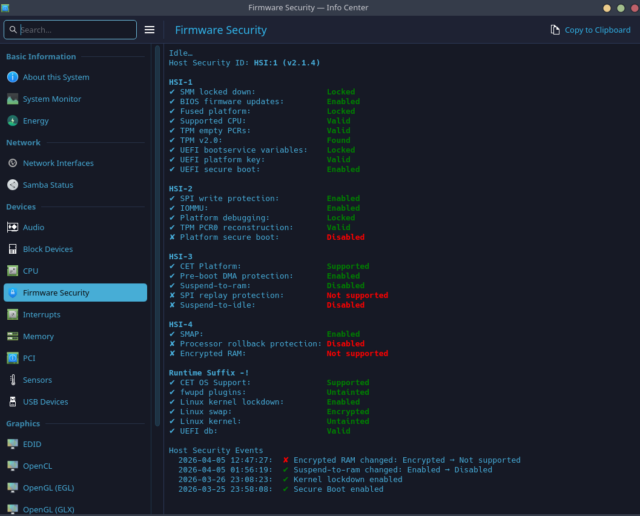
The issue came to light in April 2025, when Ben Kilpatrick, a privacy-conscious Linux hobbyist, was performing a routine system audit. While installing a new operating system on his machine—powered by a Ryzen 7 9700X (Zen 5 architecture)—he utilized the Host Security ID (HSI) tool to verify his hardware’s security posture.
To his shock, the HSI report indicated that "encrypted RAM" was "not supported." Kilpatrick, who had manually enabled TSME in his BIOS settings, was baffled. What followed was a monthslong investigative odyssey that would eventually reveal a systematic, albeit quiet, withdrawal of the feature.
The Firmware Smoking Gun
Kilpatrick’s investigation, supported by engineers at MSI, confirmed that the removal of TSME was tied to specific versions of the AMD Generic Encapsulated Software Architecture (AGESA), the firmware that initializes the hardware during the boot process.
Testing revealed that when using older firmware, the Ryzen consumer CPUs correctly identified and enabled TSME. However, with the introduction of AGESA version 1.2.7.0, the feature was effectively disabled. Even when users toggled the option to "Enabled" in their BIOS, the hardware flag remained set to "not supported."
Investigating the "Why": A Policy or a Bug?
The technical evidence pointed to a deliberate restriction. During his investigation, Kilpatrick worked with engineers from motherboard manufacturers to perform memory dumps from the AMD Boot Loader (ABL). The results were conclusive: the internal flag DfIsTsmeEnabled, which governs the activation of TSME, was explicitly set to FALSE for consumer-grade Ryzen processors in the newer AGESA firmware, while it remained TRUE for Pro-series and EPYC enterprise chips.
This distinction is critical. If the removal were an accidental bug, it could be patched. However, the consistent, platform-wide behavior suggests that this is a top-down policy decision. By restricting TSME to Pro-series processors, AMD has effectively created a security "paywall," forcing users who require basic physical memory protection to migrate to more expensive, enterprise-focused hardware.
Official Responses and the "Cagey" Stance
AMD’s response to the investigation has been notably dismissive. When approached for comment, the company offered a brief statement: "TSME is a security feature only applied to PRO CPUs as part of AMD PRO Technologies."
This statement is the first time the chipmaker has explicitly framed TSME as a tier-exclusive feature. It contradicts years of precedent where the feature functioned seamlessly on consumer-grade hardware.
The interaction on AMD’s public engineering GitHub repository was equally frustrating for researchers. When Kilpatrick presented his findings to AMD engineers, including Tom Lendacky and Mario Limonciello, the responses were largely bureaucratic. Despite being presented with evidence that even older consumer chips supported the feature—and that engineers had previously confirmed such support—the representatives ultimately pivoted.
"My apologies, but I don’t have any more information to share on this topic," Limonciello stated, effectively shutting down the dialogue. This response has done little to quell concerns that the decision was made without regard for the existing user base.
The Broader Implications for Silicon Security
The implications of this move extend far beyond a single feature in a BIOS setting. It touches on the fundamental relationship between chipmakers and the users who purchase their hardware.
1. Erosion of Trust
For years, the enthusiast community has championed AMD specifically because of its focus on open-source contributions and security transparency. By silently stripping a feature that users relied upon—without providing a migration path or a clear notification—AMD has invited skepticism. Users are now left wondering which other features might be "de-supported" via a silent firmware update in the future.
2. The "Enterprise-Only" Security Model
The trend of gatekeeping security features behind enterprise-grade hardware tiers is a growing concern. While companies have a right to segment their product lines, there is a strong argument that foundational security features—especially those that defend against basic physical exploits—should be baseline requirements for all users in an era of increasing cyber-threats. By moving TSME to the Pro tier, AMD has arguably made the average consumer significantly more vulnerable.

3. The "Silent" Update Problem
The method of removal—via an AGESA firmware update—highlights the lack of transparency in modern hardware maintenance. When a feature is removed, users are rarely warned. Because HSI and other auditing tools are not standard for the average consumer, most users may be running insecure systems without ever realizing that their once-protected memory is now exposed.
Expert Perspective: An Explanation is Owed
Joe Fitzgerald, an expert in silicon-level security, suggests that the lack of communication is the most damaging aspect of this affair. "They could have not realized they did it, leading to their cagey responses, or they could have done it intentionally and tried to get away with it," Fitzgerald noted in an interview. "But I really feel like an explanation should be in order, even if it was just, ‘TSME was never supposed to be supported. We did ship some firmwares that erroneously enabled it, but you shouldn’t use them.’"
The absence of such an explanation leaves the community in a state of limbo. Is it a bug? A policy shift? A silicon-level limitation? By refusing to clarify, AMD has turned a technical support issue into a PR crisis.
Conclusion: Where Do We Go From Here?
As of today, the situation remains unresolved. Consumers running Ryzen processors are left with two options: remain on older, potentially vulnerable firmware to retain TSME, or update their firmware for stability and performance at the cost of their physical security.
This incident serves as a stark reminder of the "black box" nature of modern computing. As CPUs become more complex and firmware-driven, the control users have over their own hardware is diminishing. Whether AMD chooses to reverse this decision or double down on its new "Pro-only" policy, the damage to its reputation among security-conscious users may take a long time to repair.
For now, the message from AMD is clear: if you want your RAM protected, you need to pay for the "Pro" badge. For everyone else, the door to physical exploitation has been quietly left unlocked.


 Asro
Asro
 Rifan Muazin