

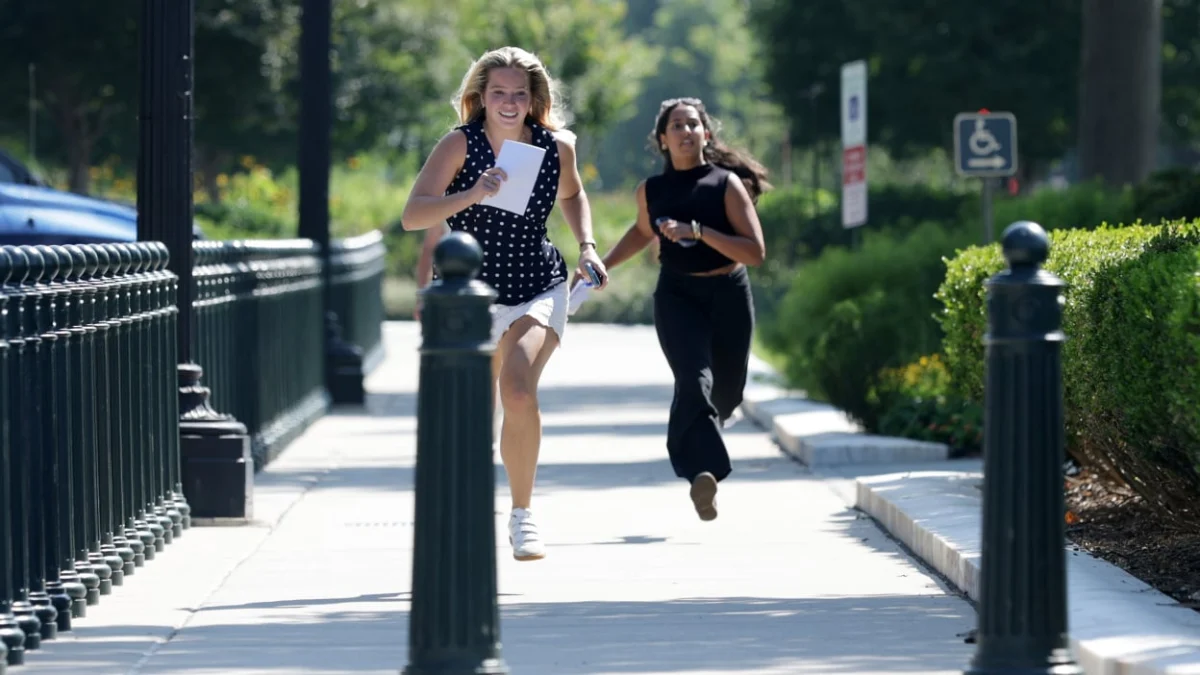
In the high-stakes, hyper-digital landscape of 2026 Washington D.C., where news cycles are measured in milliseconds and push notifications dominate the public consciousness, one would expect the delivery of Supreme Court rulings to be a purely automated, technological feat. Yet, as the sun climbed over the Supreme Court building on June 30, 2026, the fastest news delivery system in the capital remained, as it has for decades: a group of breathless interns in business casual attire and high-performance sneakers.
As the Court handed down a slate of historic rulings—including a landmark decision on birthright citizenship and contentious verdicts on campaign finance and transgender athletics—the scene outside the plaza resembled an Olympic track event. With printed opinions clutched in their hands, these young journalists sprinted toward their respective news vans, cementing the "Running of the Interns" as a persistent, albeit bizarre, relic of American media culture.
A Legacy of Ink and Asphalt: The Roots of the Relay
To understand the "Running of the Interns," one must look back to the pre-digital era. For much of the 20th century, the Supreme Court operated in a vacuum of information. Recording devices were—and remain—strictly forbidden within the courtroom walls. In an era before the internet, the only way to disseminate a ruling to the public was through the physical distribution of paper documents.
News organizations, realizing that the delay between a judge reading a decision and the public reading the text could be the difference between breaking a story and losing a scoop, turned to their most expendable yet energetic asset: the intern. The ritual was straightforward: interns would wait in the halls or near the press room, snatch the printed opinions from clerks, and bolt out of the building to waiting correspondents.
This tradition became a defining feature of modern political journalism during the 2000 Bush v. Gore decision. As the world waited for the ruling that would determine the presidency, the image of young reporters racing through the plaza became an iconic, high-tension visual. It has since become a rite of passage for D.C. journalists, with notable runs occurring during the 2012 Affordable Care Act decision and the 2015 legalization of same-sex marriage.
The Digital Paradox: Why Keep Running?
The persistence of this tradition in 2026 is, objectively speaking, a paradox. Today, the Supreme Court’s Public Information Office publishes opinions to the official website at the exact moment they are handed down. In many instances, the digital PDF is available before an intern even manages to navigate the Court’s labyrinthine hallways to reach the front door.
Furthermore, the COVID-19 pandemic forced the Court to pivot. From March 2020 through June 2022, the "running" ceased entirely as the Court released opinions exclusively online. When the practice returned after the pandemic, many industry analysts predicted it would be a "ghost tradition"—a performance piece rather than a functional necessity. NBC News and other outlets even went so far as to declare the practice "extinct."

And yet, here we are. Why does the sprint persist when a 5G connection could transmit the same data in a fraction of a second?
The answer lies in the unique demands of broadcast television. For a live news network, the "run" provides a tangible, visceral hook for the viewer. Seeing a reporter grab a paper and race toward the camera creates a sense of urgency that a simple "Breaking News" graphic on a smartphone cannot replicate. It is a visual manifestation of the work required to bring news to the public. Moreover, in an era of deepfakes and AI-generated misinformation, there is a certain "analog" security in the physical document. The intern with the paper is, in a sense, the ultimate "verified source."
A Chronology of the 2026 Sprint
The events of June 30, 2026, were a masterclass in this peculiar brand of chaotic efficiency. The morning began with the usual tension of a "decision day." Reporters from CNN, NBC, ABC, CBS, and various digital outlets were staged in the plaza, phones in hand, eyes fixed on the building’s exit.
- 9:30 AM: The Court session begins. The plaza is quiet, filled only with the murmur of producers coordinating live shots.
- 10:15 AM: A flurry of activity near the main entrance. Word filters out that the first opinion, a major ruling on campaign finance, is ready.
- 10:17 AM: The first wave of interns emerges. The dash across the plaza is caught on dozens of smartphones, instantly populating X (formerly Twitter) and TikTok.
- 10:20 AM: The second wave—this time focusing on the birthright citizenship decision—sees a more aggressive pace. One intern is recorded losing a shoe, yet continuing to run, much to the amusement of the online peanut gallery.
- 11:00 AM: The final, more technical rulings are released, and the pace of the "run" slows as the adrenaline of the morning dissipates.
Data and Demographics: The New Generation of Sprinters
The "Running of the Interns" has become a viral phenomenon in its own right. On platforms like TikTok, videos of the sprint are often set to high-octane music, with users commenting on the interns’ form, speed, and footwear choices.
There is an underlying irony to this: the very generation that is most comfortable with digital-first news is also the one keeping the most physical, analog tradition of the press alive. According to surveys of D.C. interns, the experience is viewed less as a chore and more as a "badge of honor." It is a rare opportunity for young professionals to be at the center of the news cycle, literally carrying the weight of the law across a plaza.
Some sneaker brands have even begun to engage with the spectacle, albeit subtly. The sight of a young person in business attire sprinting in high-performance running shoes has prompted social media users to suggest that the "Running of the Interns" is essentially a high-stakes, unscripted product placement opportunity.
Institutional Perspectives: What Do the Courts Think?
The Supreme Court itself maintains a stoic, if not slightly amused, distance from the practice. While the Court has modernized its digital infrastructure, it has not moved to ban the runners. Some court observers suggest that the tradition serves a purpose for the Court as well—it keeps the institution feeling "human" and accessible.

However, there is an ongoing debate within the press corps about the safety and necessity of the run. Critics point out that in the event of a medical emergency or a crowded plaza, the sprint could become a liability. Additionally, the reliance on interns to physically transport paper copies is viewed by some as an outdated labor practice that could be replaced by a simple "press lock-up" system where all outlets receive the documents simultaneously via an internal server.
Implications: The Future of Breaking News
The survival of the "Running of the Interns" in 2026 raises profound questions about the nature of modern journalism. Does the speed of information matter if the delivery method is a century old?
The implication is that in an increasingly virtual world, we crave the physical. We want to see the sweat, the sneakers, and the paper. The sprint is a reminder that behind every "breaking news" alert, there is a human process. It represents the intersection of the most powerful legal institution in the country and the raw, unpolished energy of young journalists.
As long as there are news networks eager to prove they are the first to the air, and as long as there are interns willing to trade their dignity for a chance to be part of history, the "Running of the Interns" will continue. It is, perhaps, the last truly "analog" breaking news story left in the world. And in a digital age, that might just be its greatest value.
Whether it survives until 2030 remains to be seen, but for now, the sneakers are tied, the printers are humming, and the interns are ready to run.











