Raul Delapena Setiawan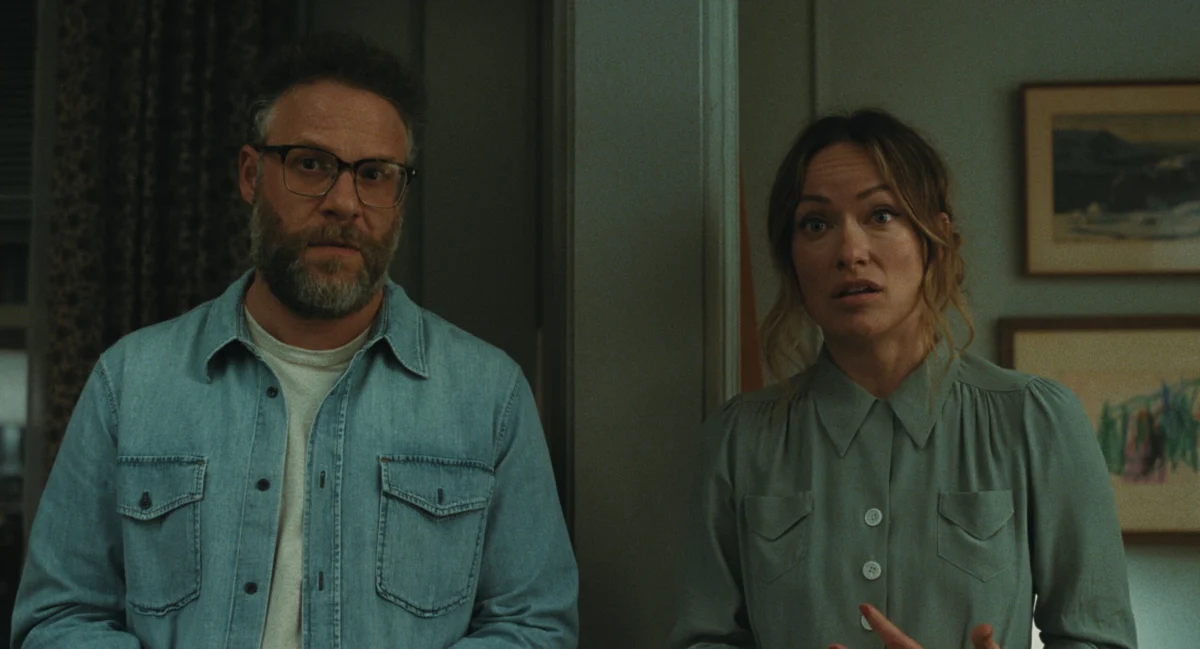
[Editor’s note: The following analysis contains significant spoilers for the film "The Invite."]
In the landscape of modern cinema, the process of adaptation is often viewed as a rigid exercise in translation. However, director Olivia Wilde’s latest feature, The Invite, stands as a testament to the idea that a story’s true life is found not in its script, but in the organic, often messy space between actors and the camera. By embracing an improvisational, workshop-heavy approach, Wilde has transformed a familiar narrative of domestic unraveling into a haunting meditation on the silence that follows a life-altering decision.
The Global Lineage of a Universal Conflict
The source material for The Invite possesses a remarkable cinematic pedigree. It originated as a Spanish-language play titled The Neighbors Upstairs, written and directed by Cesc Gay. Gay subsequently adapted his own work into the 2020 film Sentimental.
What is perhaps most striking about this material is its portability. In just five years, the narrative has been reimagined in five different languages and across five distinct cultures: Italy, Switzerland, France, South Korea, and now, the United States.
"I thought any story that has been adapted by different cultures in this way must have a kind of root to it that feels very universal," Wilde explained during a recent appearance on the Filmmaker Toolkit Podcast. "It turns out relationships are difficult in every language. What drew me to it as a director was the idea that there was a chance to make a version of this that felt specific to not only an English-speaking audience, but to this cast, who all personalized it and really continued the adaptation through the workshopping process."
A Chronology of Discovery: From Script to Screen
The path to The Invite was far from linear. Following the attachment of a high-profile cast—including Penélope Cruz, Edward Norton, Seth Rogen, and Wilde herself—screenwriters Rashida Jones and Will McCormack were brought on to develop a new draft.

Rather than adhering strictly to the page, the production team engaged in a rigorous two-week improvisational rehearsal process. This phase was critical, serving as a laboratory where the actors could inhabit their characters and discover the nuances of their relationships before the cameras even began to roll. This commitment to discovery continued throughout the 23-day shoot. To maintain the emotional integrity of the performances, Wilde made the strategic decision to film in chronological order.
This structure allowed the cast to move linearly through the story, providing a "safety" that encouraged vulnerability. It was a process that necessitated constant evolution, particularly regarding the film’s conclusion. "The end of the film was something that Seth [Rogen] and I workshopped up until the last minute," Wilde noted. "The ending is different than the original movie, and very different from our script."
Unpacking the Narrative: The Shift from "Sentimental" to "The Invite"
The core tension of the film centers on the marriage of Joe (Rogen) and Angela (Wilde), whose relationship is irrevocably altered by a single evening spent with a more sexually adventurous and emotionally open couple, Hawk (Norton) and Piña (Cruz).
In Cesc Gay’s Sentimental, the central couple remains together, finding a way to reconcile their differences. In contrast, the American iteration takes a more somber, definitive turn. Wilde and Rogen’s characters arrive at the conclusion that their marriage is effectively over.
The seeds for this shift were planted by an accidental misreading by screenwriters Jones and McCormack. While watching Sentimental for the first time, McCormack mistakenly assumed the protagonist was going to sit down at the piano—a symbol of his abandoned dreams as a professional musician—in the film’s final act.
"We were watching the original, and I was like, ‘Oh, my God, he’s going to go play the piano at the end, and it’s going to destroy me,’" McCormack recalled during a recent WGA-sponsored Q&A in New York. "And she’s going to hear it from the other room, and what does it mean?"

This moment of inspiration became the emotional anchor of the film. The writers focused on the theme of "reconciling who you actually are with who you wanted to be." For the character of Joe, the piano serves as a vessel to explore the life of someone living in the "aftermath" of their own unfulfilled ambitions.
The Power of the Unspoken: Stripping Away the Dialogue
While the thematic framework was established during the writing phase, the execution evolved significantly on set. As the production progressed, Wilde and her team realized that their initial script, while well-crafted, was often too wordy for the emotional beats they were hitting.
"We stripped away a lot of the dialogue that, while really well-written, was clearly unnecessary for two characters who we realized at that point had been so verbose, so constantly, almost manically, combative with chatter," Wilde explained.
In the final cut, the post-dinner conversation between Joe and Angela is devoid of grand, dramatic arguments about the future of their relationship. There is no final, explosive confrontation about whether they will separate. Instead, the dialogue focuses on the mundane logistics of the breakup: where they will sleep, and what to do about their summer rental house.
This stylistic choice creates a sense of "shell-shocked" realism. "They’ve made a decision," Wilde said of the final scenes. "It was silence that would communicate the kind of shell-shocked realization of the enormity of what they had just decided to do. It felt very honest to us, and it only became clear once we had shot the rest of the film."
Professional Implications: The Risk of Ambiguity
For a filmmaker of Wilde’s stature, the choice to end the film on a note of quiet, ambiguous resolution was a significant professional gamble. She admits that she typically fears silence in film, often feeling the urge to fill it with more dialogue or a swelling musical score.

"The ability to be quiet and to trust that the audience is listening is something that I’ve learned quite a lot about through this process," she shared. By allowing Angela to silently join Joe at the piano, the film leaves the audience in a state of suspended interpretation.
This creative freedom, however, is not something that is easily afforded in a traditional studio system. Wilde has been vocal about the fact that The Invite likely would have been stifled by studio notes regarding its pacing and, specifically, its understated ending.
"I can only imagine the battle I would’ve had at a studio about that ending," she admitted. By operating outside of the standard studio machinery, the production was able to maintain the integrity of its vision—a vision that prioritizes human authenticity over the demand for clear, audience-friendly resolution.
Conclusion: A New Standard for Adaptation
The success of The Invite lies in its refusal to be a carbon copy of its predecessors. By utilizing an improvisational framework, empowering its screenwriters to follow their own emotional instincts, and trusting the power of silence, Olivia Wilde has created a film that is profoundly intimate.
The story of Joe and Angela is a reminder that the most significant moments in our lives often occur in the quiet spaces—the moments after the guests have left, after the arguments have subsided, and when we are finally forced to sit with the reality of our own choices.
The Invite opened in New York and Los Angeles last week and continues its national rollout, arriving in cities including San Francisco, Washington, D.C., Boston, Austin, Chicago, and key Canadian markets on July 3, followed by a wide nationwide expansion on July 10. For those interested in the craft behind the film, the full interview with Olivia Wilde is available on the Filmmaker Toolkit podcast, providing further insight into the director’s evolving philosophy on the art of storytelling.


 Reynand Wu
 Pevita Pearce