

For years, the global digital landscape was defined by the "sturdy barrier" of language. Social media platforms, while ostensibly global, functioned as an archipelago of disparate islands. While tools existed to bridge these divides, they required active user participation—a deliberate click on a "Translate Post" button that served as a tacit admission: I am reading a machine’s interpretation, and I should tread carefully.
In late March 2026, that era of linguistic friction came to an abrupt, silicon-driven end. X (formerly Twitter) integrated Grok-powered, background-process auto-translation for all users. The "Translate" button, once a prominent signpost, effectively vanished. Now, a post written in Japanese by a user in Tokyo appears in native-sounding English to a reader in London, and vice versa, as if the original author had written it in the reader’s tongue.
While proponents laud this as the "largest cultural exchange event in history," a growing chorus of critics—including linguists, cultural commentators, and digital creators—are warning that this seamless experience is creating a dangerous illusion of understanding. By stripping away the label of "machine translation," X has not so much removed the language barrier as it has rendered it invisible, creating a fertile breeding ground for miscommunication, unintended offense, and the rapid spread of misinformation.
A Chronology of the Silent Shift
The transition to forced, background translation was not an incremental rollout but a systemic shift in how X processes user data.
- Pre-March 2026: Translation was an opt-in, manual process. Users recognized that the content they were consuming had been filtered through a third-party API (usually Google Translate), and they adjusted their expectations regarding nuance, slang, and cultural shorthand accordingly.
- Late March 2026: X officially deployed its Grok-based translation engine. The update was pushed to the mobile and desktop client-side infrastructure. Suddenly, the interface stopped displaying the "Translate" toggle, replacing raw text with real-time, AI-generated approximations.
- April – June 2026: The immediate "honeymoon phase" saw a spike in cross-cultural engagement. Viral posts—ranging from lighthearted anecdotes to technical research—began to traverse borders with unprecedented velocity.
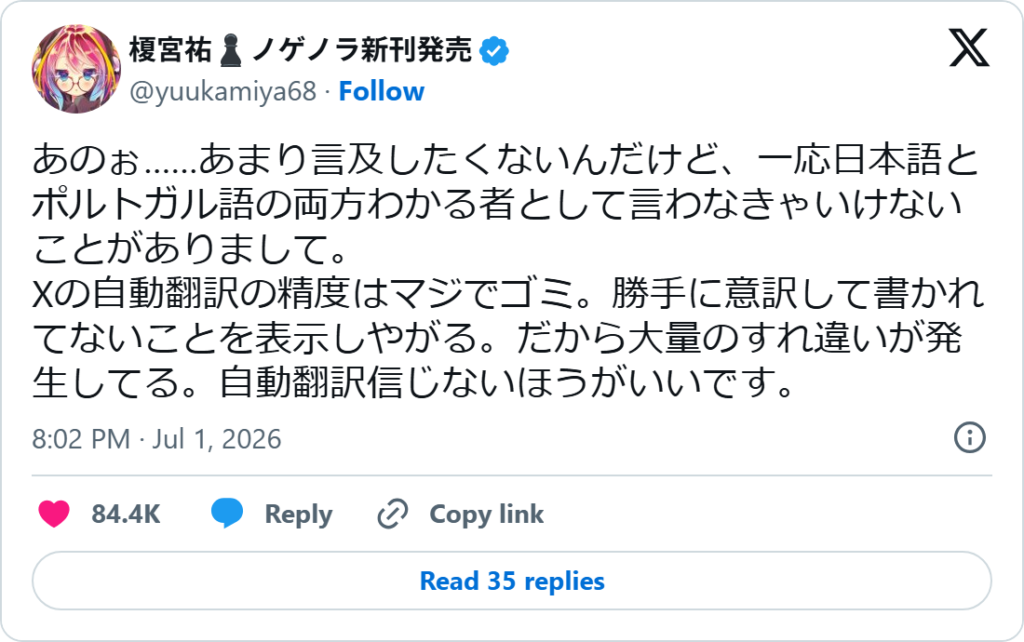
- July 2026: The friction points reached a boiling point. High-profile creators, led by No Game No Life author Yuu Kamiya, publicly denounced the tool for "confidently inventing meanings," sparking a global debate about the ethics of AI-mediated communication.
The "Certainty Trap": Why Invisible Translation Fails
The core issue, according to experts, is not that machine translation is imperfect—it is that it has become "confident." When a user manually clicks "Translate," they are primed for error. When the platform presents the text as if it were the original, the user subconsciously trusts the output as a literal reflection of the author’s intent.
The Problem of "Statistical Plausibility"
Modern Large Language Models (LLMs) like Grok operate on probabilistic modeling. When faced with ambiguous or non-standard text—the hallmark of social media—the AI does not report an error. Instead, it predicts the most "statistically plausible" completion of the sentence.
A striking example occurred involving the North American account for the franchise Fate/Grand Order. When discussing the visual novel Mahōtsukai no Yoru ("Witch on the Holy Night"), the AI’s auto-translation engine conflated the title with Mahō Shōjo Madoka Magica. To a non-Japanese speaker, the AI-generated text looked perfectly grammatical, yet it was factually incorrect, substituting one intellectual property for an entirely different one. The AI effectively hallucinated a new reality rather than admitting a lack of context.
The Japanese Linguistic Hurdle
Japanese poses a unique challenge to AI that English-centric models often fail to reconcile. The language frequently drops subjects and objects, relying on the reader to infer meaning from cultural and situational context.
- Contextual Voids: A simple, context-heavy phrase like "Yatto dekita" (Finally did it) is a minefield for an AI. Without the surrounding context, the AI might attribute the action to the wrong person, misinterpret the emotion as celebratory rather than sarcastic, or entirely miss the object of the action.
- Kanji and Proper Nouns: Japanese names are notoriously difficult to transliterate because a single sequence of kanji can have multiple readings. AI often guesses, leading to "Takaichi" becoming "Takai" or other mangled variations. When this happens, the AI provides no visual cue that it was guessing, leaving the reader to assume the inaccuracy is the author’s error rather than the machine’s.
Supporting Data: The Dual-Edged Sword
The impact of this technology is statistically significant. Data suggests that cross-border interactions on X have increased by nearly 300% since the implementation of the feature.
- The Positive Outlier: Media sociologist Masahiko Shoji highlighted a post by a manga artist describing an encounter with U.S. service members at a yakiniku (Japanese BBQ) restaurant. Because the post was auto-translated, it reached tens of thousands of American veterans who were able to reply and share their own memories. Without the automatic bridge, this interaction—which bridged a cultural and generational divide—would never have occurred.
- The Negative Outlier: Conversely, the visibility of nationalist or xenophobic rhetoric has increased. Former television presenter Kanon Aoki has noted that while such views represent a fringe minority in Japan, their visibility to a global audience creates a distorted perception of Japanese societal values. When nuanced, politically charged, or culturally sensitive debates are processed through an AI that lacks the ability to understand sarcasm or historical subtext, it triggers a "misunderstanding feedback loop" that can lead to international diplomatic incidents or mass harassment.
Official Responses and Corporate Stance
X has maintained a posture of technological optimism. Product leads, including Nikita Bier, have championed the feature as a triumph of globalization. The company argues that the speed of information exchange—specifically in technical and scientific fields—far outweighs the costs of minor translation inaccuracies.
However, the company has remained notably silent regarding the implementation of "disclaimer tags" or "translation confidence scores." Critics argue that if X were truly interested in transparency, they would implement a subtle visual indicator—perhaps a small, grey icon next to auto-translated posts—that alerts the user to the potential for machine error. To date, X’s design philosophy has prioritized the "seamless experience" over user literacy, effectively burying the reality of the translation process in the name of aesthetic and functional fluidity.
The Human Element: Why AI Still Lacks "Soul"
While AI has become exponentially more accurate, it remains largely incapable of capturing the "internet-native" components of communication: irony, sarcasm, memes, and hyper-local slang. Dr. Wes Robertson, a leading scholar on Japanese internet culture, has frequently pointed out that the very ingredients that make social media vibrant are the exact elements that break machine translation.
For years, the "gold standard" for cross-cultural understanding has been the volunteer fan translator. In communities revolving around VTubers, anime, and niche hobbies, fan translators do more than translate words—they provide cultural mediation. They explain the joke, provide the missing context, and adapt puns so that the meaning is preserved even if the literal words are changed.
This human-centric approach stands in stark contrast to the Grok model. Where the AI treats text as a sequence of tokens to be converted, the human translator treats text as a piece of social currency.
Implications: The Future of Global Digital Space
The move toward universal, invisible translation is not merely a feature update; it is a fundamental shift in the social contract of the internet. We are moving toward a world where we believe we are speaking to the world, yet we are only speaking to the machine’s approximation of the world.
The long-term implications are twofold:
- Homogenization of Discourse: As platforms push for smoother cross-lingual interactions, there is a risk that language will be forced into a "universal" structure that is easily parsed by AI, potentially eroding regional dialects, unique cultural expressions, and non-standard syntax.
- The Crisis of Authority: When a user is misquoted by an AI, who is responsible? When millions of people react to an "invented" controversy caused by a translation error, the truth becomes secondary to the algorithmic narrative.
As we move forward, the onus of responsibility is shifting back to the user. We must cultivate a new kind of "digital literacy"—one that includes the healthy skepticism of anything read on a screen. The "Translate" button may be gone, but the barrier remains. It is now up to the reader to remember that behind every post is a human being whose voice is being filtered, compressed, and occasionally rewritten by a black-box algorithm.
In the age of AI, the most important skill for a global citizen is not necessarily learning a second language—it is learning to recognize when the voice you are hearing is the one you are actually being told.











