

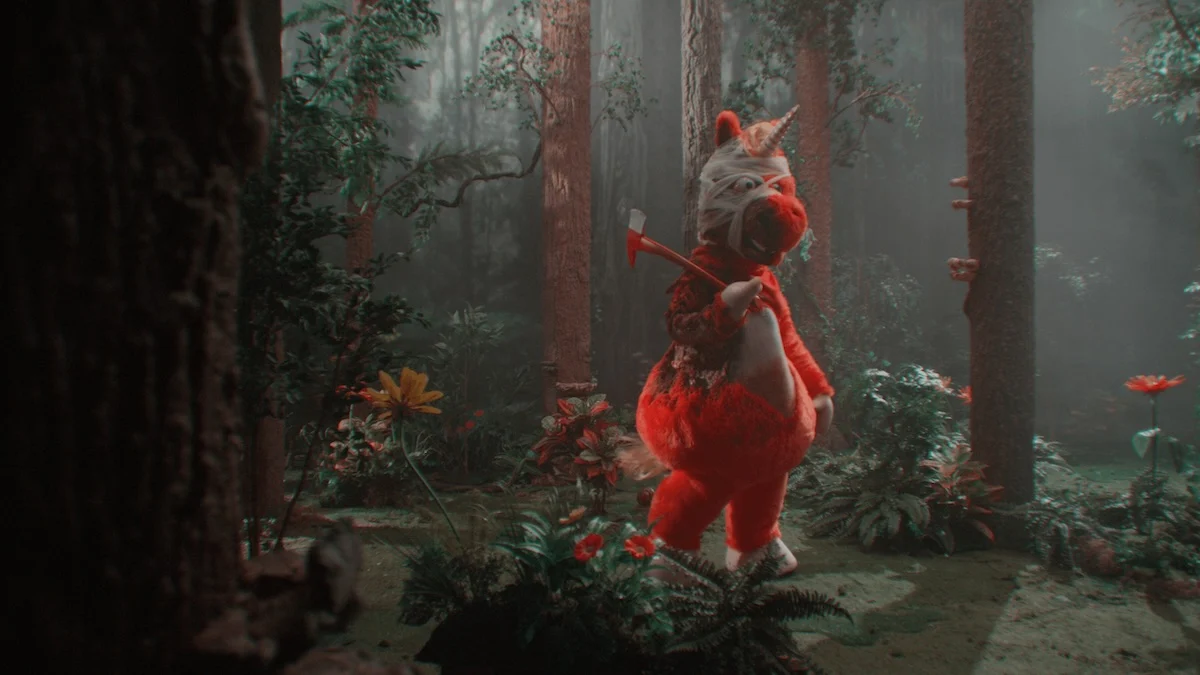
In 2014, the internet was brought to a standstill by Too Many Cooks, an Adult Swim short that acted as a kaleidoscopic, genre-defying critique of the American sitcom. Creator Casper Kelly masterfully dismantled the tropes of 1980s and 90s television, evolving from a saccharine, repetitive opening credit sequence into a surrealist, slasher-filled fever dream. Twelve years later, Kelly is returning to the well of childhood nostalgia with Buddy, a feature film that promises to weaponize the uncanny valley of 90s children’s programming. Set for release on August 28, 2026, Buddy represents a bold, if crowded, evolution in the subgenre of “killer mascot” horror.
The Premise: When the Playground Becomes a Prison
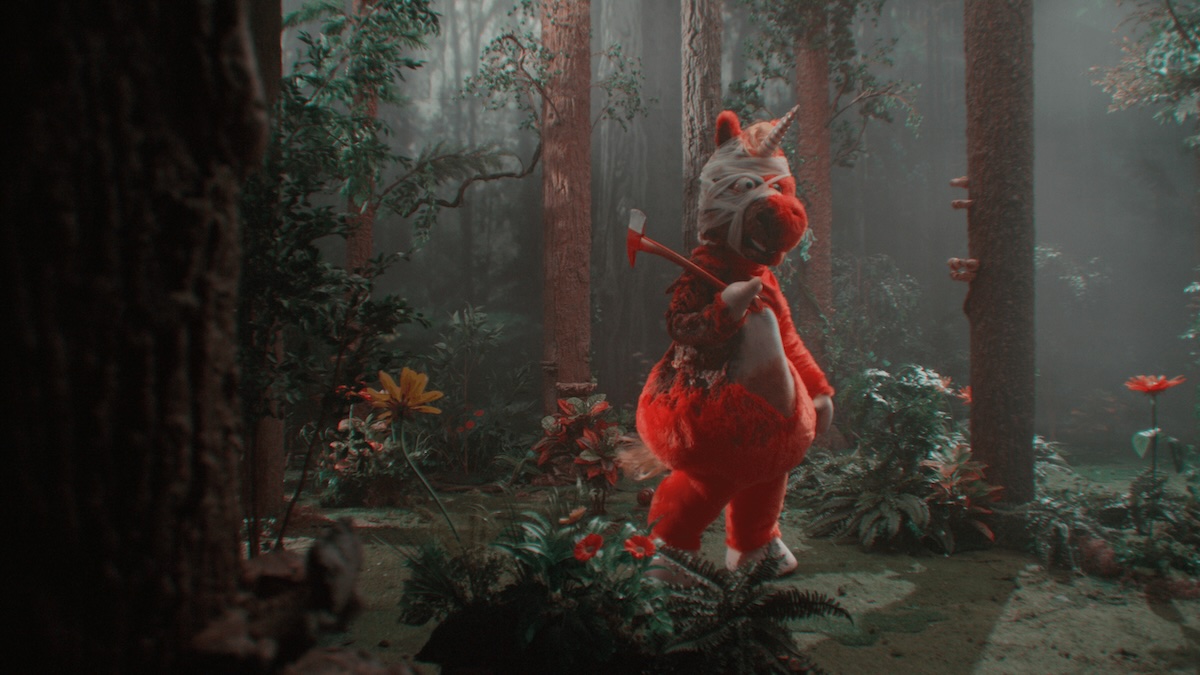
The narrative of Buddy centers on Grace, played by the formidable Cristin Milioti (The Penguin, Made for Love). The film follows Grace, a suburbanite who begins to peel back the layers of a fictional 90s children’s show featuring the titular orange unicorn, Buddy. The promotional material released by Roadside Attractions leans heavily into the “lost media” aesthetic—grainy VHS tracking, saturated primary colors, and the unsettling, wide-eyed stare of a costumed character that seems to know it is being watched.
The teaser trailer provides a chilling glimpse into Kelly’s vision: cheery, synthesized theme music that gradually warps into discordant, minor-key tones. As the footage progresses, the joyous playground backdrop is juxtaposed with brief, flickering frames of mangled bodies and terrified children. It is a classic exercise in “corrupted innocence,” a thematic staple for Kelly, who seems intent on exploring the darker psychological undercurrents of the media that shaped a generation.
A Chronology of the "Killer Mascot" Subgenre
Buddy does not arrive in a vacuum. To understand why Kelly’s latest project is significant, one must look at the historical trajectory of the "killer children’s show" trope in popular media:
- 2014: Too Many Cooks airs on Adult Swim, effectively creating the blueprint for using retro-sitcom aesthetics to hide psychological terror.
- 2014: Five Nights at Freddy’s (the video game) debuts, sparking a massive multimedia franchise that turned animatronic mascots into icons of modern horror.
- 2018: The viral short The Hug is released, focusing on a birthday party performer who becomes aggressive, further cementing the "creepy mascot" trope.
- 2019: Warner Bros. releases The Banana Splits Movie, an official horror reimagining of the classic Hanna-Barbera variety show.
- 2022: Terrifier 2 utilizes a segment involving a distorted children’s program, proving that the aesthetic remains a potent tool for directors of extreme horror.
- 2026: Buddy arrives, marking the culmination of a decade-long fascination with subverting the "wholesome" icons of the late 20th century.
This timeline suggests that audiences have developed a sophisticated appetite for the subversion of childhood safety nets. By taking the colorful, friendly mascots of the 90s and placing them in a narrative framework of dread, directors are tapping into a collective anxiety regarding the artificiality of early television.
The Ensemble: A Masterclass in Character Casting
One of the most intriguing aspects of Buddy is its voice cast, which reads like a "who’s who" of actors capable of oscillating between whimsical and terrifying. The production has secured an impressive roster to bring the film’s inanimate and costumed characters to life:
- Keegan-Michael Key: Voices Buddy, the central orange unicorn. Key’s background in high-energy sketch comedy makes him an inspired choice to capture the manic, forced cheerfulness required of a children’s show host.
- Patton Oswalt: Voices “Strappy,” a backpack character. Known for his ability to convey snark and underlying desperation, Oswalt is likely to provide the film with its darker, more cynical humor.
- Clint Howard: Cast as George, the "crazy cowboy puppet." Howard’s presence is a nod to cult horror history, lending the film an air of B-movie authenticity.
- Michael Shannon: Takes on a dual role, voicing both a train and a ventriloquist’s dummy. Shannon, an Academy Award-nominated actor known for his intense, brooding performances, is the film’s "wild card," capable of injecting genuine menace into characters that would otherwise be seen as harmless.
By pairing these actors with the grounded, desperate performance of Cristin Milioti, Kelly is attempting to bridge the gap between high-concept satire and traditional, character-driven horror.
Analytical Perspective: The "Too Many Cooks" Effect
The success of Buddy will likely hinge on whether Kelly can replicate the structural brilliance of Too Many Cooks. That short succeeded because it understood the grammar of television—the way credits were designed, the way lighting changed between genres, and the specific cadence of 90s acting.
In Buddy, the horror is not just in the jump scares; it is in the erosion of reality. If the film mirrors Kelly’s previous work, the audience should expect a narrative where the boundaries between the "show within the show" and the "real world" of the protagonist begin to dissolve. The danger lies not in the mascot itself, but in the obsession with the mascot. As Kelly explores in the teaser, Grace is not merely watching the show; she is being drawn into its logic. This blurring of lines—where the fictional rules of a children’s program start to dictate the physical reality of the film—is where the "sublime terror" Kelly is known for will likely manifest.
Market Implications and The "Barney" Elephant in the Room
Perhaps the biggest hurdle Buddy faces is the sheer volume of "killer mascot" content currently in development. The public’s palate for this specific type of horror is becoming increasingly crowded. With an official, high-budget Barney movie currently in the works from A24—produced by Daniel Kaluuya and potentially featuring Ayo Edebiri—the cultural conversation regarding the dark side of children’s icons is reaching a saturation point.
Industry analysts are questioning whether Buddy can offer something distinct. If the A24 Barney project leans into the melancholic or dramatic potential of the material (similar to the cult hit Brigsby Bear), Buddy must ensure its horror elements are sharp enough to cut through the noise. There is a genuine risk of "genre fatigue." When the "killer mascot" trope is used by everyone from indie YouTube filmmakers to major studios, the element of surprise is lost.
Conclusion: Will the Broth Be Spoiled?
Casper Kelly has proven he is a master of the surreal, but Buddy is his first attempt at a full-length, feature-film horror experience. While the casting is impeccable and the aesthetic is clearly dialed in, the film faces a tall order: it must prove that the concept of "creepy children’s entertainment" still has teeth.
If Buddy succeeds, it will be because it treats the nostalgia of the 90s not just as a visual aesthetic, but as a psychological weight. If it fails, it may simply be another addition to a genre that is rapidly running out of room to grow. As the saying goes, "too many cooks can spoil the broth," but in the hands of a creator who understands the recipe for chaos as well as Kelly does, we may be in for a meal that is as unforgettable as it is unsettling.
Buddy arrives in theaters on August 28, 2026. Whether it becomes the definitive horror statement on children’s media or merely another entry in a crowded field remains to be seen, but one thing is certain: our childhood icons are no longer safe.










