

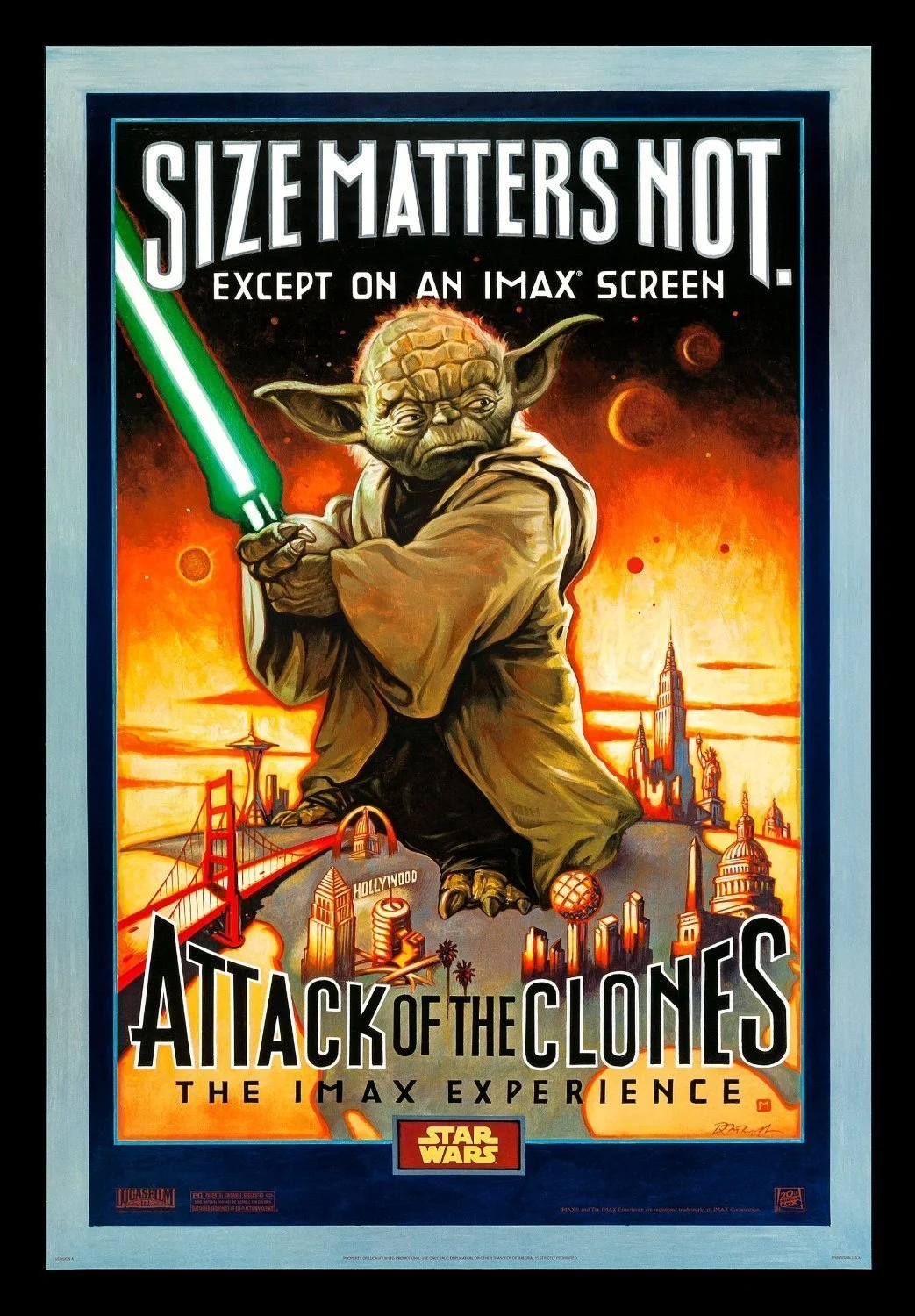
In the annals of cinematic history, few formats hold the same reverence and technical mystique as IMAX 70mm. For a brief window in the early 2000s, this massive celluloid format became the holy grail for blockbuster presentation. Yet, as digital projection began its inevitable march toward total industry dominance, many unique, experimental prints were relegated to the shredder. Among these casualties was the 2002 IMAX release of George Lucas’s Star Wars Episode II: Attack of the Clones.
For over two decades, the specific version of the film screened in those giant-screen theaters—featuring a unique 1.81:1 aspect ratio and a heavily truncated runtime—was thought to be lost to time. That was until filmmaker V. Trent stumbled upon an un-projected, pristine theatrical safety print, triggering a Herculean effort to preserve a forgotten piece of Star Wars history.
The 2002 Experiment: A Different Cut for a Bigger Canvas
When Attack of the Clones hit theaters in the fall of 2002, it wasn’t just a standard wide release. George Lucas, ever the technological pioneer, authorized an IMAX 70mm version that diverged significantly from the theatrical cut audiences saw in standard multiplexes.
At the time, the limitations of the medium were physically rigid. IMAX 70mm film platters could only accommodate a maximum of two hours of celluloid. To fit the sprawling space opera onto the platter, the film was trimmed by approximately 20 minutes, removing various narrative threads and scenes to ensure the runtime complied with the mechanical constraints of the projectors.

Beyond the editing, the visual presentation was fundamentally altered. The original 2.40:1 theatrical aspect ratio was reframed to a Lucas-approved 1.81:1. This change was designed specifically to maximize the vertical expanse of the IMAX screen, offering audiences a more immersive, "taller" image that filled the viewer’s field of vision. Once the limited IMAX run concluded, these prints were subject to a strict directive from Lucasfilm Ltd. mandating their destruction. For twenty-two years, that specific 1.81:1 visual experience became a phantom of the fan community.
Chronology of a Discovery: From Vault to Laboratory
The recovery of this artifact is a story of serendipity and technical obsession. Filmmaker V. Trent, who eventually acquired the print, describes the discovery as the "archival find of a lifetime."
"Presumably due to the heavy restrictions from Lucasfilm Ltd. in 2002, the IMAX feature prints of Episode II are now essentially nonexistent," Trent explained in an interview with IndieWire. "To have a visual archive of the 1.81:1 IMAX aspect ratio is incredible. It represents a moment in the transition between analog spectacle and the digital future."
Upon inspection, Trent realized he hadn’t just found a used, scratched-up print from a theater lobby; he had secured an un-projected theatrical safety print. Because the reel had served as an untouched, "backup spare" in a distribution chain, it had bypassed the physical trauma of commercial projection.

"The silver halide emulsion is in a completely virgin, factory-fresh state," Trent noted. "The digital data and the color science captured on those frames are an exact, mathematically perfect match to the original master file. It is a rare survivor that simply shouldn’t exist by all accounts of industry policy."
The authenticity of the print was confirmed by the presence of a "control chart," or LAD (Laboratory Aim Density) strip, still attached to the leader. These strips are used by lab technicians to calibrate printing machines. The fact that the leader was completely uncut served as irrefutable proof that the reel had never been subjected to the standard prep work required for public exhibition.
The Preservation Process: Manual Digitization
Once the rarity of the material was established, the question became one of preservation. Utilizing standard industry scanning systems—which involve high-speed rollers and intense light sources—posed a significant risk of physical damage, including potential scratching or the degradation of the delicate sprocket holes.
Trent opted for a more intimate, albeit grueling, approach: manual frame-by-frame photography. He constructed a controlled environment, utilizing a darkened room and a precision-calibrated backlight. Over the course of three days, he photographed each individual frame of the IMAX reel.

"Every single grain of sand, the specific glow of the lightsabers, and the intricate, tactile details in Yoda’s skin were impeccable," Trent said. "Even with my naked eye, the resolution of the IMAX DMR [Digital Media Remastering] print was breathtaking."
The post-production phase proved even more labor-intensive than the capture itself. Trent secured 983 individual frame captures, which he then had to crop and align manually. "I had to go through an even longer period of going through all 984 captures, cropping every individual frame one by one to ensure they were perfectly centered," he added. Once aligned, he imported the high-resolution 4K HDR images into his editing suite, retiming the sequence to run at the standard 24 frames per second to restore the intended motion.
Official Stance and Historical Implications
Lucasfilm has historically maintained a tight grip on its assets, often favoring the digital "Special Edition" master files for all future distribution. While the company has not issued a formal comment on the discovery of this specific print, the existence of such an artifact highlights the ongoing tension between "official" canonized versions of films and the physical history of their exhibition.
The 1.81:1 ratio is a time capsule of the early 2000s, a period when IMAX was transitioning from documentary-focused "educational" theater experiences to the home of Hollywood’s biggest spectacles. By digitizing this print, Trent has preserved a specific directorial choice—a framing decision that Lucas deemed the superior way to experience his film on the world’s largest screens—which had been effectively erased from public memory.

The Legacy of the Format
For film purists and archivists, the significance of this project extends beyond Star Wars. It underscores the vulnerability of analog film in an era of cloud-based distribution. As digital files replace physical prints, the risk of "losing" specific exhibition formats grows.
Trent hopes his work will serve as a visual reference for future historians and fans. He is currently looking into the possibility of loaning the physical print to the Lucas Museum of Narrative Art, ensuring that this piece of cinema history is preserved for the public rather than hidden in a private collection.
"My first-ever moviegoing experience happened to take place in an IMAX 70mm film theater," Trent reflected. "The format, and the filmmakers like Christopher Nolan who have championed the true IMAX 70mm film format, greatly inspire me. To have contributed to the legacy of the format in an independent fashion has been my great privilege."
Conclusion: A Living Archive
The resurrection of the Attack of the Clones IMAX print is more than just a hobbyist’s passion project; it is a vital act of cultural preservation. By manually rescuing these frames, Trent has ensured that the specific aesthetic vision George Lucas had for the 2002 IMAX release remains accessible. In an age where films are constantly updated, color-corrected, and re-edited for streaming services, the existence of a "virgin" archival print provides a necessary anchor to the past—a reminder that cinema is not just the final product on a screen, but the physical history of how we once watched the stars.










