In the crowded landscape of the Metroidvania genre, where the echoes of Castlevania and Metroid provide the foundation for countless indie titles, Skautfold: Moonless Knight manages to carve out a distinct, albeit brutal, identity. Developed as part of the Skautfold series, this entry pivots sharply toward the punishing design philosophy of the "Soulslike" subgenre, blending cosmic horror with the precise, rhythmic dance of high-stakes combat. Set within an alternate-history Japan plagued by a fractured moon and the subsequent fallout of eldritch horrors, the game is a masterclass in atmosphere and mechanical depth—provided the player has the fortitude to endure its steep learning curve.
The Premise: A World Reimagined Under Cosmic Terror
The narrative backdrop of Skautfold: Moonless Knight is as evocative as it is oppressive. The game eschews traditional fantasy tropes, opting instead for a haunting, alternate-history interpretation of Japanese aesthetic sensibilities. The inciting incident—a lunar fracture that spills cosmic terrors into the terrestrial realm—sets the stage for a sprawling, interconnected palace that serves as the game’s primary playground.
Players take on the role of a knight navigating this architectural labyrinth, a structure teeming with cultists, mutated monsters, and remnants of a civilization grappling with extinction. The environmental storytelling is subtle, relying on visual cues and the sheer oppressive weight of the level design to convey a sense of hopelessness. It is a world that feels lived-in, yet inherently hostile, demanding that the player respect the danger inherent in every shadowed corridor.
The Core Mechanic: Mastering the Guard System
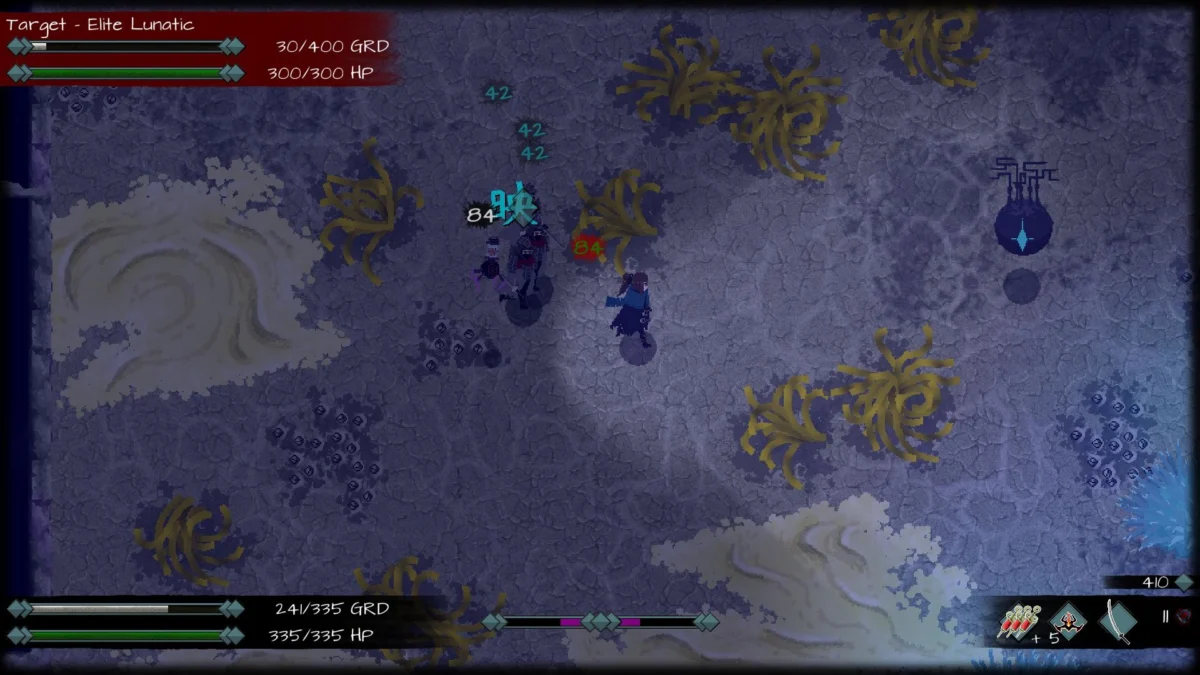
If the narrative provides the "why," the combat provides the "how." Skautfold: Moonless Knight distinguishes itself from its peers by moving away from the conventional stamina bars found in many contemporary action-RPGs. Instead, the game introduces a sophisticated "Guard" mechanic.
The Guard System: A Paradigm of Risk and Reward
In most action games, stamina dictates how many swings a player can take. Here, the Guard meter functions as both an endurance pool and a defensive barrier. Every block, parry, or successful deflection chips away at this meter, forcing players to manage their defensive posture with the same intensity they bring to their offensive strikes.
This creates a unique "rhythm" to the combat. Players are forced into a constant state of decision-making: Do you hold your ground to mitigate damage, knowing that a depleted Guard meter leaves you vulnerable to a critical hit? Or do you dodge, sacrificing the safety of a block for the potential to counter-attack? This risk-versus-reward loop is the heartbeat of the game, becoming increasingly satisfying as the player moves from panic-induced button mashing to calculated, frame-perfect execution.
Progression and Arsenal Diversity
The game supports this combat philosophy with a robust progression system. Players have access to a variety of weapon types, each changing the cadence of the fight. Furthermore, the inclusion of relics—which serve a dual purpose as both combat enhancements and essential exploration tools—ensures that the player’s arsenal feels intrinsically linked to their ability to navigate the world. As you learn the game’s ins and outs, the progression feels earned rather than gifted, rewarding curiosity and experimentation.
Chronology of the Experience: From Frustration to Flow
The journey through Skautfold: Moonless Knight is not a linear climb in power; it is a jagged, undulating experience that challenges the player’s patience at every turn.
- The Initial Encounter (Hours 1–5): For the uninitiated, the early hours of Moonless Knight are notoriously unforgiving. The game provides minimal guidance, dropping the player into a complex, interconnected palace with little instruction on the nuances of the Guard mechanic. This phase is characterized by frequent death and a sense of being "lost."
- The Mastery Phase (Hours 5–15): As the player internalizes the rhythm of the combat, the game shifts. The once-intimidating cultists become manageable, and the satisfaction of a perfect parry replaces the frustration of the early game. This is where the Metroidvania elements truly begin to shine, as the player starts to recognize the shortcuts and hidden paths that the game’s level design cleverly hides in plain sight.
- The Endgame and Exploration (Hours 15+): By the final act, the player’s reliance on relics and refined combat skills turns the game into a dance. The exploration becomes less about survival and more about uncovering the deepest secrets of the palace, pushing the boundaries of what the game allows the player to achieve.
Supporting Data: Aesthetic and Atmospheric Design
Visuals and sound are often relegated to secondary status in mechanical-heavy games, but Skautfold: Moonless Knight elevates them to essential components of the gameplay loop.

- Pixel Art and Architecture: The game utilizes a gritty, dark pixel art style that eschews the bright, hand-drawn look seen in many modern Metroidvanias. This aesthetic choice is deliberate, reinforcing the theme of cosmic horror. The architecture feels heavy and imposing, with shadows that actually matter to the gameplay, concealing enemies and loot alike.
- Audio and Tension: The soundtrack is a masterclass in atmospheric tension. It avoids soaring, heroic melodies in favor of haunting, minimalist soundscapes that heighten the feeling of being an intruder in a dying world. The audio cues for combat are equally vital, providing the necessary feedback for the player to react to enemy patterns without relying solely on visual stimuli.
Official Perspectives: The Philosophy of the Developer
While the developer’s stance remains consistent with the "tough but fair" ethos of the Soulslike genre, the game serves as a clear statement of intent. Skautfold: Moonless Knight is not a game designed to accommodate every player; it is designed to be conquered by those who value the process of improvement.
In interviews and community discourse, it has been noted that the minimal guidance provided to the player is a feature, not a bug. By forcing players to map the world mentally and learn enemy move-sets through repetition, the developer ensures that the sense of accomplishment remains high. For the player, this means that the game’s perceived "flaws"—the lack of hand-holding, the obtuse navigation, and the high difficulty—are actually the primary pillars of the intended experience.
Implications for the Metroidvania Genre
Skautfold: Moonless Knight represents a significant intersection of two traditionally distinct genres: the exploration-heavy Metroidvania and the combat-heavy Soulslike. Its success—or lack thereof—in the eyes of the player base provides a litmus test for the industry at large.
The Challenge of Accessibility
The primary implication here is the trade-off between accessibility and engagement. By refusing to cater to a broader audience, Moonless Knight cements itself as a "niche" title. This is a bold move in an era where many developers are adding "story modes" or "assist features" to their titles. The game’s refusal to apologize for its difficulty serves as a rallying cry for a segment of the gaming community that misses the days of games that required genuine persistence.
The Future of "Dark" Metroidvanias
As more developers attempt to bridge this gap, Skautfold: Moonless Knight provides a blueprint for how to balance complex movement-based exploration with rigid, stamina-less combat. The "Guard" system, in particular, is a mechanical innovation that other developers would do well to study. It moves the conversation forward, suggesting that combat depth does not necessarily require the traditional stamina bar.
Conclusion: Is It For You?
Ultimately, Skautfold: Moonless Knight is a game that knows exactly what it wants to be. It is not interested in being a breezy, pick-up-and-play experience. It is a slow burn that demands patience, observation, and a willingness to learn from failure.
For the player who is tired of modern titles that guide them by the hand, the palace of Moonless Knight offers a welcome challenge. It is a bleak, challenging, and often frustrating journey, but one that is punctuated by the profound satisfaction of mastering a truly distinctive combat system. If you can stomach the darkness and the crushing weight of its atmosphere, you will find a rewarding, deep, and beautifully oppressive experience that lingers long after you’ve put the controller down.
However, if you are looking for a relaxing romp or a story-focused adventure, the fractured moon may be a sky you’d prefer to avoid. In the end, Skautfold: Moonless Knight is a testament to the fact that when a game stays true to its vision—no matter how unforgiving that vision may be—it inevitably finds its audience among those who truly appreciate the craft.