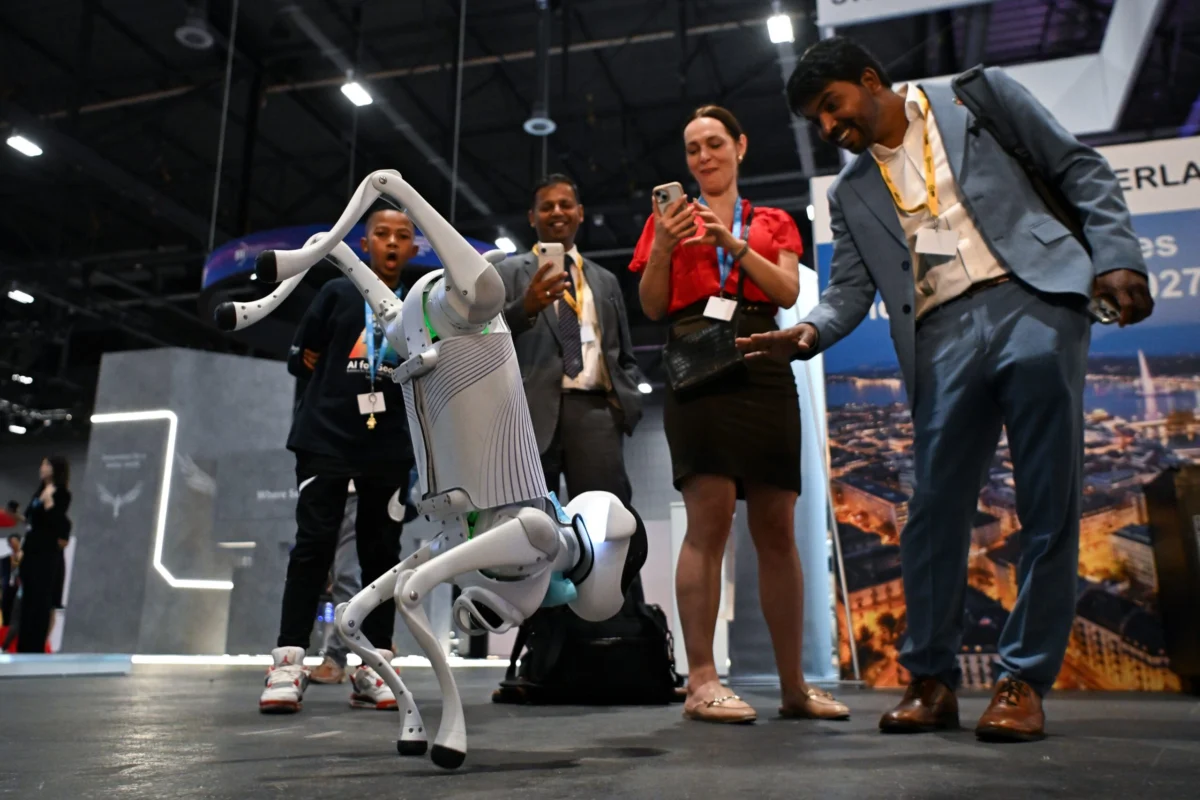
In the sprawling 106,000-square-meter convention center on the outskirts of Geneva’s airport district, the atmosphere at the UN’s AI for Good summit is one of sensory overload. Attendees navigate a labyrinth of live coding sessions, AI-driven obstacle courses, and delegates wandering through the halls wearing glowing, green, silent-disco-style headphones—a necessity to pipe simultaneous UN panel discussions directly into their ears.
Amidst this high-tech carnival sits the "Networking Zone," where participants congregate on the UFOTECH, a rotating circular bench that bears a striking resemblance to a lazy Susan at a banquet hall. Yet, beneath the veneer of this futuristic gathering, a profound tension simmers. While the world’s attention is often monopolized by Silicon Valley executives testifying before Congress about the existential risks of superintelligence, the AI for Good summit—now in its 10th year—is attempting to pivot the conversation toward more grounded, albeit complex, humanitarian objectives.
The Mandate: Engineering Morality
Organized by the International Telecommunication Union (ITU), the summit serves as a global forum where the public and private sectors attempt to reconcile the promise of artificial intelligence with its potential for societal harm.
"Our conviction that artificial intelligence, deployed responsibly, could help solve humanity’s most pressing problems—from hunger to disease to a warming planet," Doreen Bogdan-Martin, secretary-general of the ITU, declared during her keynote. "Today, that idea is being tested, including by the challenges AI itself is bringing, even as we strive to use it for good."
However, the definition of "good" remains elusive. As the conference progressed, a drumbeat of skepticism grew, fueled by concerns that the unchecked deployment of AI by corporate monopolies is already hardwiring global inequality and eroding fundamental human rights.
A Chronology of Discontent
The summit’s history has evolved from a niche technical gathering into a high-stakes geopolitical battleground.
- The Early Years: Initially focused on "AI for Good" as a concept of social development, the early iterations of the summit were characterized by optimism regarding the potential for AI to aid developing nations in healthcare and infrastructure.
- The Inflection Point: As LLMs (Large Language Models) moved from research labs to the consumer market, the summit’s focus shifted toward regulation and the "digital divide."
- The Current Climate: By its 10th anniversary, the conference has become a site of protest and intense scrutiny. During a keynote by Amazon CTO Werner Vogels, pro-Palestine activists stormed the stage, disrupting the event to allege that the company’s technology is being weaponized in the Middle East. The protesters were eventually removed, but the incident underscored a growing refusal to accept the industry’s "utopian" narrative.
The Infrastructure of Inequality
A central theme of this year’s summit was the widening gap in "compute sovereignty." Speakers argued that access to hardware—specifically the GPUs necessary to train and run frontier models—has become the new battleground for global power.
"If we mean AI for good, meaning compute for all, we must recognize that this is [about] development infrastructure, not just technology," stated Syed Munir Khasru, chairman of the Institute for Policy, Advocacy, and Governance.
The concern is that if poorer nations remain dependent on foreign platforms and standards, they will be relegated to the role of data-providers rather than creators. This is further complicated by the linguistic bias of current models. Because most LLMs are optimized for English, smaller, localized models running on cheaper hardware are becoming essential if AI is to serve non-Western communities.
The geopolitical stakes are high. With the US and China constantly recalibrating export controls on high-end chips, smaller nations are caught in the middle, risking exclusion from the global compute economy.
Expert Perspectives: The Engineering Trap
One of the most vocal critics at the event was Vijay Janapa Reddi, an engineering professor at Harvard University. During a presentation, he cut through the corporate jargon with a blunt assessment of the industry’s trajectory.
"When we’re talking about AI, we love the hype, we get excited about it," Reddi said. "The damn thing never actually lands in practice."

Reddi’s argument is that "good" is too vague a metric for engineers to build against. In software development, performance is measurable, but "goodness" is subjective. "When you’re an engineer, good means nothing," he noted. "I can’t build you something that is good. A plane that flies for five minutes ain’t no good."
This sentiment is echoed by Giulio Coppi, a senior humanitarian officer at the advocacy group Access Now. Coppi believes the humanitarian sector has been far too trusting of Big Tech. "We should be out of the age of innocence," he says, warning that NGOs and public organizations have spent a decade funding opaque, multimillion-dollar tech stacks they don’t truly understand. "You can’t even explain what’s inside your tech stack, because it has kept changing."
Translating Principles into Enforcement
As the summit neared its conclusion, the focus turned toward the "hidden architecture" of AI governance. Anja Kaspersen, director of global markets development at IEEE, argued that the most consequential decisions are not made on the summit stage, but are embedded in technical standards and procurement contracts.
"Traditionally, engineers may consider human rights are someone else’s business," says Gilles Thonet, deputy secretary-general of the International Electrotechnical Commission. "Actually, they’re not."
To address this, experts proposed the creation of "middleware"—a technical and legal layer that translates high-level human rights principles into verifiable enforcement mechanisms. Jeremy Ng, counsel for AI and the digital economy at the World Bank, urged that AI impact assessments must move beyond "governance theater" and become practical tools with real legal and operational teeth.
Official Responses and the Path Forward
In an attempt to bridge the gap between discourse and action, the UN announced the formation of a 44-member commission co-chaired by Rwandan President Paul Kagame and Salesforce CEO Marc Benioff. The commission is designed to provide a more formalized structure for AI oversight.
"No single stakeholder can shape the future of AI alone," Bogdan-Martin reiterated. "It needs builders. It needs you."
However, the disparity between the pace of the summit’s discourse and the pace of innovation was physically present on the convention floor. While delegates discussed the ethics of algorithms, humanoid robots were seen maneuvering through the crowds with startling speed, drawing stares from attendees.
Implications: The Sprint vs. The Consensus
The overarching implication of the 2026 AI for Good summit is that the technology is sprinting far ahead of the global consensus. The "AI for Good" movement faces a fundamental crisis: it is trying to apply democratic, human-centric governance to a technology that is currently being defined by private, profit-driven, and state-sponsored competition.
For the UN, the challenge is clear: if it cannot create a framework that defines "good" in a way that is technically enforceable and universally accessible, it risks being left behind. The summit succeeded in bringing together a diverse group of stakeholders, but it also highlighted that the "age of innocence" regarding technology is effectively over.
As the doors closed on the convention center, the question remained: can a global body, hampered by bureaucratic deliberation, successfully steer a technology that moves at the speed of light? Or will the "good" continue to be defined by those who hold the hardware, the chips, and the data, leaving the rest of the world to simply adapt to the fallout?
For now, the rotating benches of the Networking Zone continue to turn, mirroring the cyclical nature of the debate—constant motion, yet not necessarily moving forward.