Muslim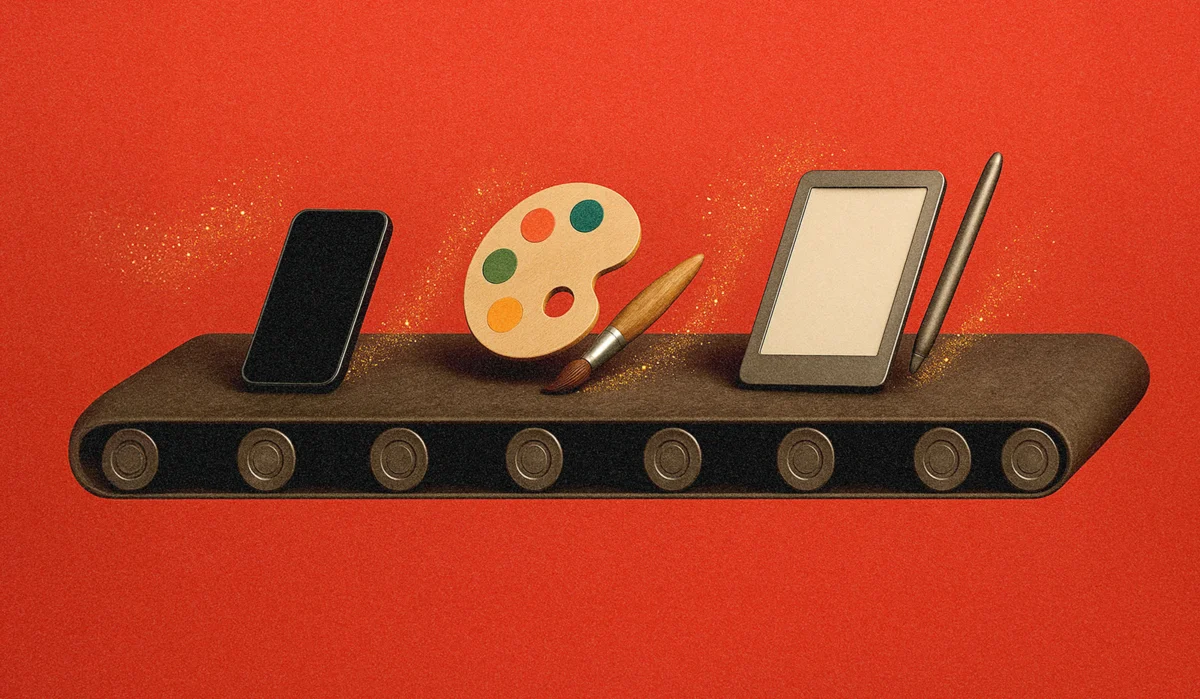
By Krystal Scanlon
July 10, 2026
At the 2026 Cannes Lions International Festival of Creativity, a recurring theme dominated the stages and cabanas lining the Croisette: the transformative power of generative AI. Nearly every major platform executive touted the technology’s ability to compress production timelines and scale creative output. Yet, beneath the veneer of technological optimism, a more nuanced, somewhat anxious sentiment emerged. In private meetings and public panels, industry leaders quietly acknowledged a burgeoning crisis—the "homogenization of creative."
As advertisers increasingly rely on a standardized suite of AI tools to generate marketing assets at scale, platforms are bracing for a systemic risk: the proliferation of "AI slop." This deluge of automated, visually indistinguishable content threatens to erode the very authenticity that makes these platforms essential to human connection and, by extension, effective for advertising investment.
The Main Conflict: Efficiency vs. Identity
The core tension lies in the paradox of modern digital marketing. Advertisers demand efficiency, yet platforms depend on the uniqueness of their communities to keep users engaged. If every ad on a feed begins to share the same stylistic DNA—born from the same foundational Large Language Models (LLMs)—the platforms risk losing their distinct character.
For companies like Meta, Snap, and Reddit, the challenge is not just about adopting AI, but about protecting the "soul" of their inventory. While they are aggressively integrating AI into their creative suites, executives are signaling a shift in strategy: these tools should function as a force multiplier for human intent, not a replacement for the idiosyncratic spark that captures audience attention.
Chronology of the "AI Creative" Shift
The trajectory of this issue has accelerated rapidly over the past 24 months:
- Phase 1 (2024): The Adoption Surge. Advertisers, eager to cut costs, flocked to early-stage generative tools to automate basic ad copy and image generation. The focus was purely on throughput and "faster-to-market" capabilities.
- Phase 2 (2025): The Saturation Point. As adoption became ubiquitous, social media feeds saw a massive influx of AI-generated content. Marketers began noticing a "regression to the mean," where ads began to look and feel strikingly similar, leading to declining engagement rates.
- Phase 3 (2026): The Correction. The current climate at Cannes reflects a strategic pivot. Platforms are now actively building "guardrails" and emphasizing the importance of human-led creative strategy, attempting to steer brands away from generic, machine-only outputs.
Supporting Data and Industry Observations
The fear of creative sameness is not purely speculative. LinkedIn’s leadership has been vocal about the structural limitations of current AI infrastructure. Davang Shah, LinkedIn’s vp of marketing, noted that because most industry-standard tools rely on a finite pool of foundational data, the outputs are mathematically destined to converge.
"All of the LLMs are ultimately using the same pool of data to come up with recommendations," Shah explained. "At some point, you could imagine it comes to a mean." This statistical reality means that without a heavy hand from human creators, the "average" ad will become the "only" ad, making it increasingly difficult for brands to distinguish themselves in a crowded marketplace.
TikTok’s head of creative product strategy, Moritz Bartsch, echoed this concern, pointing to the input-output relationship. "If everyone puts one-liners into the LLMs, everyone’s going to get very generic outputs," Bartsch observed. The danger, according to TikTok, isn’t the technology itself, but the "lazy" application of it by marketers looking for a quick fix rather than a strategic advantage.
Official Responses from Platform Titans
The platforms are navigating this minefield with varying strategies, each tailored to their specific brand identity:
Snap: The Human Connection
Snapchat, having long positioned itself as a platform for "real" relationships rather than a traditional, algorithmic-driven newsfeed, views AI as a tool for personalization rather than mass production. Abby Laursen, vp of product marketing at Snap, stated, "We’ve seen a lot through our research that one of the impacts [of AI] is that you end up in a world where you just have feeds of endless content that tend to look very similar. It’s hard for people to know what to trust." For Snap, the objective is to leverage AI to simplify performance without spawning a wave of synthetic, low-trust content.
Reddit: The Community Mandate
Reddit faces a unique challenge. Its value proposition is built entirely on the integrity of its niche communities. Roeloff van Zwol, evp of ads monetization, emphasized that creative must be "tailored to the conversation" of specific subreddits. "We want to make sure we preserve the authenticity and integrity of Reddit," van Zwol stated. This implies a strict set of guidelines for advertisers: if an ad doesn’t sound like it belongs in the conversation, the community will reject it, regardless of how efficiently it was produced.
Meta: The Creator-Centric Approach
Meta is focusing on the "drudgery" of production. By automating the repetitive, manual tasks involved in video editing and asset creation, they hope to free up creators to focus on the high-level conceptual work. Yair Livne, vp of product management for Facebook creators, noted that the company sees the creator as the "heart" of the ecosystem. "We’re trying to amplify that and ensure creators spend more time on [authentic creation] versus on the grunt work."
Google: Scaling the "Idea"
Google’s Sean Downey remains a proponent of the "AI as an assistant" philosophy. He argues that the primary role of AI is to help brands think about scale, not to replace the original idea. "The most important thing of any campaign is the idea," Downey said. "AI is helping them think about scale."
OpenAI: The Divergent Path
David Dugan, who joined OpenAI after a decade at Meta, provided a necessary counterpoint. He argued that the "one-size-fits-all" approach to AI regulation is a mistake. "SMBs are very curious about how you can give me tools that help me generate creative to run ads in the simplest way," he said. "That is dramatically different from a large enterprise that’s invested in their brands over decades." For the enterprise, control is paramount; for the SMB, accessibility is the priority.
Implications for the Future of Advertising
The "AI-homogenization" crisis poses several long-term implications for the advertising industry:
- The Premium on Human "Creative Direction": As production becomes automated and cheap, the value of the "Big Idea"—the strategic, emotional, and human-led concept—will skyrocket. Agencies that can provide high-level creative direction will thrive, while those focused on "execution-only" services may face obsolescence.
- Platform Differentiation: Platforms that prioritize "curation" and "authentic discovery" over raw volume may gain a competitive advantage. If a platform becomes flooded with AI slop, users will leave. Therefore, we should expect more stringent content moderation policies regarding AI-generated assets in the coming years.
- The "Authenticity Tax": Brands may find themselves having to pay more to prove their humanity. We may see a rise in "verified human-made" content labels, or a return to unpolished, "lo-fi" content as a way to signal authenticity in an era of hyper-polished, synthetic media.
- Strategic Guardrails: Expect platforms to introduce more sophisticated, AI-driven creative testing tools that explicitly penalize "generic" or "high-entropy" (repetitive) content. The goal will be to incentivize advertisers to experiment with different creative directions rather than falling into the LLM-driven "mean."
As the dust settles on Cannes 2026, the message is clear: the technology is no longer the bottleneck. The bottleneck is now the human capacity to use these tools to create something that actually matters. In a world where anyone can generate a million ads in a minute, the most valuable commodity remains the one thing AI cannot replicate: the intentional, messy, and deeply human connection to a brand’s story.


 Basiran
 Pevita Pearce