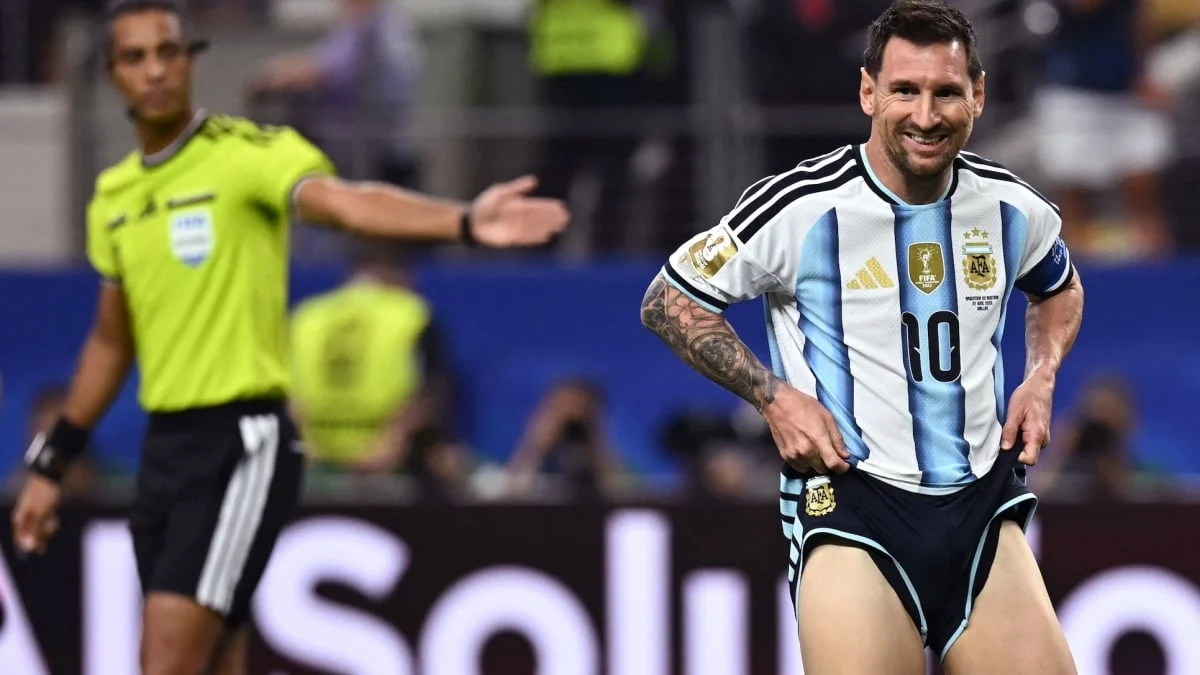
In a career defined by celestial talent and an insatiable hunger for glory, Lionel Messi has once again redefined the boundaries of footballing possibility. Just days before his 39th birthday, the Argentine maestro delivered an early gift to his nation and the global footballing community, ascending to the summit of the FIFA World Cup’s all-time goalscoring charts. With a clinical brace against Austria, Messi surpassed the legendary Miroslav Klose, etching his name into the annals of history with a record-breaking 18th World Cup goal.
This achievement is more than a mere statistic; it is the culmination of a multi-generational odyssey. As the confetti fell in the digital sphere and the roar of the stadium reached a fever pitch, it became clear that we are witnessing the final, luminous chapter of the most decorated career in the sport’s history.
The Historic Night: A Chronology of Brilliance
The narrative of the match was scripted for high drama. Entering the fixture against Austria, Messi sat level with Klose on 16 goals, needing only a single strike to claim the record outright.
The first half saw a disciplined Austrian side looking to frustrate the Argentine engine. However, the inevitability of the moment seemed to hang in the air. As the match progressed, Messi’s movement—always precise, always predatory—began to dismantle the Austrian defensive structure.
The record-breaking moment arrived with typical Messi flair. After an initial goal early in the contest put him level with the record, the tension shifted to whether he could secure the outright lead. The game entered deep into stoppage time with the scoreline firmly in Argentina’s favor, but the crowd remained on their feet. In the final seconds of added time, a trademark surge into the penalty area saw Messi slot home his 18th goal. The stadium erupted. The record was his.
The Penalty Paradox
The match was not without its moments of vulnerability, which served only to humanize the legend. In a sequence that underscored the unpredictable nature of football, Messi failed to convert from the penalty spot. This miss marked a curious, albeit unwanted, record: Messi became the first player in history to miss a penalty in three separate World Cup tournaments.
Social media discourse immediately fractured into two camps. Detractors pointed to the miss as a rare lapse in composure, while his legions of supporters argued that the miss was almost symbolic—a refusal to claim the historic record through the "easy" route of a spot-kick, preferring instead the artistry of open play.
Supporting Data: By the Numbers
To understand the magnitude of Messi’s 18th goal, one must look at the historical context of the FIFA World Cup leaderboard.
- The New Standard: 18 Goals (Lionel Messi)
- The Previous Benchmark: 16 Goals (Miroslav Klose)
- The Chasing Pack: Kylian Mbappé (14 Goals)
For over a decade, Miroslav Klose’s record—set during Germany’s triumphant 2014 campaign—stood as a testament to longevity and positional perfection. That Messi, a player who has spent his career as a playmaker as much as a finisher, has eclipsed a pure target-man’s record is a testament to his evolving role on the pitch.
A Legacy of Consistency
Fans and analysts alike have noted the uncanny consistency in Messi’s goal-scoring patterns. Viral clips comparing his current goals to those scored during his formative years at FC Barcelona have circulated online, highlighting that despite the physical toll of nearly two decades at the elite level, his technical execution remains untouched. His height—a modest 5 ft. 7 in.—has never been a hindrance; rather, it has been his low center of gravity and unparalleled agility that have allowed him to weave through defenses that dwarf him in stature.
The Digital Echo: Google and the Global Reaction
The cultural impact of the record-breaking goal was instantaneous. Recognizing the significance of the event, Google implemented a real-time celebratory feature. For hours following the final whistle, any search query for "Messi" triggered a cascade of virtual blue-and-white confetti, allowing fans across the globe to participate in the celebration.
This digital tribute mirrored the sentiments of the stadium-goers. One viral moment captured a fan in the stands holding a sign that appeared to have been prepared since 1926—a humorous nod to the fact that Messi’s greatness feels as though it has been a destiny written long before his birth.
The Future: The Mbappe Challenge and the GOAT Debate
While the world celebrates the present, the future is already knocking at the door. Kylian Mbappé, the French phenomenon, sits at 14 goals. With youth on his side and an explosive playing style, many analysts predict that if any player is to eventually challenge Messi’s new record, it will be the Frenchman.
Interestingly, the relationship between the two is defined by mutual respect rather than hostility. Despite the rivalry, Mbappé has been vocal in his admiration for his elder peer, recently going on record to state that, in his opinion, Messi remains the greatest player to ever grace the game. This sentiment fuels the ongoing "GOAT" (Greatest of All Time) debate, though for many, the argument effectively ended the moment the ball hit the back of the net for the 18th time.
Implications for the Sport
What does this record mean for the future of international football?
- The New Benchmark: The bar has been set significantly higher. Young strikers entering the World Cup stage now have a monumental target to aim for, which may change the tactical approach to tournament squad building.
- The Evolution of the No. 10: Messi has successfully transitioned from a traditional winger to a false nine, and finally into a deep-lying playmaker who still leads the scoring charts. This evolution serves as a blueprint for future generations of attackers.
- The "Last Dance" Narrative: This tournament acts as a poignant farewell for many of the sport’s most iconic figures. The record serves as the perfect punctuation mark to a career that has defined the 21st century.
A Sartorial Note on the Sidelines
Amidst the high-stakes drama, the internet found levity in the reactions from the Austrian bench. One specific image of an Austrian staff member’s bewildered expression regarding his own team’s tactical setup became an instant meme, serving as a humorous juxtaposition to the sheer, clinical brilliance occurring on the pitch. It was a reminder that while the world watches history being made, football remains a game of human reactions, fashion faux pas, and the occasional, beautiful chaos.
Conclusion
As Lionel Messi prepares for his 39th birthday, he does so as the undisputed king of the World Cup. Whether he adds to his tally in the remaining fixtures of this tournament or chooses to step away after this final act, his legacy is secure. He has provided more than just goals; he has provided moments of transcendence that have connected fans across borders, languages, and generations.
The prospect of a potential Messi vs. Mbappé final looms on the horizon, a clash that would pit the established deity against the rising heir. Should that materialize, it will not just be a game—it will be a historic confrontation between the past and the future of the sport. But for now, the footballing world can simply exhale, reflect, and appreciate the 18 goals that redefined the impossible.