

By [Your Name/Journalistic Desk]
Date: July 10, 2026
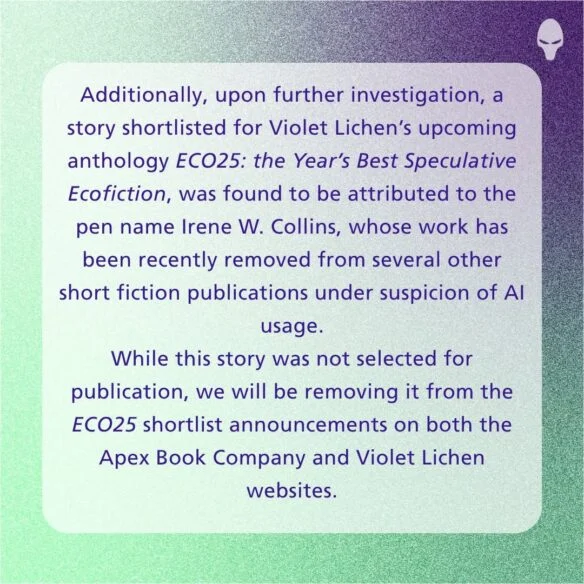
The intersection of generative artificial intelligence and literary publishing reached a critical flashpoint today as Apex Magazine, a stalwart of the speculative fiction community, announced the removal of a short story from its latest issue due to suspected AI involvement. In a move that signals the growing vigilance—and mounting anxiety—of independent literary outlets, the magazine also confirmed it has rescinded the selection of a second author’s work from an upcoming anthology, effectively disqualifying them from publication.
This development highlights a burgeoning crisis in the literary world: how publishers, editors, and journals can effectively police the boundaries of human-authored content in an era where Large Language Models (LLMs) are capable of mimicking professional prose with increasing sophistication.
Main Facts: The Purge of Suspected AI Content
Apex Magazine, a cornerstone of science fiction and fantasy publishing since its founding in 2005, released a formal statement on July 10, 2026, addressing the integrity of its recent editorial output. The magazine, led by Editor-in-Chief Lesley Conner and Publisher Jason Sizemore, confirmed that a piece of short fiction currently appearing in their latest issue was found to have been generated, or at least heavily assisted, by artificial intelligence.

In the publishing industry, "AI-assisted" is often a catch-all term for content generated by software such as ChatGPT, Claude, or specialized creative writing models, which the author subsequently passes off as original, human-composed work. The discovery forced the editorial team to take the drastic, reputation-saving step of removing the content entirely.
Furthermore, the magazine’s investigative sweep extended beyond the current issue. A second, unrelated author who had been shortlisted for a forthcoming Apex anthology has also been removed from contention. The magazine has signaled that these actions were taken to preserve the quality and human-centric nature of their publication, which has produced 153 issues over the last two decades.
Chronology: A Rapid Escalation
The timeline of this incident reflects the suddenness with which AI-related issues can derail a publication’s workflow.
- Submission Phase: The authors in question submitted their manuscripts through the standard Apex portal, which likely includes a clause regarding original authorship.
- Initial Acceptance: The stories were vetted, selected, and scheduled for publication based on their narrative quality and fit for the magazine’s aesthetic.
- Internal Review and Discovery: Following the release of the latest issue, editorial staff or community members identified "red flags" consistent with AI-generated text—often including repetitive sentence structures, a lack of deep emotional resonance, or tell-tale "hallucinations" in logic and prose.
- July 10, 2026: Apex Magazine confirmed the removal of the works and issued a public statement via Facebook, formalizing their stance against undisclosed AI usage.
The speed of this discovery underscores that even highly experienced editorial boards are now forced to function as digital forensic investigators.

Supporting Data and Industry Context
The struggle faced by Apex Magazine is far from an isolated incident. The literary community has been grappling with the "AI deluge" for several years.
- The Proliferation Problem: In 2023 and 2024, prominent sci-fi journals like Clarkesworld Magazine were forced to temporarily close their submission portals after being overwhelmed by thousands of AI-generated submissions in a matter of weeks.
- Editor Workload: Editors are now tasked with checking for linguistic patterns that suggest algorithmic generation. While some software tools exist to detect AI, they are famously unreliable, often producing false positives that can ruin the reputations of genuine, human writers.
- The Ethical Gap: For journals like Apex, which have built their reputation on the "human touch"—the unique voice, lived experience, and creative risk-taking of human authors—the presence of AI-generated content is viewed as a form of intellectual property fraud that undermines the value of the entire literary ecosystem.
Official Responses: The Stance of the Editors
In their public communication, the leadership at Apex—Lesley Conner and Jason Sizemore—emphasized transparency and the protection of their brand. The statement, while brief, suggests a firm "zero-tolerance" policy regarding undisclosed AI use.
By removing the stories, the editors have sent a clear message to the writing community: Apex values the labor of human authors. The decision to make this public—rather than quietly retracting the work—serves as a deterrent to others who might consider using LLMs to bypass the grueling, often multi-year process of honing one’s craft to meet the standards of a professional magazine.
Implications: The Future of Literary Publishing
The Apex incident raises profound questions that will define the next decade of creative writing.

1. The Burden of Proof
The most significant challenge for editors is the legal and ethical "burden of proof." If a magazine accuses an author of using AI, it can lead to immediate blacklisting. If the accusation is wrong, the magazine risks a defamation claim and the loss of trust from the writing community. How do we verify "humanity" in writing without invading the privacy of the writer’s drafting process?
2. The Redefinition of "Authorship"
We are entering a period where the definition of an "author" is being stretched. Is using a grammar checker AI-assistance? What about using AI to brainstorm plot points? Or to summarize research? The industry is currently scrambling to define the difference between "tools" and "ghostwriters." Magazines will likely move toward strict, detailed submission guidelines that explicitly categorize what is and is not permitted.
3. The Erosion of Trust
The most dangerous casualty of this trend is trust. For decades, the relationship between a literary magazine and its readership was built on a foundation of mutual respect. Readers trusted that the stories they read were the result of human struggle and imagination. If that trust is eroded by the suspicion that any given story might be a product of a machine, the commercial value of literary fiction—which relies heavily on the "author brand"—could plummet.
4. The Future of Submission Portals
We may see a return to more intensive, gatekept submission processes. While the "open submission" model has been a hallmark of democratizing literature, it is becoming increasingly unsustainable. Journals may begin to require writers to provide "proof of process"—such as draft notes, outlines, or early versions of a manuscript—to verify that the work was indeed human-led.

Conclusion: Protecting the Human Spirit in Prose
Apex Magazine’s decision to remove the suspected AI stories is a necessary act of maintenance in an increasingly automated world. It is a reminder that the value of literature does not reside merely in the words on the page, but in the human consciousness that organized them.
As the industry moves forward, the case of Apex will likely be cited as a pivotal moment in the "Human-First" movement. For writers, the message is clear: the path to publication remains through the honing of authentic, human-centric craft. For publishers, the mandate is equally clear: vigilance, transparency, and a commitment to the artists who, unlike algorithms, possess the unique, lived experience that defines great literature.
As we look toward the remainder of 2026, it is evident that the battle over the soul of speculative fiction is only just beginning. Whether through new detection technologies or a return to more traditional, human-vetted submission pipelines, the industry is determined to ensure that the stories of the future remain written by human hands.










