In the annals of cinematic fantasy, the 1980s occupy a singular, shimmering space—a decade defined by practical effects, bold experimentation, and a lack of the polished, digital sheen that characterizes the blockbuster era of the 21st century. While the 1990s saw a temporary cooling of the genre, the 1980s remained a fertile ground for high-concept, often bewildering, and undeniably ambitious storytelling. Among the most iconic artifacts of this era is John Boorman’s 1981 epic, Excalibur.
As part of our ongoing retrospective on the canonical fantasy films of the 1980s—a series that has previously examined the brutal edges of Dragonslayer and the dark, misunderstood depths of Disney’s The Black Cauldron—we turn our attention to the heart of Welsh mythology. Excalibur is not merely a film; it is a sprawling, jewel-toned fever dream that redefined how the Arthurian legend is projected onto the silver screen.
The Mythic Chronology: From Stone to Sea
John Boorman’s adaptation is a capacious, operatic retelling that draws heavily from Sir Thomas Malory’s Le Morte d’Arthur and T.H. White’s The Once and Future King. However, Boorman does not simply translate these texts; he infuses them with a distinct, almost hallucinogenic energy that sits somewhere between high fantasy and avant-garde theater.
The narrative structure follows the traditional arc of the legend, albeit with the narrative streamlining characteristic of Boorman’s vision. The story begins with the political volatility of Uther Pendragon, his deceptive seduction of Igrayne, and the subsequent forging of the destiny of the boy king, Arthur. From the iconic moment of drawing the sword from the stone to the tragic unraveling of the Round Table—driven by the adulterous affair between Guinevere and Lancelot—the film tracks the inevitable decline of Camelot. It culminates in the climactic battle against the usurper Mordred, Arthur’s death, and the final, haunting imagery of his body returning to Avalon.
To achieve a cohesive, if unconventional, narrative, Boorman implemented several key changes. In this version, the Sword in the Stone and the titular Excalibur are a single, singular blade, collapsing the dual-weapon mythology of earlier accounts. Furthermore, the sorceress Morgan le Fay and the mystical figure of Nimue are merged into a singular character, and the grail-seeking mantle—traditionally held by Galahad—is bestowed upon Perceval, who also serves as the one to return the sword to the Lady of the Lake, effectively bypassing the role of Sir Bedivere.
Supporting Data: The Visual and Auditory Palette
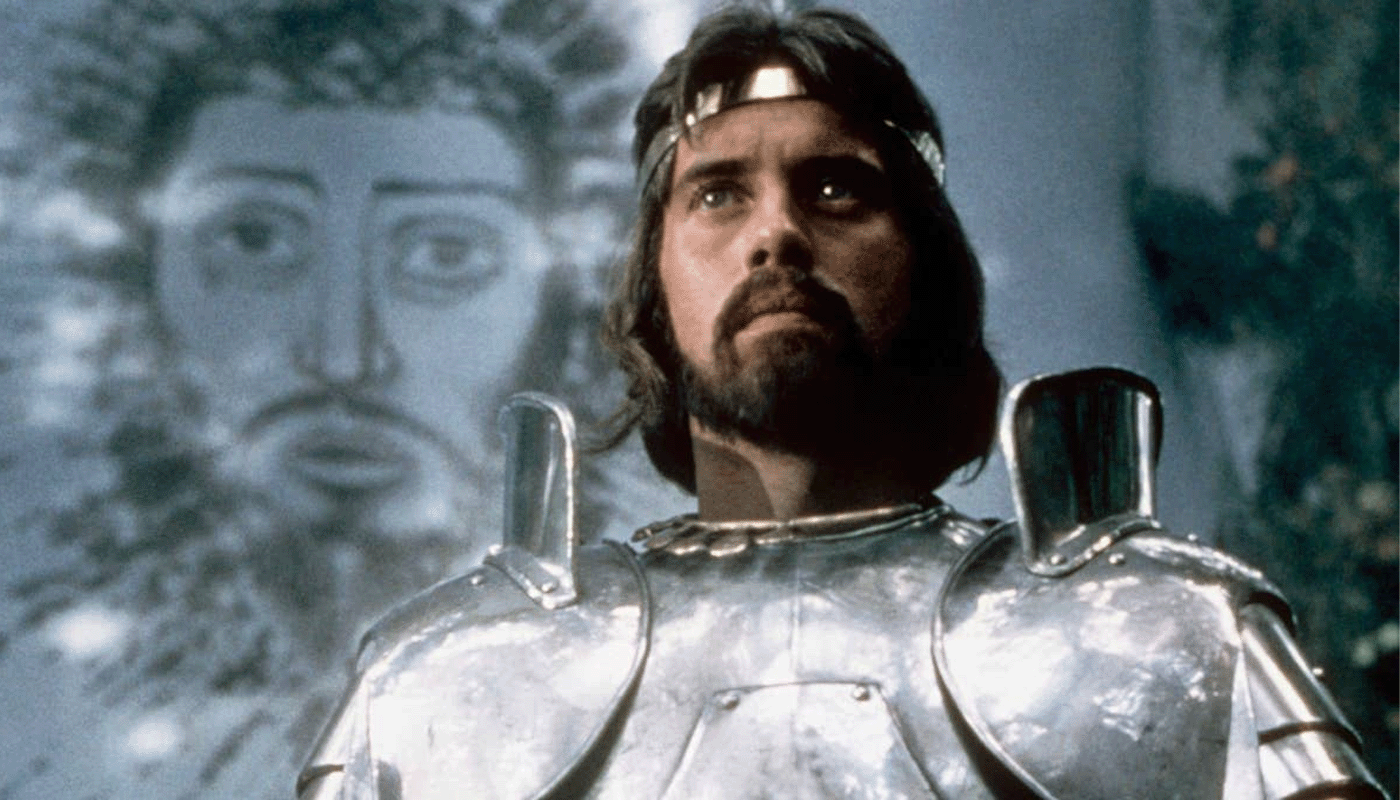
The reputation of Excalibur has solidified over forty-five years as a "flawed masterpiece." Visually, the film is an undeniable triumph, garnering an Academy Award nomination for Alex Thomson’s cinematography. The screen is saturated with emerald greens, deep blues, and the glint of chrome and polished plate armor.
However, these aesthetic choices are where the "inscrutable" nature of the film begins. The sets of Camelot are composed of stainless-steel blocks—an aesthetic choice that feels jarringly anachronistic, defying any historical classification. The costuming, too, is a point of contention; Uther’s decision to maintain his full suit of plate armor during his romantic trysts is a choice that remains one of the most absurd, yet strangely iconic, sequences in film history.
The auditory experience is equally polarizing. The frequent, thunderous use of Carl Orff’s Carmina Burana serves as a sonic intrusion, often cutting into the film’s quieter, more lyrical moments with a jarring, operatic intensity. Yet, this "clash" of elements—the medieval aesthetic, the futuristic armor, and the bombastic classical score—is exactly what makes Excalibur feel less like a historical period piece and more like a mythic, timeless hallucination.
The Human Element: Performances and Casting
The film’s central performance by Nigel Terry remains a source of significant debate. As Arthur, Terry is understated, sometimes bordering on the befuddled. Eschewing the traditional "warrior-king" archetype, Boorman’s Arthur feels more like an observer of his own destiny. For audiences expecting the swagger of a heroic leader, Terry’s portrayal—complete with a West Country accent—can feel like a void at the center of the film.
Contrastingly, Nicol Williamson’s turn as Merlin is nothing short of legendary. Williamson brings a campy, droll, and undeniably brilliant energy to the wizard. He is the film’s anchor, providing the necessary dose of cynicism to balance the high-minded tragedy. His interplay with Helen Mirren’s Morgana is the emotional and intellectual pulse of the movie. Mirren, in one of her early iconic roles, is the perfect foil: sultry, ambitious, and terrifyingly sharp.
The film is also a "who’s who" of future British prestige acting. A young Gabriel Byrne marks his debut as Uther, while Liam Neeson provides a raw, if strangely groomed, portrayal of Sir Gawain. Patrick Stewart appears as Leodegrance, and Ciarán Hinds makes a memorable splash as King Lot. Watching Excalibur today is a fascinating exercise in identifying the early career seeds of the current generation of British acting royalty.
Implications: The Enduring Legacy
Does Excalibur hold up as a masterpiece? The answer depends on one’s appetite for the unconventional. If judged by the standards of coherent, grounded fantasy, it falls short. If judged as a work of surrealist art, it is unparalleled.
Its legacy is profound. Zack Snyder has famously cited it as his favorite film, and the visual language of the movie—the blending of the dreamlike with the visceral—has left an indelible mark on subsequent Arthurian adaptations. Films like The Green Knight (2021) and King Arthur: Legend of the Sword (2017) owe a stylistic debt to Boorman’s willingness to let the "hallucinogenic" take precedence over the "logical."
The film serves as a bridge between the earnest, high-fantasy literature of the mid-20th century and the dark, brooding cinematic landscape that would emerge in the 2000s. It proved that the Arthurian legend could be malleable—that it could be dark, sexy, strange, and visually experimental without losing its mythic weight.
Final Verdict: A Relic of Creative Audacity
Forty-five years later, Excalibur remains a polarizing, shimmering relic of a bygone era. It is a film that refuses to be "polished." It makes choices that range from the brilliant to the bewildering—from the "Herkules" font choice to the goth-club-inspired dance sequences.
Is it a masterpiece? Perhaps not in the traditional sense. It is a work of "creative audacity." Boorman didn’t set out to make a history lesson; he set out to capture the essence of a dream. In doing so, he created a film that is fundamentally "weird," a quality that has become increasingly rare in the era of corporate-mandated, focus-tested blockbuster filmmaking.
For the viewer, Excalibur demands a certain level of surrender. You must accept the green-tinted lighting, the clanking armor, and the sudden, thunderous crescendos of Orff. If you can surrender to the dream, you will find that Excalibur is not just an adaptation—it is an experience, and one that stands as a vital, if jagged, pillar in the history of fantasy cinema.
Join us for our next installment, as we pivot from the highfalutin, jewel-toned heights of Arthurian myth to the gritty, low-budget fringes of the genre with a look at the Roger Corman-produced classic, ‘Sorceress’ (1982).