Pevita Pearce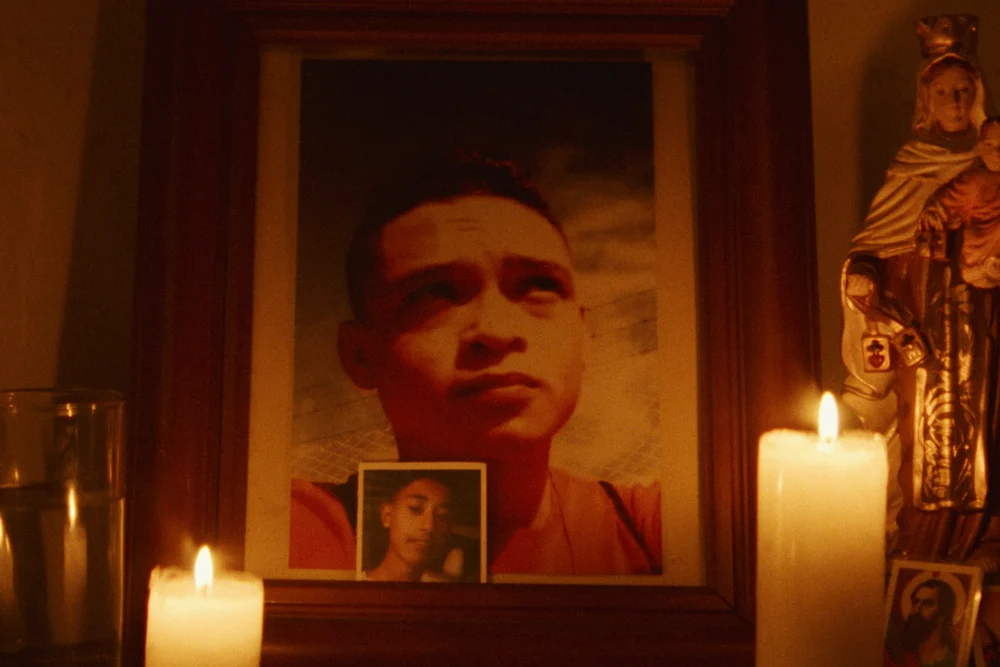
Since the mid-1960s, the landscape of Colombia has been irrevocably scarred by a multi-faceted conflict involving the government, leftist guerrilla groups, and right-wing paramilitary organizations. Amidst the violence, one of the most haunting legacies is the phenomenon of "forced disappearance." While the term has become a grim, euphemistic staple of political discourse, the reality remains a static, agonizing void for thousands of families.
Directors Juan Miguel Gelacio and Esteban Hoyos García’s latest feature, Five Years, Four Months, which recently premiered in the Crystal Globe competition at the Karlovy Vary International Film Festival, serves as a cinematic excavation of this trauma. By focusing on the fictionalized character of Martha Baquero—a composite portrait derived from real-life testimonies—the filmmakers explore not the political machinery of the war, but the visceral, temporal distortion experienced by those left behind.
The Chronology of a Search: From Paperwork to Potential Graves
The narrative of Five Years, Four Months is deceptively simple, mirroring the exhausting, repetitive nature of a search for the missing. Martha Baquero is a woman defined by her absence. Her son, Fabian, has been taken, and her life has subsequently been hollowed out, replaced by a singular, grueling routine.
The film tracks Martha as she navigates the bureaucratic labyrinth of post-conflict Colombia. We watch her endure endless bus journeys across rugged, verdant terrains—a visual metaphor for the distance between her current reality and the closure she seeks. She is a constant traveler, moving between government offices where she files endless, soul-crushing paperwork, and remote burial sites where she assists in painstaking exhumation projects.
These "narratively uneventful" sequences are the backbone of the film’s structure. Gelacio and García deliberately employ a calm, steady rhythm to emphasize the "in-between" state of Martha’s existence. She is a woman perpetually suspended in the waiting room of life. The filmmakers capture the sensorial landscape of this isolation: the ambient hum of traffic, the wind in the trees, and the low-frequency noise of a country trying to move forward while the earth remains full of secrets.
Supporting Data: The Scale of Disappearance in Colombia
The film is grounded in a stark statistical reality that few can ignore, yet many have become desensitized to. According to data from the National Center for Historical Memory (CNMH) in Colombia, more than 80,000 people have been forcibly disappeared in the country since the 1960s. This figure—a staggering indictment of decades of internal strife—represents more than just a number; it represents a systemic failure of state and insurgent actors to respect the fundamental rights of non-combatants.
The exhumation projects depicted in the film are part of a massive, ongoing effort by the Unit for the Search of Persons Deemed as Missing (UBPD), an entity created under the 2016 Peace Agreement. The process of identifying remains is scientifically complex and emotionally harrowing, often taking years to produce results. For mothers like Martha, the uncertainty is a weaponized form of psychological torture that prevents the completion of the grieving process.
The Psychological Toll: Performance and Sensory Dissonance
A central achievement of Five Years, Four Months is the performance of Jenny Nava. As Martha, Nava offers a masterclass in controlled, opaque acting. She is present in nearly every frame, yet she remains a cipher. Her face, largely unreadable, is not a mask of severe tragedy but one of profound, muted endurance.
The filmmakers utilize meticulous sound design to bridge the gap between Martha’s inner numbness and her external, hyper-aware reality. In scenes where she interacts with the outside world, there is a perceptible tension. She often forces a note of gaiety into her voice, a social performance intended to reassure others that she is "functioning." This cognitive dissonance—the attempt to inhabit a normal life while being consumed by a bottomless, internal abyss—is the film’s most heartbreaking observation.
In one significant sequence, Martha joins a dance therapy group for grieving mothers. Here, the film offers a brief, fleeting connection to humanity. The women in the group function as a support network, a collective body that remembers when the state chooses to forget. Yet, even here, Martha remains distinct. She is a woman who refuses to settle for the collective comfort of shared grief; she is, for reasons the audience can only intuit, holding out for a truth that feels increasingly supernatural.
Official Responses and the Burden of the State
The Colombian government’s role in addressing these disappearances has been a subject of intense scrutiny and debate. Under the 2016 peace accord, the creation of the Special Jurisdiction for Peace (JEP) was intended to provide justice and truth for victims. However, the path to truth remains obstructed by shifting political tides and the recalcitrance of former combatants.
Official responses to the crisis of the disappeared have often been criticized for being reactive rather than proactive. While the JEP has made strides in uncovering mass graves, many families report feeling alienated by the cold, legalistic pace of the proceedings. Five Years, Four Months captures this institutional apathy through the lens of Martha’s exhaustion. She is not a beneficiary of a system; she is a victim of a process that treats her son’s existence as a case file to be processed rather than a life to be mourned.
The Blur Between Reality and the Supernatural
The most striking departure from pure realism in the film comes through the inclusion of dream sequences—eerie, slow-motion glimpses of naked, anonymous bodies in a dark, primeval forest. These images do not feel like hallucinations; they feel like the suppressed truth of the landscape.
As the film progresses, the narrative takes a turn that might surprise those expecting a purely documentary-style social realist drama. Guided by another grieving mother, Sandra (played with seasoned grit by Carmía Martínez), Martha embarks on a journey to "speak with a dead man." This leap into the metaphysical—a potential scam in a criminal underworld—serves as a metaphor for the desperation of the bereaved. When logic fails and the state offers nothing, the human mind will naturally turn to the impossible to find peace.
The climax of the film, a beautifully shot conversation between Martha and Sandra, strips away the artifice. As they talk about Fabian, the natural world around them seems to vibrate with the memory of the lost. The lush, vibrant Colombian landscape, once a backdrop for violence, is transformed into a sanctuary for love.
Implications: A Cinematic Call to Witness
Five Years, Four Months does not provide answers. It does not offer a neat resolution to the mystery of Fabian’s disappearance, nor does it offer a political manifesto. Instead, it offers something more enduring: it demands that the audience sit with the uncomfortable, lingering reality of the "disappeared."
The implications for Colombian society are clear: there can be no true peace while the earth still holds the remains of those stolen by war. The film suggests that the "dizzying gulf" between the grieving and the rest of the world is a failure of empathy. By forcing the viewer to inhabit the rhythm of Martha’s wait, the filmmakers make it impossible to look away.
In the final assessment, the film is a testament to the power of the human spirit to seek truth even when the truth is buried under decades of silence. Through its hypnotic pacing and deep emotional intelligence, Five Years, Four Months reminds us that the struggle of the mother is the struggle of the nation. Until every name is accounted for, the conflict, in the hearts of the mothers, remains a living, breathing, and devastatingly present reality.


 Layla Zulfa
 Ammar Sabilarrohman