For over a decade, blogging has been the cornerstone of B2B and B2C digital marketing. It remains the gold standard for establishing thought leadership, driving SEO authority, and nurturing audiences. However, the digital landscape is not static. As search engine algorithms shift, user behavior evolves, and generative AI floods the internet with automated content, the traditional "publish and pray" approach is yielding diminishing returns.
To understand how to navigate this volatile environment, we look to the 11th Annual Blogger Survey from Orbit Media. This authoritative research provides a roadmap for marketers seeking to move beyond the noise and achieve measurable ROI. We sat down with Andy Crestodina, CMO and Co-Founder of Orbit Media, to decode these findings and understand what they mean for the future of content marketing.
The Reality of Time: Why High-Effort Content Still Wins
One of the most pressing questions in the industry is whether generative AI has finally accelerated the production process. With tools capable of drafting articles in seconds, one might expect the average time spent per post to plummet.

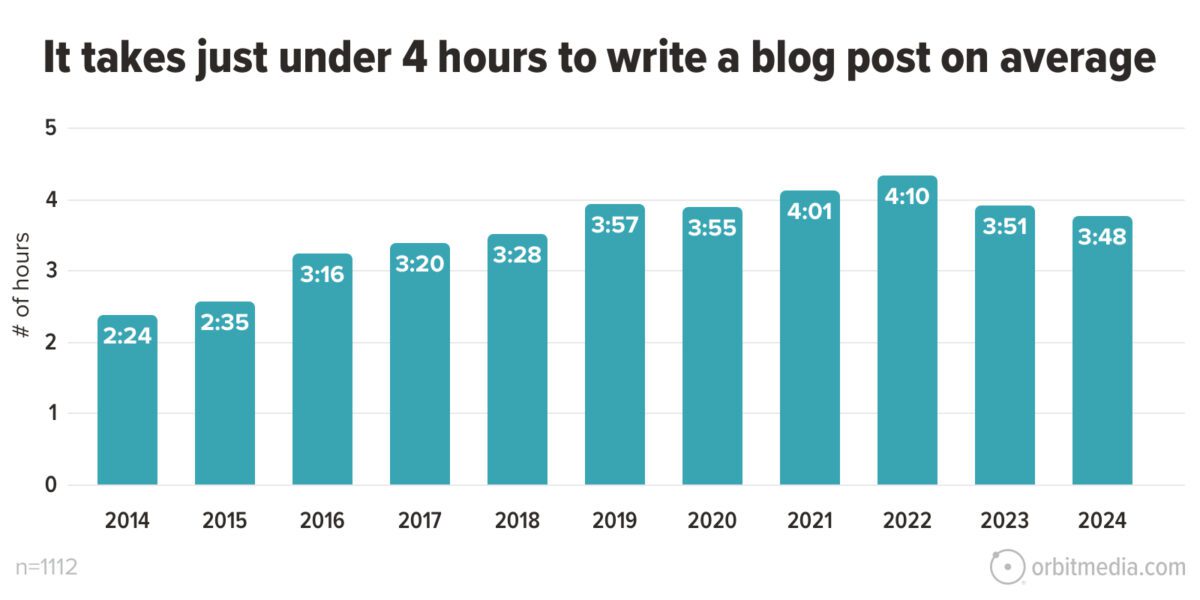
The data, however, tells a different story. The average time spent creating a single blog post is three hours and forty-eight minutes—a mere three-minute decrease from the previous year. This resilience of "time-on-task" highlights a critical truth: while AI can assist in the mechanics of writing, the high-quality, strategic, and human-centric content that actually performs requires significant time investment.
The 2,000-Word Threshold
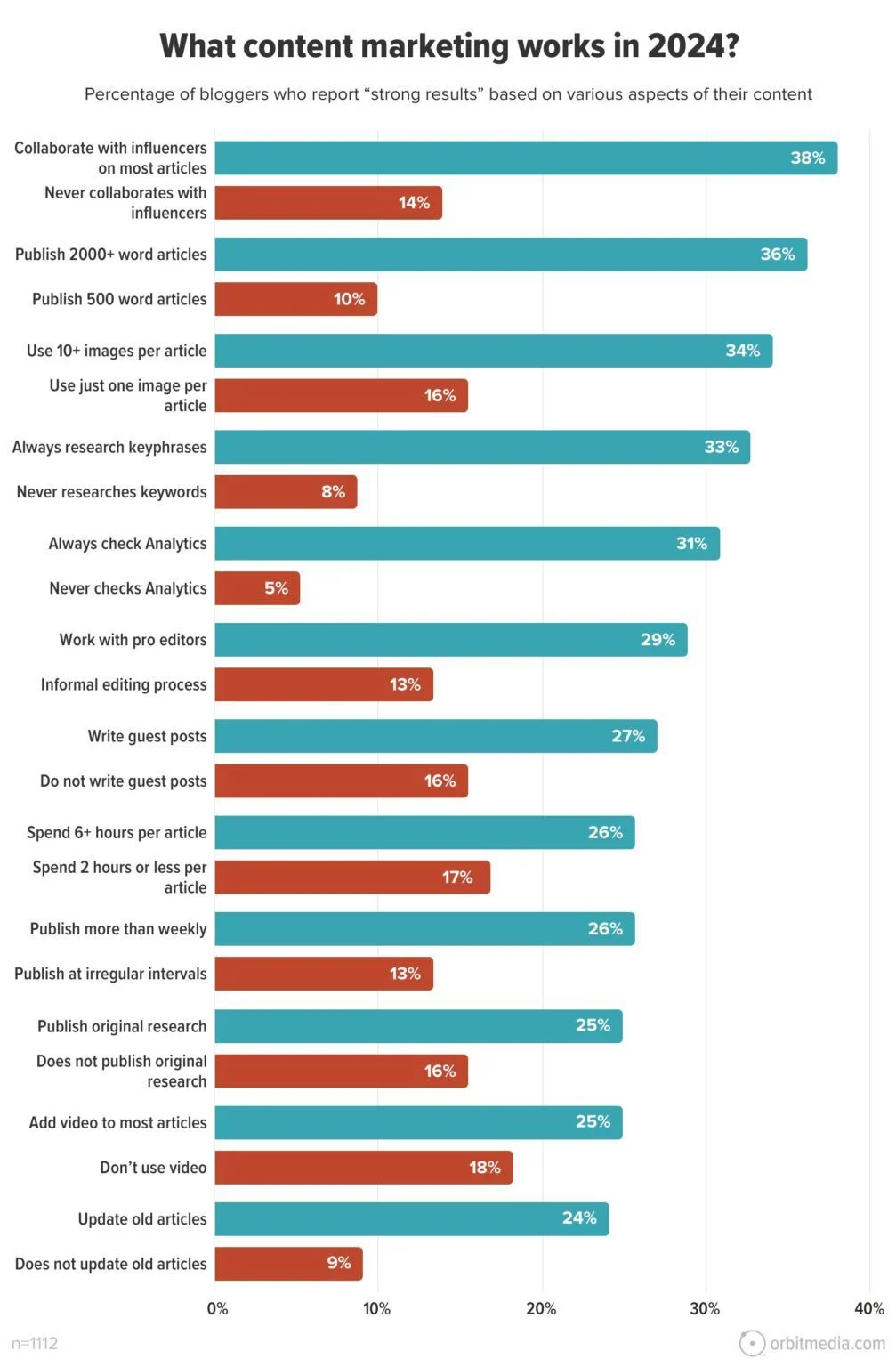
The survey findings reveal a clear correlation between effort and impact. Marketers who consistently produce long-form content (2,000+ words) are significantly more likely to report "strong results." This isn’t just about word count; it’s about the depth of research, the inclusion of original data, and the comprehensive nature of the argument. When you treat your blog as a long-form resource rather than a quick traffic-driver, you build an asset that accumulates value over time.
Shifting the Paradigm: Treating Blogs Like Social Feeds
Perhaps the most significant takeaway from this year’s research is the necessity of treating your blog like a social media stream. Social platforms have spent millions refining the science of engagement—why shouldn’t your blog benefit from that same rigor?
Top-performing blogs share several traits with successful social media channels:
- Visual-first design: Breaking up text with original charts, diagrams, and video.
- High-frequency consistency: The data suggests a bi-weekly cadence is the absolute minimum for maintaining audience momentum.
- Interactive elements: Inviting comments, conducting polls, and creating a sense of community.
Marketers who fail to treat their blog as a destination—a living, breathing space for their audience—are often the ones struggling to see meaningful engagement.
The AI Paradox: Adoption vs. Performance
The integration of Artificial Intelligence in content creation has reached a saturation point, with 80% of bloggers now utilizing AI in some capacity, up from near-zero in 2022. Yet, the survey identifies a glaring gap: there is no direct correlation between AI usage and improved performance.

AI is a tool, not a strategy. It excels at ideation, drafting, and visual generation, but it fails to replicate the strategic nuance, industry expertise, and brand voice that foster trust. The most successful content creators today are using AI as an assistant to free up time for high-level creative work—not as a replacement for the human expert.
Expert Q&A: Andy Crestodina on the Future of Content
To dig deeper, we spoke with Andy Crestodina, who has been at the forefront of digital marketing innovation for over two decades.
Q: What research findings were the most surprising to you personally?
Andy Crestodina: "The data tells us, year after year, that big efforts drive big outcomes. What’s surprising is seeing so many programs stick to the same low-effort, short-form content on a monthly cadence, despite the data showing it doesn’t work. It’s like doing the same workout for a decade and wondering why you aren’t getting stronger. We see a lack of original research, a lack of collaboration, and a lack of multimedia. If you don’t put in the work, you should set your expectations low."

Q: The data suggests that podcasters are the most likely to report strong results. Why?
Andy Crestodina: "It’s a pattern of behavior. The people who hit the record button and work with others are generally the same people who are willing to put in the work across other channels. Podcasting requires collaboration and high-quality production, which mirrors the effort required for a high-performing blog. It’s not just about the audio format; it’s about the mindset of the creator."
Q: "The most visible marketing metrics are the least important." What should we be measuring instead?
Andy Crestodina: "Traffic is the vanity metric. It’s easy to track, but it’s becoming harder to sustain as search traffic fluctuates and ‘zero-click’ searches increase. We need to move toward bottom-of-funnel metrics. Are people subscribing to your newsletter? Are they reaching out for a demo? Are they mentioning your brand in conversation? The most important outcomes—word-of-mouth and top-of-mind awareness—are notoriously hard to measure, but they are the ones that actually drive the business."
Implications for Content Marketing Leaders
Based on the 11th Annual Blogger Survey, it is clear that the "Golden Age" of easy organic traffic is over. To remain competitive in 2025 and beyond, content leaders must pivot their strategies:

1. Diversify Distribution
Stop relying solely on Google. The "don’t build on rented land" mantra is being challenged by reality. As Andy Crestodina notes, "I broke the old rule and launched a LinkedIn newsletter. We have less traffic, but more visibility. We aligned ourselves with big tech’s goal of keeping their visitors on their platform, and they rewarded us." B2B brands should look to publish directly where their audience already spends their time.
2. Prioritize "High-Effort" Content
Stop producing generic, 500-word SEO-bait articles. Focus on deep-dive research, original case studies, and expert interviews. This content is inherently harder to create, but it is also harder to replicate, making it an enduring competitive advantage.
3. Embrace the "Human-in-the-Loop" Model
Use AI for the heavy lifting—transcription, summarization, and outlining—but ensure that a human expert is the final editor and voice. Your content must demonstrate "Experience, Expertise, Authoritativeness, and Trustworthiness" (E-E-A-T), which AI cannot invent on its own.

4. Redefine Success
Move away from traffic as the primary KPI. Begin tracking conversion-oriented metrics, such as newsletter sign-up rates, time spent on key pages, and lead quality. If a blog post doesn’t move the reader further down the funnel, it is effectively a loss, regardless of how many pageviews it generated.
The Road Ahead
The findings from Orbit Media’s research serve as a wake-up call for content teams. The internet is louder than ever, and the cost of mediocrity is rising. However, for those willing to lean into the effort—to invest in original research, collaborate with peers, and prioritize high-value content over high-volume filler—the opportunities are vast.
The strategy for 2025 is simple to state but difficult to execute: stop doing what everyone else is doing, and start doing what actually works. By focusing on the human elements of storytelling and the strategic rigors of audience building, brands can navigate the decline of traditional search traffic and emerge as trusted voices in their respective industries.