

Language is the mirror of culture, and nowhere is this more evident than in the study of Japanese. For learners navigating the complexities of the language, vocabulary often extends beyond simple dictionary definitions. Among the most critical and frequently misused terms is the adverb sugu (すぐ). While it is often translated as "soon" or "shortly," its usage carries deep-seated cultural expectations regarding time, urgency, and social obligation. In this second installment of our exploration, we delve into the mechanics, context, and sociolinguistic implications of sugu.
The Core Definition: What Does "Sugu" Really Mean?
At its most basic level, sugu is an adverb used to describe an event occurring in close temporal proximity to the present moment. Unlike English, where "soon" can be a vague, non-committal timeline, sugu implies an immediate, direct follow-through. When a Japanese speaker says, "Sugu ikimasu" (I will go right away), they are setting a social contract that their physical arrival should happen with minimal delay.
The term captures a "sense of being already the time for something." It suggests that the window of opportunity is narrow and the action is anticipated. Understanding this nuance is essential for anyone attempting to bridge the gap between being a student of the language and a fluent communicator.
Chronology and Evolution of Usage
The usage of sugu has evolved alongside the modernization of Japanese society. Historically, time in Japan was governed by the changing of seasons and the rhythm of agricultural life. However, in the fast-paced, urbanized environment of contemporary Japan, sugu has become a cornerstone of professional and personal efficiency.
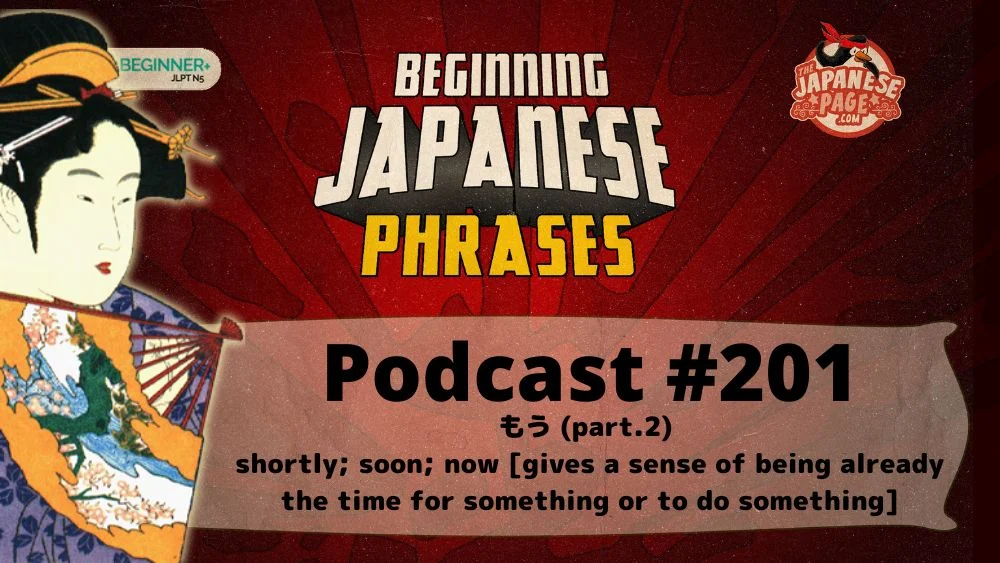
![Beginning Japanese Phrases Podcast #201: もう(part.2) shortly; soon; now [gives a sense of being already the time for something or to do something]](https://www.thejapanesepage.com/wp-content/uploads/2025/07/website-image-1.jpg)
- The Pre-Modern Era: In earlier iterations of the language, immediacy was often framed within the context of duty (giri) or nature. Actions were taken when the time was "ripe."
- The Industrialization Period: As Japan modernized, the need for precision grew. Sugu began to replace more formal, rigid time-markers, providing a flexible but urgent way to coordinate logistics in bustling cities like Tokyo or Osaka.
- The Digital Age: Today, sugu has found a new home in text messaging and digital communication. When a friend messages "Sugu ni kaeru" (I’ll be back soon), the sugu serves as a reassuring placeholder, managing expectations in an age where instant connectivity is the standard.
Supporting Data: Why Context is King
To master sugu, one must look at the data surrounding its frequency and collocation. Linguistic studies suggest that sugu is most effective when paired with verbs of motion or completion.
- Sugu ni (immediately): Used when the action is instantaneous.
- Sugu ni… (time frame): Often followed by a specific duration (e.g., "Sugu ni modorimasu" – I will return in a moment).
Data from language learners consistently shows that "time-blindness"—the inability to correctly estimate the length of a delay—is the primary hurdle. If a colleague says they will finish a task sugu, it rarely means five minutes; it means "as soon as the current priority is cleared." This distinction between "immediate" and "as soon as possible" is where many international business professionals experience friction.
Official Responses and Linguistic Perspectives
Prominent linguists often categorize sugu as a "relational adverb." Unlike absolute adverbs (e.g., "at 5:00 PM"), sugu relies entirely on the relationship between the speaker and the listener.
According to experts at the Japanese Language Institute, the word functions as a social buffer. It softens the potential harshness of a delay. By using sugu, the speaker expresses an intention to act, which is often considered more important in Japanese social etiquette than the literal time elapsed.
![Beginning Japanese Phrases Podcast #201: もう(part.2) shortly; soon; now [gives a sense of being already the time for something or to do something]](https://www.thejapanesepage.com/wp-content/uploads/2020/09/TJP-Article-header-image-800x360-1.jpg)
When conducting a vocabulary quiz—such as the one recommended for our readers—it is essential to realize that the correct answer is rarely a static time value. Instead, the correct answer is usually the one that best reflects the intent of the speaker to minimize the wait time for the listener.
Implications for Learners and Professionals
The implications of misinterpreting sugu are not merely academic; they are professional and social. In a workplace setting, misunderstanding the urgency implied by a supervisor’s use of sugu can lead to perceived incompetence. Conversely, over-promising with sugu when one cannot deliver immediately can damage professional credibility.
How to Navigate the "Sugu" Trap
- Calibrate Expectations: If you are the listener, treat sugu as a signal of intent rather than a stopwatch.
- Use with Precision: If you are the speaker, avoid using sugu if you know a task will take more than 30 minutes. Use a more specific timeframe to avoid frustration.
- Practice with Content: Utilizing immersive tools, such as audio files and Anki decks, allows learners to hear the pitch and inflection associated with sugu in natural conversation.
The Path to Fluency: The Complete Beginner Bundle
For those serious about mastering nuances like sugu, the journey requires more than just a dictionary. It requires a holistic approach that integrates reading, listening, and cultural context.
The Complete Beginner Bundle offers a comprehensive solution for those looking to transition from basic hiragana to JLPT N5 proficiency. With over 23 ebooks, 2,000 audio files, and integrated app support, this bundle is designed to take the guesswork out of language acquisition.
![Beginning Japanese Phrases Podcast #201: もう(part.2) shortly; soon; now [gives a sense of being already the time for something or to do something]](https://www.thejapanesepage.com/wp-content/uploads/2026/07/Two-Bundles-in-One.jpg)
- Value Proposition: At a reduced price of $49 (down from $129), learners save $80, gaining access to lifetime updates.
- Practical Application: The materials include real-world scenarios that teach you how to use terms like sugu naturally, rather than as a robotic translation.
- Next Steps: For those who prefer a guided approach, joining Makoto+ offers a free membership that provides a low-risk way to explore the language further.
Conclusion
The term sugu is a testament to the sophistication of the Japanese language. It is a word that balances the need for speed with the social requirement for politeness and consideration. By studying the context, understanding the linguistic evolution, and applying these concepts through structured learning materials, you can move past the textbook definitions and into the heart of Japanese communication.
Whether you are preparing for the JLPT or simply hoping to navigate a conversation with greater ease, remember that sugu is your bridge to faster, more meaningful connections. Start your journey today, and ensure that when you speak, your words carry the weight and urgency they deserve.
Ready to test your knowledge? Take our 5-question vocabulary quiz to see if you’ve truly mastered the nuances of "Sugu" and other essential adverbs. And don’t forget to explore the Complete Beginner Bundle to support your long-term language goals.











