For any social media agency owner, the first week of a new contract is defined by a singular, dreaded question: "So, when do the posts actually start?"
It is a moment of professional friction. You have secured the signature and processed the first payment, yet the client’s feed remains static. Behind the scenes, you are likely buried in the "Onboarding Void"—a period where your team is burning hours on intake, auditing, strategy development, and calendar drafting. Every hour spent on these foundational tasks is an hour where the client pays for a service they cannot yet see.
This slow start is more than a logistical nuisance; it is a retention risk. According to research by Wyzowl, 63% of customers cite the onboarding experience as a deciding factor in their initial purchase, and 86% report that they are significantly more loyal to businesses that invest in a high-quality, efficient transition. In the agency world, the first three weeks set the psychological tone for the entire client-agency relationship.
The Systems Problem: Why Onboarding Stalls
Onboarding is rarely slow because agencies lack talent; it is slow because they lack systems. Most agencies treat every new client as a blank slate, manually repeating the intake process, the audit, and the initial strategy build. This "manual-first" approach is the primary reason why onboarding often stretches into 30 or 90 days.
However, the emergence of the Model Context Protocol (MCP) and sophisticated AI orchestration is changing the economics of agency growth. By integrating Claude with tools like SocialPilot, Apify, and Slack, agency owners can move from a "blank page" workflow to a "pipeline" workflow. This transition isn’t about replacing the human strategist; it’s about automating the administrative burden that keeps them from delivering value.
Chronology of an Automated Onboarding Sprint
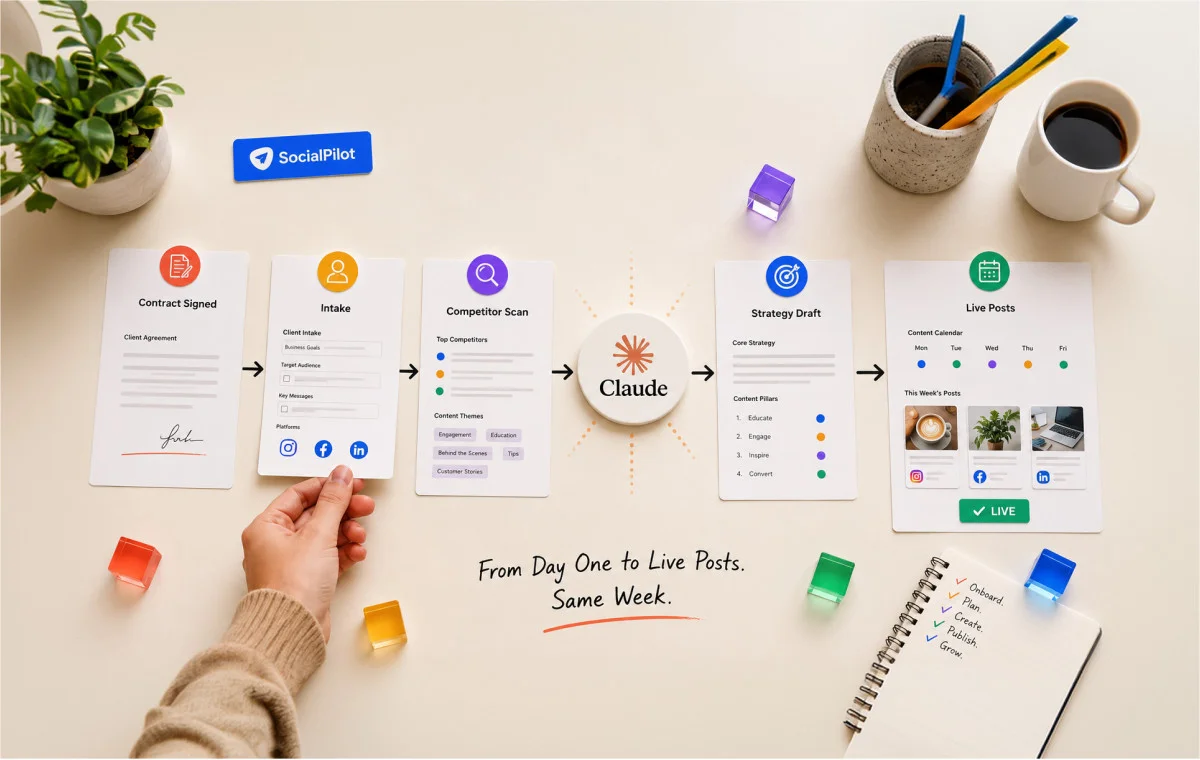
To eliminate the onboarding void, agencies are moving toward a seven-step automated pipeline. When integrated correctly, these steps run in a single, continuous AI thread, allowing a strategist to move from intake to a fully scheduled calendar in a fraction of the time.
Step 1: The Structured Intake
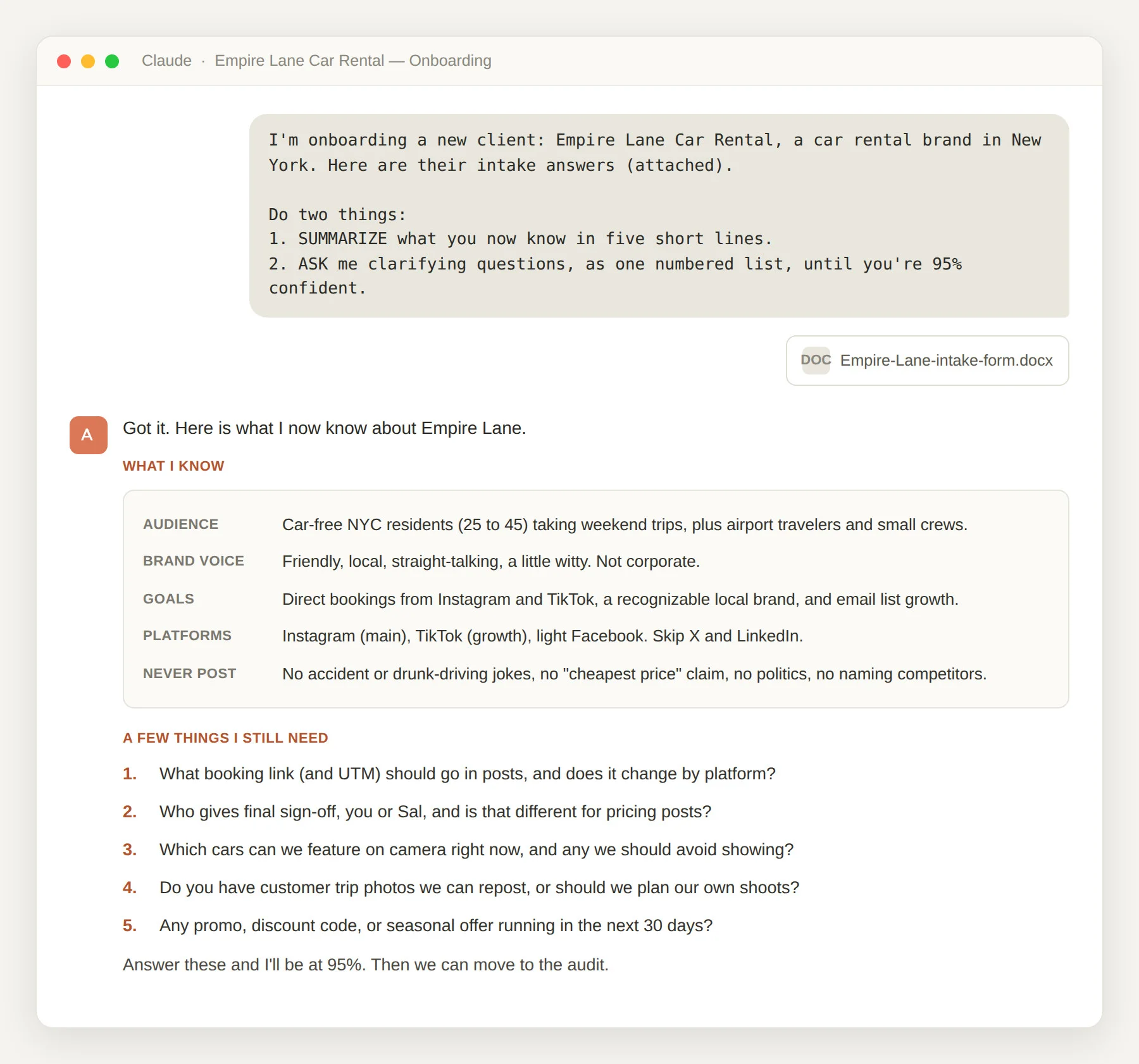
Instead of long, back-and-forth email threads or disconnected kickoff calls, successful agencies are now using structured intake forms (via Typeform or Tally). By feeding these raw responses into Claude with a standardized prompt, the AI summarizes audience, brand voice, and goals instantly. It then generates a list of clarifying questions to ensure the strategy is robust before the actual planning begins.
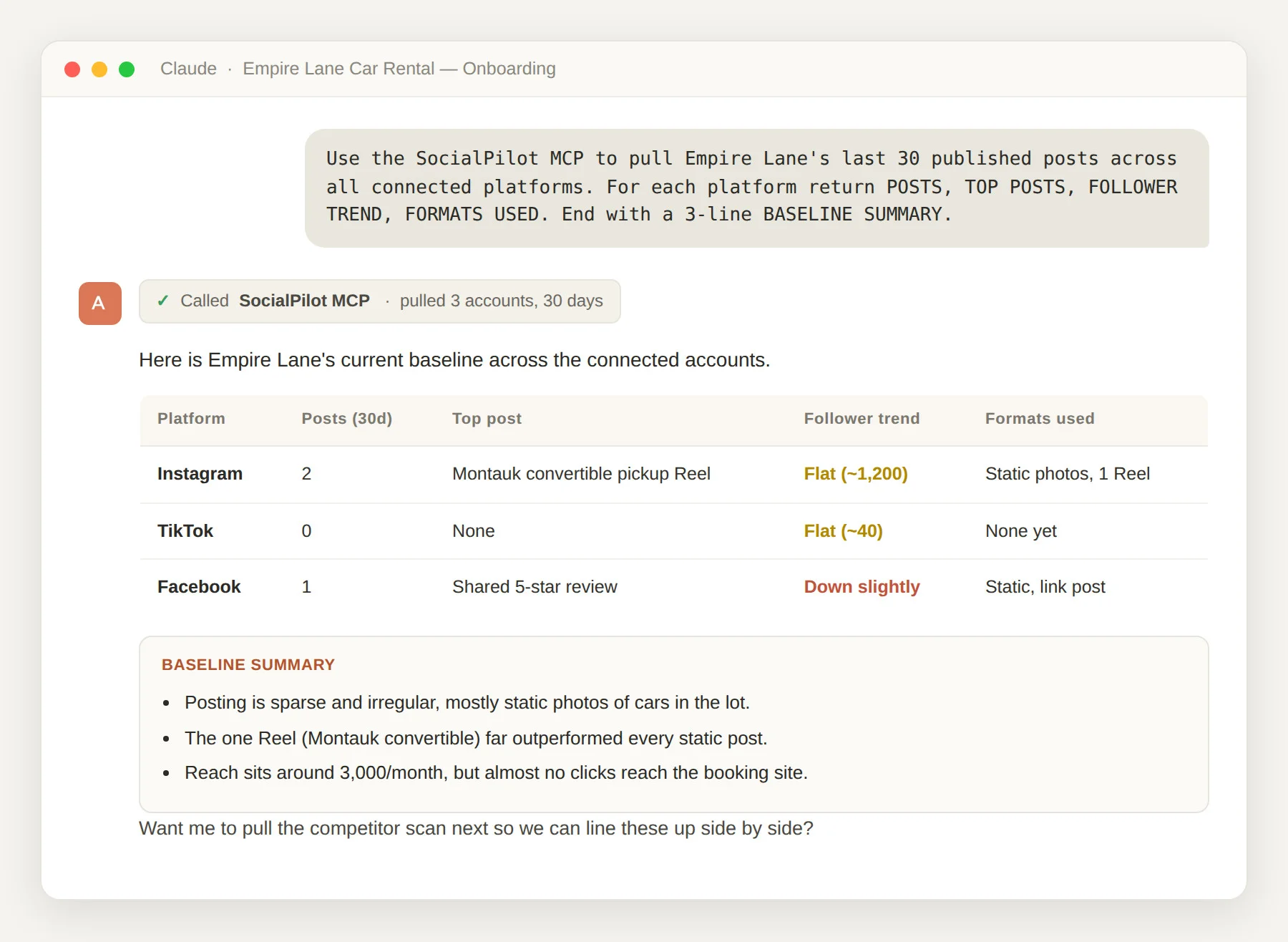
Step 2: The Automated Baseline Audit
You cannot plan for growth without understanding the historical baseline. Rather than manually logging into five different platforms to calculate engagement rates, the SocialPilot MCP allows Claude to pull the last 30 days of performance data directly into the chat. The AI identifies top-performing content formats and trends, providing an objective starting point.
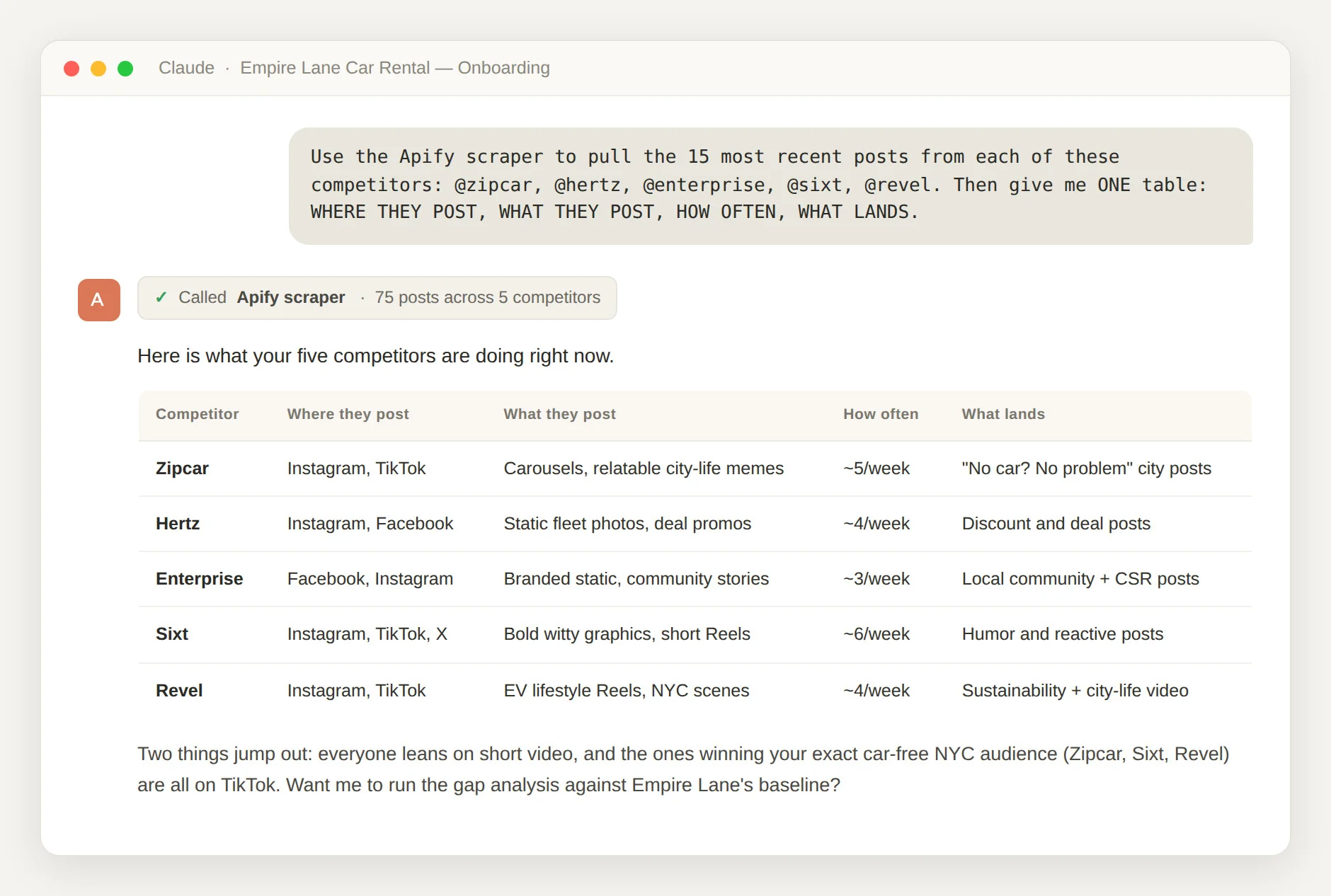
Step 3: Competitor Intelligence
Using the Apify MCP, the AI scrapes recent activity from a client’s primary competitors. It creates a comparative analysis that goes beyond surface-level observations. It maps where rivals are active, what formats are driving engagement, and—crucially—where they have gone quiet.
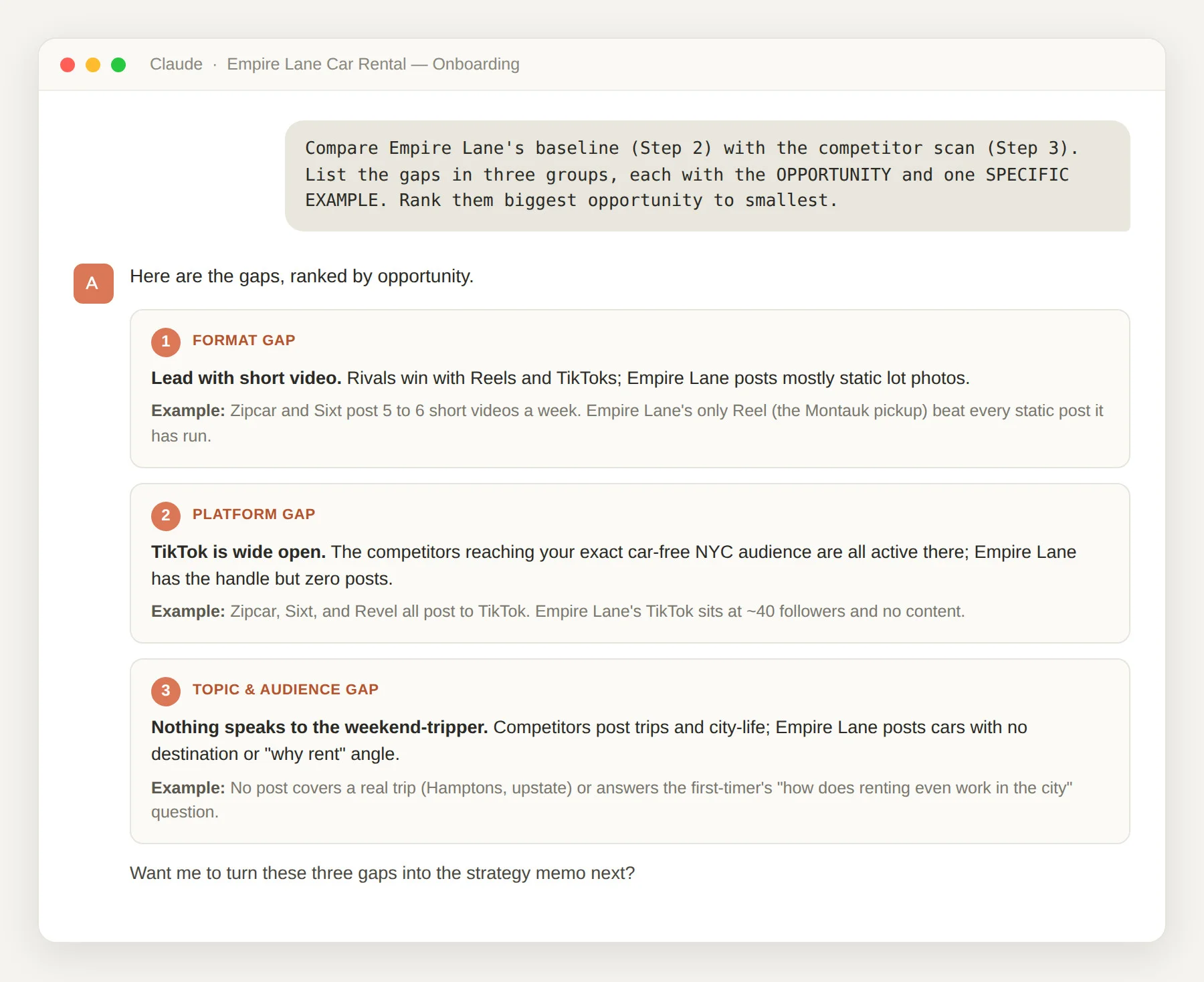
Step 4: Gap Analysis
With the client’s baseline and the competitor landscape established, Claude performs a systematic gap analysis. It ranks opportunities by priority, focusing on platform gaps, format deficiencies, and missed topic opportunities. This is where the strategy shifts from generic to hyper-personalized.
Step 5: The Internal Strategy Memo
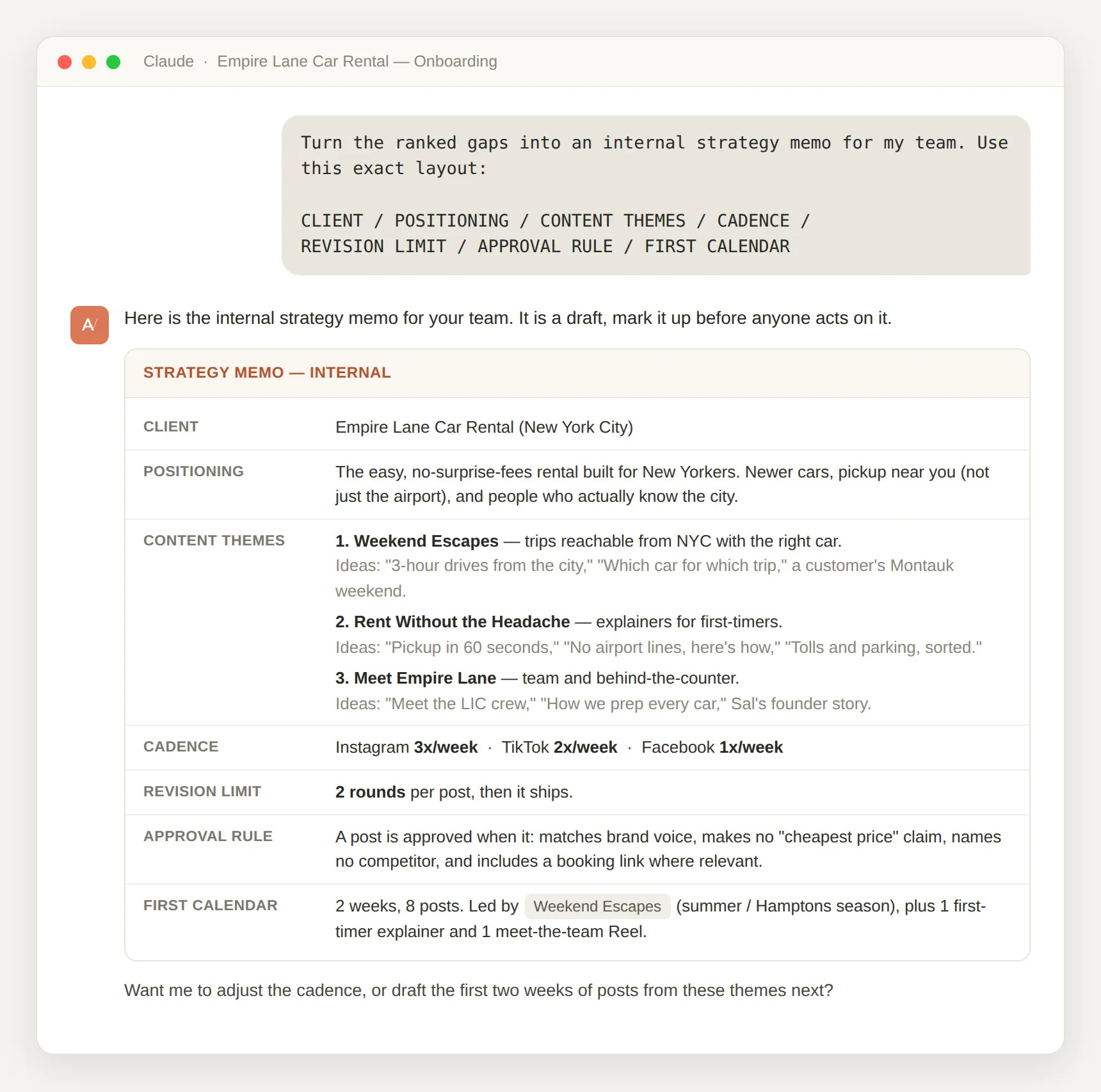
Claude then translates these gaps into an internal strategy memo. This document serves as the "source of truth" for the account, outlining positioning, content themes, revision limits, and approval workflows. By setting these boundaries early, agencies head off the "endless feedback loop" before it ever begins.
Step 6: Calendar Construction and Scheduling
With the strategy solidified, the AI drafts the first two weeks of content. Using the SocialPilot MCP, these posts are scheduled directly into the client’s workspace. Each post remains in a "pending approval" state, ensuring that the strategist retains quality control while eliminating the manual labor of data entry.
Step 7: The Client Brief
The final step is the most critical for client satisfaction. Claude generates a concise, jargon-free brief that summarizes the strategy and includes a link to the SocialPilot approval workflow. By sending this via Slack or email, the agency provides the client with a tangible "win" within the first few days of the contract.
Supporting Data: The Productivity Frontier
The economic potential of this shift is substantial. Data from organizations like Databar indicates that onboarding tasks—which traditionally absorb 20 to 40 hours of a senior strategist’s time—can be condensed into 4 to 8 hours when AI orchestration is properly implemented.
This aligns with findings from McKinsey, which suggest that generative AI can automate tasks occupying 60% to 70% of employee time. In the context of marketing agencies, this productivity surge allows firms to scale their client count without a corresponding linear increase in headcount. The goal is not merely "speed"—it is about removing the friction that leads to revenue leakage. When a client sees live, approved, and professional content in their first week, the agency’s perceived value skyrockets.
Official Perspectives on AI-Driven Agencies
The shift toward AI-integrated onboarding is being discussed heavily in professional communities. Freelancers and agency operators on platforms like Reddit are increasingly sharing "recipes" for connecting LLMs to their existing toolstacks.
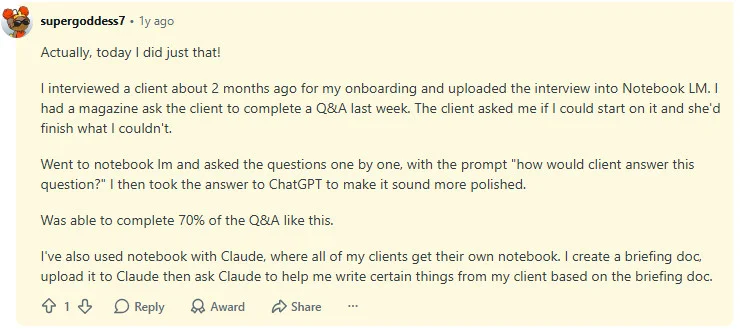
The consensus among early adopters is that the "30-day onboarding myth" is a relic of the past. As one freelancer noted in a recent thread on r/notebooklm, the key is to "give the AI the client’s context once, and let it do the repeat drafting." By treating the onboarding process as a code-like pipeline rather than a series of one-off creative tasks, agencies are successfully standardizing their quality while drastically reducing their overhead.
Implications for the Future of Agency Management
The broader implication of this automation is a shift in the agency business model. As onboarding time is compressed, the agency’s competitive advantage shifts from "who can spend the most hours on a client" to "who can build the most effective system for client success."
- Scalability: Agencies can onboard more clients simultaneously without compromising on the quality of the strategy.
- Profitability: By reducing the "free" hours spent on non-billable setup, agency margins increase significantly.
- Retention: Clients who see immediate, data-backed execution are far less likely to churn during the critical first 90 days.
- Systemization: Because the process lives within the tools (via MCP connectors) rather than the individual, the agency’s knowledge base becomes institutionalized.
Ultimately, the goal is to make onboarding a transparent, predictable, and high-velocity process. When the strategist spends their time refining the AI’s output rather than drafting from scratch, the client receives a higher level of creative thought.
For agency owners ready to make the jump, the roadmap is clear: connect your management tools to an AI-orchestration layer, build your pipeline once, and stop losing the first three weeks of every engagement to the void. As the industry continues to evolve, the agencies that survive will be those that view AI not as a content generator, but as a system architect.