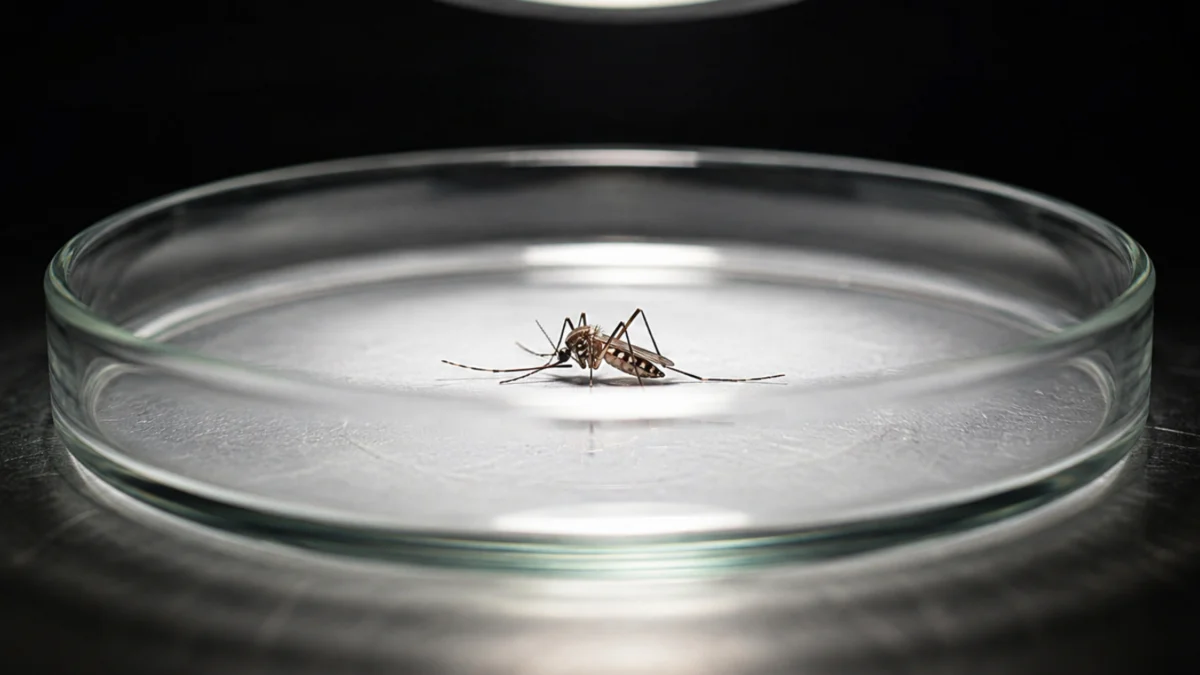
In the vast, chaotic ecosystem of TikTok, where trends rise and fall with the speed of a digital heartbeat, a new, unsettling sub-genre has emerged: the macabre scientific observation. At the center of this viral phenomenon is a creator operating under the moniker "Fatsocat." With a following exceeding 623,000 users and a staggering 28 million cumulative likes, Fatsocat has carved out a niche that is as fascinating as it is deeply disturbing. While his content initially focused on the general exploration of the insect world, he has recently pivoted to an obsessive, systematic campaign against mosquitoes—a crusade that has earned him the dubious title of the internet’s "mosquito serial killer."
Unlike the average person who reflexively swats at a buzzing mosquito, Fatsocat treats these insects as subjects in a grim, high-stakes laboratory. His videos, which frequently garner millions of views, document the capture, experimentation, and eventual "archiving" of these pests. By applying a methodical, almost clinical approach to his extermination efforts, Fatsocat has ignited a firestorm of debate across social media, drawing comparisons to the fictional television serial killer Dexter Morgan.
A Chronology of the Macabre: From Curiosity to Collection
The evolution of Fatsocat’s content reveals a descent from general entomological curiosity to a highly personalized and ritualistic practice.
The Early Stages: Scientific Inquiry
Initially, Fatsocat’s videos were characterized by standard macro-videography, showcasing the intricate mechanics of common household insects. These videos served as a gateway, drawing in viewers with the promise of seeing the "tiny world" in high definition. However, as the account grew, so did the creator’s ambition. The pivot to targeting mosquitoes appeared to be a response to the universal human disdain for the buzzing, blood-sucking parasite.
The Escalation of Experiments
The experiments quickly transcended simple pest control. Fatsocat began testing the limits of mosquito resilience, pitting them against various environmental stressors. He has subjected larvae to caustic substances like rat poison and the chemical cocktail found inside glow sticks. He has experimented with containment, trapping adult mosquitoes using mysterious, sticky substances, and has even engaged in "gladiatorial" matches, such as introducing a mosquito to an ant-mimicking spider to observe the outcome.
The Archive: The Notebook of the Departed
The most chilling aspect of the content, however, is the aftermath. Each subject, once its "experiment" concludes, is not simply discarded. Instead, Fatsocat meticulously adds them to a growing collection. He secures them with clear tape onto the pages of a notebook, labeling each entry with a date. This ritualized preservation is what truly unsettled the public, transforming the videos from "pest control" to something far more thematic and eerie.
Supporting Data: The Viral Mechanics of a Digital Phenomenon
The popularity of Fatsocat’s content is not merely accidental; it is driven by a combination of high-production value, suspenseful narration, and a uniquely morbid hook.
The "Syringe" Incident
One of the most widely shared videos—and perhaps the most visceral—depicts a mosquito that has just fed on the creator’s blood. Fatsocat captures the insect inside a syringe. He proceeds to vacuum out the air, creating a pressurized chamber, before filling the syringe with cigarette smoke. His narration remains calm and instructional: "The mosquito struggled a little. Feeling dizzy is perfectly normal at this point, and falling asleep is too." The video concludes with the subject being added to his notebook, a sequence that has served as a primary catalyst for the "Dexter" comparisons.
Documenting the "Days"
In another segment, Fatsocat tracks his progress over "three days," though the visible evidence in his notebook suggests a much longer timeline. He places a group of mosquitoes in a container with a burning mosquito coil, documenting their decline with the same monotone, scientific detachment. When he finally opens his notebook to reveal the pages—filled with dozens of preserved insects, dated from May 30 through June 24—it becomes clear that this is a long-term, curated project.
Reddit and the Social Media Explosion
The phenomenon eventually bled into the wider internet. On July 17, a compilation of his videos reached the front page of Reddit, accumulating over 31,000 upvotes and 2,600 comments in less than 24 hours. The discourse was a volatile mix of fascination, repulsion, and dark humor. While moderators eventually removed the post, the damage—or the interest—was already done. The viral spread highlighted a strange human fascination with the systematic destruction of things we find inherently repulsive.
The Public Response: A Study in Psychological Projection
The audience reaction to Fatsocat’s videos provides a fascinating case study in how the internet processes transgressive behavior.
The "Dexter" Comparison
The most frequent critique of the content is its stylistic resemblance to the ritualistic nature of serial killers. The use of a "trophy book," the clinical narration, and the calm demeanor in the face of death have led many users to draw parallels to the protagonist of Dexter.
The Moral Quandary
The reaction is polarized. One Reddit user noted, "It was the ‘quietly open my notebook’ part. Don’t want to do it too loud lest we wake up the newest entries." This sentiment captures the collective unease—the idea that the creator is treating these insects not as simple bugs, but as "entries" in a ledger of death.
Conversely, others have pointed out the inherent absurdity of empathizing with a creature that is medically considered one of the deadliest animals on Earth. "Never thought I would feel bad for mosquitoes but this did it," one commenter admitted. This creates a psychological tug-of-war: the viewer hates the mosquito, yet feels a creeping sense of wrongness regarding the creator’s behavior.
Implications: The Ethics of Online Content
The rise of Fatsocat is not an isolated event. It follows a growing trend of "extreme experimentation" videos, such as the widely documented attempts by YouTuber Rusty Cage to kill a persistent Lone Star tick. These videos raise critical questions about the nature of online content, the boundaries of animal cruelty, and the normalization of macabre behaviors for clicks.
The Evolution of "Shock" Media
Historically, shock media was loud, aggressive, and explicitly violent. Today’s iteration is quiet, methodical, and arguably more disturbing because of its composure. By presenting the destruction of life as a scientific pursuit, creators can bypass many of the traditional ethical hurdles associated with animal abuse.
The Question of Digital Ethics
While mosquitoes are not typically covered under animal cruelty laws, the presentation of their death as a trophy-collecting exercise touches on a philosophical nerve. Does the intent of the creator matter? Is there a difference between killing a pest for health reasons and killing it to curate a scrapbook of corpses?
The Future of the "Fatsocat" Model
As the digital landscape continues to favor high-engagement, "oddly satisfying" yet disturbing content, we can expect more creators to adopt the "serial killer" aesthetic to capture the attention of a desensitized audience. Fatsocat represents a shift toward a more narrative-driven, dark-humored approach to nature documentation.
Conclusion: A Window into the Human Psyche
Whether Fatsocat is a misunderstood hobbyist with an interest in entomology or a calculated performer crafting a persona for maximum engagement, his impact is undeniable. He has managed to turn the mundane act of pest control into a psychological thriller, proving that the internet’s appetite for the bizarre is as insatiable as it is unpredictable.
Ultimately, the "mosquito serial killer" is a mirror. The repulsion and fascination he triggers in his millions of viewers say less about the life of a mosquito and more about the human tendency to anthropomorphize death and find narrative order in the chaotic, often messy process of elimination. As long as the notebook continues to fill with entries, the internet will remain glued to the screen, watching, waiting, and wondering just how many pages are left to turn.