

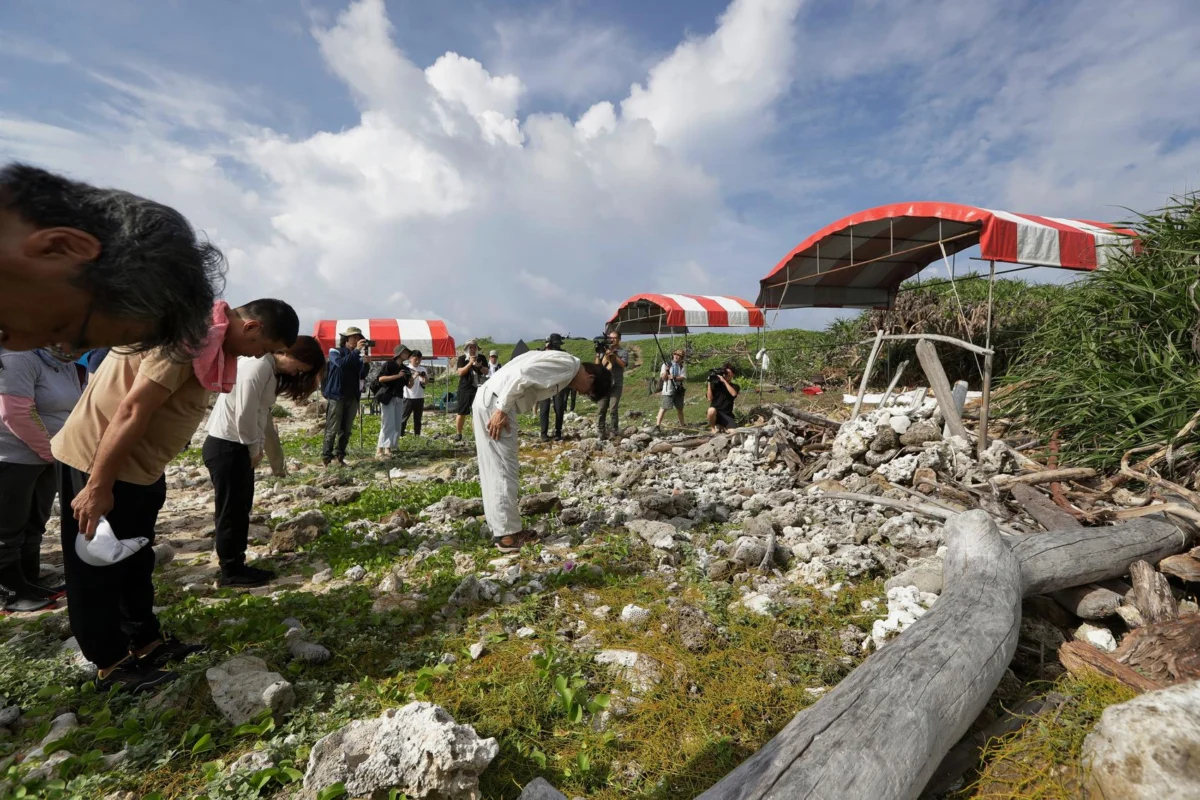
HENGCHUN, TAIWAN — Under a somber, grey sky in southern Taiwan, a small group of researchers and volunteers bowed their heads in silent prayer this past Monday. Before them lay the rugged, wind-swept coastline of Hengchun Township, a site that has remained largely undisturbed for eight decades. This was no ordinary excavation; it was a desperate, long-overdue mission to reclaim the remains of Japanese soldiers lost to the depths of the Bashi Channel during the final, desperate years of World War II.
As the excavation equipment moved into position near the discharge outlet of Taiwan’s Third Nuclear Power Plant, the atmosphere was thick with the weight of history. For the families of the fallen, this week-long operation represents a fragile flicker of hope—a chance to finally bring closure to a narrative that has been haunted by silence and uncertainty since 1944.
A Legacy of Conflict: The Bashi Channel Tragedy
The site of the excavation is inextricably linked to one of the most brutal chapters of the Pacific War. In 1944, as Allied forces tightened their grip on Japanese supply lines, the Bashi Channel—a vital maritime corridor between Taiwan and the Philippines—became a graveyard for military transport vessels.
According to historian and activist Kazuko Tachi, who has dedicated years to mapping the movements of these ill-fated ships, the tragedy at the Bashi Channel was catastrophic. "More than 4,700 soldiers and crew members perished when their ships were struck by U.S. forces," Tachi explains. "Of those aboard, only 65 survived to tell the tale."
The recovery team, led by the Japan Association for the Recovery and Repatriation of War Casualties, believes that the currents of the Bashi Channel eventually brought the remains of many of these victims ashore. "It is believed that many bodies from the sunken vessel reached this shore," said Tatsuaki Inoue, a representative for the association. "We feel very sorry that we kept them waiting for such a long time, but on the other hand, we are very happy that we are finally able to excavate in search of their remains."
Chronology of a Forgotten Front
To understand the urgency of this mission, one must look at the complex history of Taiwan during the 20th century. Taiwan, which remains a self-governing island today, was a Japanese colony from 1895 until the conclusion of World War II in 1945. Consequently, the island served as a critical staging ground for Japanese military operations in the Pacific.
- 1895–1945: Taiwan serves as a Japanese colony, integrating it into the imperial military framework.
- 1944: The peak of the Bashi Channel maritime disaster, resulting in thousands of deaths as U.S. forces target Japanese transport ships.
- 1975: The last major excavation in Taiwan, which resulted in the discovery of 242 sets of remains.
- 2016: Japan enacts a landmark law to accelerate the recovery of war remains, providing funding and legal frameworks for expanded DNA testing.
- 2024–2026: Renewed diplomatic and social efforts lead to the current excavation project in Hengchun.
For years, the location of these remains was a matter of oral tradition. Local residents in Hengchun, who remembered the aftermath of the war, shared stories of bodies washing ashore. It was through these community interviews and the painstaking collection of historical records that volunteers were finally able to narrow down the search area to a rocky coastal patch near the Third Nuclear Power Plant.
The Statistical Reality of Japan’s Lost Millions
The scale of the missing is staggering. Official Japanese records indicate that approximately 41,900 soldiers who fought for the Empire of Japan died on Taiwanese soil. While 26,300 bodies have been successfully recovered over the decades, 15,600 remain officially missing.
On a global scale, the numbers are even more harrowing. More than 2.4 million Japanese soldiers died overseas during World War II, and the remains of roughly 1 million of those individuals have yet to be recovered. This massive deficit has turned the search for remains into a perpetual, essential mission for the Japanese government and various non-profit organizations.
Beatrice Trefalt, an associate professor of Japanese studies at Monash University in Australia, notes that Japan’s wartime experience was uniquely defined by these maritime losses. "Because of the enormous amount of uncertainty about who died or not, or how, the search for remains has been a constant in postwar Japanese history," Trefalt explains. "Many families believe the government has a moral and political responsibility to acknowledge those who were conscripted and died during the conflict."
Official Responses and the Evolution of Policy
The Japanese government’s approach to these remains has shifted significantly over the last half-century. Initially, recovery efforts were sporadic, occurring largely between the 1950s and the 1970s. However, as the generation of survivors aged and the political landscape matured, public pressure grew for a more systematic, scientific approach.
Akira Nishimura, a professor of religious studies at the University of Tokyo, highlights the psychological impact on the bereaved. "For families who have not received the remains of their loved ones, the lack of certainty—the feeling that they were unable to give them a proper sendoff—is likely one of the main reasons why the recovery of remains continues even 80 years later," he says.
The 2016 legislation represents the most significant shift in policy, extending the search mission through 2030 and integrating advanced DNA testing. This scientific advancement is crucial; if remains are found at the Hengchun site, they will be meticulously processed and, if DNA can be successfully extracted and matched, returned to Japan for final burial.
Spiritual and Cultural Implications
The recovery mission is not merely a bureaucratic task; it is deeply spiritual. In Pingtung, the region surrounding the excavation site, there is a profound local awareness of the history of the Japanese dead.
Beside the Chaoyin Temple stands a monument dedicated to the spirits of the fallen. Inside the temple, a Japanese flag rests beside a statue of the Bodhisattva Ksitigarbha, a figure in Buddhist tradition revered for guiding and protecting the souls of the departed. The inscription on the monument—"We pray for the peace of all humanity in the world"—serves as a bridge between the trauma of the past and the necessity of reconciliation.
Kazuko Tachi, who moved to Taiwan and became immersed in this history after listening to the accounts of local elders, views her work as a form of sacred duty. "Those Taiwanese uncles taught me the importance of holding a memorial service for the war dead," she reflects. "It’s been more than 80 years since the war ended, but I believe it is important to pray for the war dead, which I will keep on doing."
The Path Forward
As the excavation teams work through the heat of the Taiwanese sun, they carry the weight of 15,600 missing souls. The challenges are significant: the harsh coastal environment, the degradation of physical remains over eight decades, and the complexities of international cooperation.
Yet, the persistence of these volunteers is a testament to the idea that a war is not truly over until the dead have been accounted for. The mission in Hengchun serves as a reminder that the scars of World War II are not just found in history books; they are found in the soil of distant shores and in the hearts of families who still wait for a sign.
Whether or not the current excavation yields remains, the effort itself has succeeded in bringing the history of the Bashi Channel out of the shadows. It is a process of memory-making, ensuring that those who perished in the chaos of 1944 are no longer just statistics in a ledger, but individuals whose stories—and remains—are worthy of being brought home.
In the coming week, the world will watch as the earth is turned, hoping that the quiet prayers offered at the start of this mission will finally find an answer. For the families, the wait continues, but for the first time in a very long time, that wait is accompanied by the sound of progress.











