Directed by: James Whale
Written by: Garrett Fort and Francis Edward Faragoh (based on the novel by Mary Shelley)
Starring: Colin Clive, Mae Clarke, John Boles, and Boris Karloff
Depending on the historian you consult, this year marks either the 130th or 131st anniversary of the "first horror film." While the designation remains a subject of intense academic debate, the ambiguity is born of a fundamental truth: the term "horror" was not a recognized genre classification until the 1920s. For decades, early cinematic experiments designed to unsettle were categorized under labels like "fantasy," "trick film," or "historical drama." Today, we look back at the jagged, shadow-drenched path that led from Edison’s Kinetoscope to the definitive monstrous triumph of James Whale’s 1931 masterpiece, Frankenstein.
The Genesis of the Macabre: From Trickery to Terror
The timeline of horror is not a straight line, but a series of accidental breakthroughs. The first contender for the throne is Thomas Edison’s 1895 production, The Execution of Mary, Queen of Scots. Spanning less than twenty seconds, this silent, static tableau was marketed as a "Chamber of Horrors" intended to be "blood-curdling." While it lacks a narrative, director Alfred Clark’s ingenious use of an editing "stop-trick"—cutting the film to swap an actress for a dummy—achieved a visual decapitation that shocked audiences of the Victorian era.
However, film historians generally favor narrative structure over mere spectacle. By that metric, Georges Méliès’s 1896 three-minute film, Le Manoir du diable (The House of the Devil), holds the crown. Originally intended as a playful demonstration of visual trickery, the film features a diabolical castle, bats, ghosts, and a woman who transforms into a hag. It is, by all accounts, the first cinematic attempt to translate Gothic literature’s dread into moving pictures.
As the medium matured, filmmakers began mining the rich vein of classic literature. William Selig’s 1908 adaptation of Robert Louis Stevenson’s Dr. Jekyll and Mr. Hyde marked the first of many celluloid explorations into the duality of the human soul. Though the original print is considered lost, it set a precedent for the "one-reel" adaptations of the era, followed by the Edison Company’s 1910 Frankenstein and various iterations of Edgar Allan Poe’s works, such as Alice Guy-Blaché’s 1913 The Pit and the Pendulum. By 1911, the Italian epic L’Inferno brought feature-length ambition to the genre, showcasing the visceral horrors of Dante’s vision with a level of scale previously unseen.
The German Expressionist Influence
The 1920s saw the horror genre find its aesthetic soul in German Expressionism. Films like Paul Wegener’s The Golem (1915) and Paul Leni’s Waxworks (1924) utilized distorted sets and high-contrast lighting to mirror the internal psyche of their characters. None, however, reached the cultural impact of F.W. Murnau’s Nosferatu (1922). An unauthorized adaptation of Bram Stoker’s Dracula, the film sparked a legal war with Florence Stoker, the author’s widow. Despite a court order to destroy all copies of the film, bootleg reels survived, preserving a foundational piece of cinema history that would forever influence the visual language of the monster movie.
The Universal Era and the Rise of the Star-Monster
The horror film as a "cultural ecosystem" required one missing ingredient: the movie star. In the early studio system, actors were typically typecast as heroes or ingenues. Horror, however, turned that model on its head by linking actors to their monstrous alter-egos.
The turning point was Lon Chaney. His desire to portray the sympathetic, deformed Quasimodo in 1923’s The Hunchback of Notre Dame proved that audiences were hungry for tragic, monstrous figures. Universal Studios, under the leadership of Carl Laemmle Sr., recognized the potential. Following the success of The Phantom of the Opera (1925), Universal was positioned to become the premier home of cinematic monsters.
When the industry shifted to "talkies," Universal faced a crisis of identity. Carl Laemmle Jr., the studio’s new head of production, sought to stabilize the company by pursuing an authorized adaptation of Dracula. Despite skepticism from his father, who viewed horror as a "niche" genre, the 1931 release of Dracula, starring Hungarian actor Bela Lugosi, was a massive financial success. The studio had found its goldmine.
Frankenstein: An Architectural Feat of Science and Shadow
Following the success of Dracula, Universal turned to Mary Shelley’s Frankenstein. The studio acquired the rights to a stage adaptation by John L. Balderston, who would become a key architect of the Universal monster canon.
The production process was fraught with shifts in creative vision. The original director, Robert Florey, envisioned a film heavily influenced by German Expressionism and initially pushed for Lugosi to play the creature. However, Lugosi famously declined the role, claiming he refused to play a "grunting, babbling idiot." Enter James Whale, a theater-trained visionary who took Florey’s expressionist concepts and elevated them into a work of art.
Whale’s focus was on high-contrast theatricality—the silhouettes of the graveyard, the drafty, vertical scale of the laboratory, and the iconic moment when the creature gazes at the sun. To populate this laboratory, Whale hired Kenneth Strickfaden, an electrical engineer who created the "mad scientist" aesthetic. Strickfaden’s sparking coils and humming generators became the definitive visual shorthand for science-gone-wrong, a standard that persists in cinema today.
The Making of an Icon: Boris Karloff
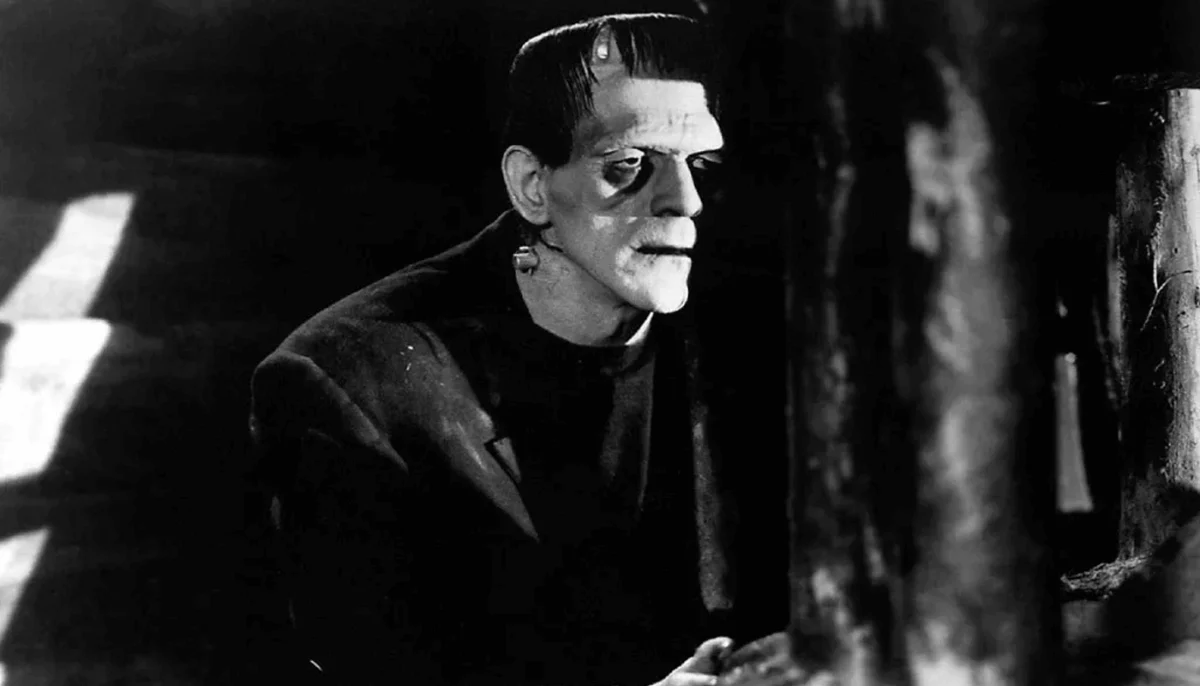
The casting of the creature was the most pivotal decision of the production. Boris Karloff, an established actor with over 80 films to his credit, was brought on not just for his resume, but for the striking structure of his face. Together, Whale and Karloff envisioned the monster not as a mindless killing machine, but as a naive, misunderstood child—a tragic figure rather than a traditional villain.
The physical transformation was a grueling ordeal. Makeup artist Jack Pierce spent hours each day applying cotton and collodion to create the creature’s high, square forehead. Karloff added putty to his eyelids and removed his dental bridge to create a sunken, death-like visage. Clad in a fifty-pound costume featuring steel leg struts and heavy asphalt-spreader boots, Karloff delivered a performance that was physically agonizing yet deeply poignant. His ability to convey both terror and profound sadness through his eyes transformed a pile of "stitched-together parts" into one of the most sympathetic figures in film history.
Censorship and the Legacy of the "Pre-Code" Era
Frankenstein was released during the "pre-Code" era, a brief window of creative freedom before the strict enforcement of the Hays Code in 1934. Yet, even in 1931, the film faced intense censorship. Scenes of religious blasphemy—specifically Henry Frankenstein’s declaration, "Now I know what it feels like to be God!"—and the tragic drowning of the child Maria were cut or edited in various markets.
For decades, the removal of the Maria scene fundamentally changed the character of the monster; without the sequence showing the creature’s accidental, non-malicious nature, he became a more straightforward villain. Fortunately, archival efforts in the late 20th century recovered the missing footage, allowing modern audiences to see the film as Whale intended.
The Institutional Response
Critical reception in 1931 was fascinated, if slightly unnerved. The New York Times described it as a "morbid, gruesome affair," while Variety praised the film’s "swift twists" between the macabre and the mundane, noting how the contrast intensified the eerie atmosphere. The industry realized that they had tapped into a primal nerve. The "horror" niche had proven to be a sustainable and profitable market.
Today, we view Frankenstein through the lens of nearly a century of cinematic evolution. We have seen the creature parodied, deconstructed, and reimagined, yet the 1931 original retains its power. It stands as a testament to a moment when the lights went down, the shadows grew long, and cinema learned how to truly frighten the world. As we look back, the legacy of James Whale’s work is not merely in the scares it provided, but in the humanity it found within the monster.