

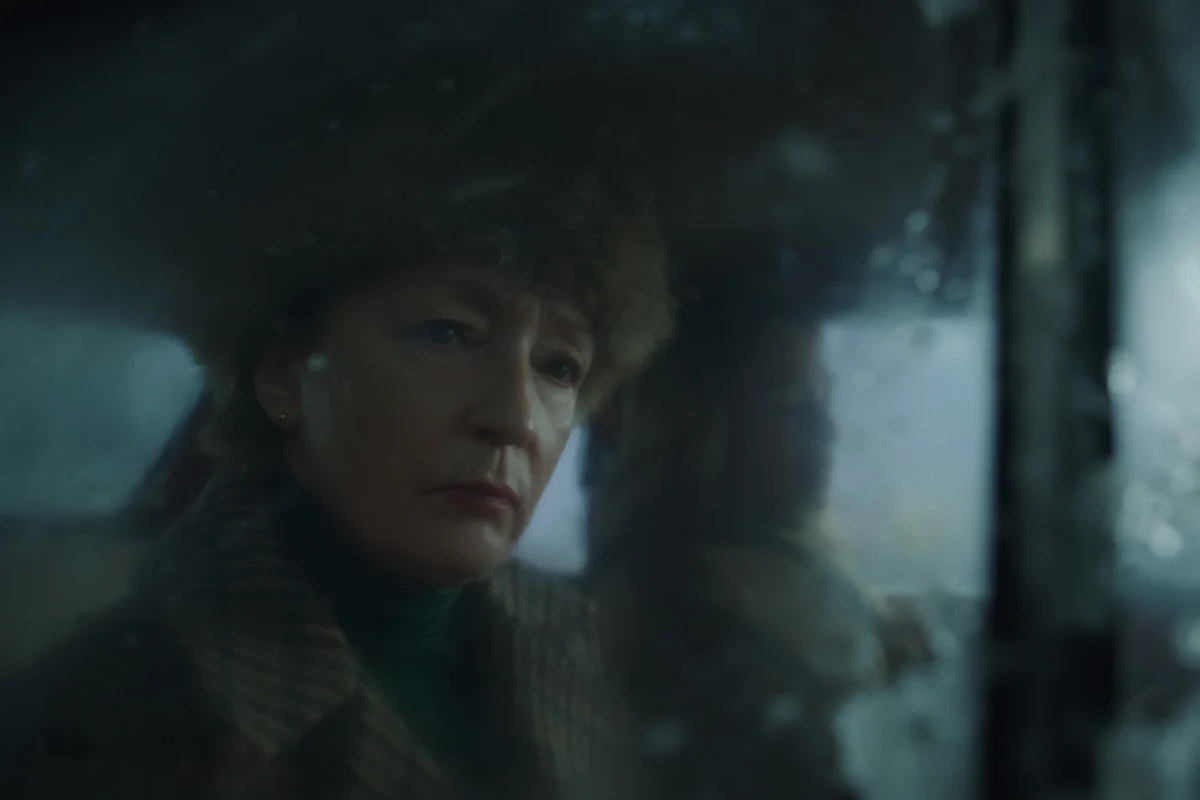
In the chilling, snow-swept streets of 1981 Warsaw, a routine academic lecture tour transforms into a high-stakes survival nightmare. Cohen Media Group has officially unveiled the trailer for Winter of the Crow, a tense, atmospheric Cold War thriller directed by the visionary Kasia Adamik. Anchored by a powerhouse performance from Academy Award nominee and Tony Award-winning actress Lesley Manville, the film promises to be one of the most compelling historical dramas of the year.
Set against the sudden, brutal imposition of martial law in Poland, the film follows a British academic who finds herself trapped behind the Iron Curtain, forced to navigate a landscape of political repression, paranoia, and state-sponsored violence. With a nationwide theatrical release slated for October 9, the film serves as both a gripping, pulse-pounding thriller and a haunting reflection on the fragility of personal freedom in the face of totalitarianism.
The Plot: A Scholar’s Descent into Darkness
Winter of the Crow is inspired by the acclaimed short story "Professor Andrews Goes to Warsaw" by Nobel Prize-winning author Olga Tokarczuk. The narrative centers on Joan Andrews (Manville), a distinguished British psychiatry professor who arrives in the Polish capital in December 1981, expecting a standard series of guest lectures at a local university.
However, the political climate of the era is volatile. Almost overnight, the Polish government declares martial law. Borders are sealed, communications are cut, and the city is plunged into a state of total lockdown. For Joan, the intellectual stimulation of Warsaw is replaced by the suffocating reality of a nation under siege. Her transformation from a detached observer to a hunted fugitive begins when she happens upon a brutal murder committed by the secret police. Armed only with a Polaroid camera—a relic that serves as both her only link to reality and her greatest liability—Joan finds herself in the crosshairs of an authoritarian regime determined to erase the evidence of its crimes.
As the city descends into a winter of fear, Joan is forced to abandon her academic persona and survive in the shadows, navigating a labyrinthine urban landscape where every stranger is a potential informant and every corner hides a threat.
Chronology of Production and Development
The journey of Winter of the Crow from page to screen has been a meticulous process of historical reconstruction and artistic collaboration.
The Source Material
The project originated from the desire to adapt Tokarczuk’s evocative prose, which captures the surreal, disorienting experience of being trapped in a country that has effectively ceased to function as a civil society. The screenwriters worked closely with the thematic core of the story, emphasizing the "Kafkaesque" nature of Joan’s ordeal.
Principal Photography and Financing
The production was a significant international effort, reflecting the global impact of the Cold War narrative. The film was co-financed by a coalition of European and international entities, including:
- The Polish Film Institute
- Film Fund Luxembourg
- UK Global Screen Fund
- Silesia Film
Executive produced by the legendary filmmaker Agnieszka Holland—a figure synonymous with Polish political cinema—the production team was led by producers Olga Chajdas, Stanisław Dziedzic, Katarzyna Ozga, Nicolas Steil, and Samantha Taylor. The team focused on achieving an authentic visual aesthetic, utilizing the stark, brutalist architecture of Warsaw to mirror the internal psychological state of the protagonist.
Supporting Data: A Cast of Exceptional Caliber
While Lesley Manville carries the weight of the film on her shoulders, she is supported by a stellar ensemble cast that brings the dangerous social strata of 1981 Poland to life.
- Lesley Manville (Joan Andrews): Coming off a triumphant Tony Award win for her performance in the revival of Oedipus, Manville brings a seasoned, raw determination to the role. Variety’s review of the film noted, "Manville carries the film with an air of increasingly raw determination," highlighting her ability to convey the transition from academic composure to primal survival instinct.
- Tom Burke: Known for his roles in Furiosa: A Mad Max Saga and The Souvenir, Burke brings his signature intensity to the supporting cast.
- Andrzej Konopka: A veteran of Polish cinema (The Lure, Nina), Konopka adds a layer of local authenticity to the film’s depiction of the security apparatus.
- Zofia Wichłacz: Recognized for her role in the international hit World on Fire, Wichłacz rounds out the ensemble, grounding the story in the perspective of those living under the constant threat of the regime.
- Sascha Ley: A versatile performer known for We’ll Find Happiness, Ley contributes to the film’s international scope.
Official Responses and Creative Vision
The transition of this story to the big screen is a moment of pride for both the studio and the director.
"Anchored by a remarkable performance from Lesley Manville, Kasia Adamik has created a film that is both a gripping thriller and a deeply human story," said Robert Aaronson, executive vice president of Cohen Media Group. "The screenplay truly captures the uncertainty and tension of this pivotal moment in history. We’re very proud to bring it to theaters this October."
Director Kasia Adamik expressed that the film is a deeply personal project. "I wanted to capture the fear and uncertainty of a moment when everyday life could change in an instant," Adamik explained in a recent press statement. "Lesley Manville brings such intelligence, strength, and humanity to Joan, and I’m thrilled that audiences will have the opportunity to experience her extraordinary performance—and this story—on the big screen."
The film’s reliance on the perspective of an outsider—a British academic—allows the audience to feel the same disorientation that the Polish people faced during the 1981 crackdowns, making the political horror personal and immediate.
Implications: The Enduring Relevance of the Cold War
The release of Winter of the Crow arrives at a time when historical narratives regarding authoritarianism and the erosion of democracy are resonating with global audiences. By focusing on the 1981 imposition of martial law, the film explores the fragility of the "everyday." It serves as a reminder that the institutions we rely on can be dismantled overnight, and that truth—much like Joan’s Polaroid photographs—is often the first casualty of political repression.
Beyond its function as a thriller, the film serves as a testament to the resilience of the human spirit. Joan Andrews is not an action hero; she is a middle-aged academic thrust into a situation she is woefully unprepared for. Her survival is not predicated on combat skills, but on her ability to observe, adapt, and hold onto her humanity in a world that is desperately trying to strip it away.
Cultural Significance
With the backing of the Polish Film Institute and the involvement of luminaries like Agnieszka Holland, Winter of the Crow is positioned to be a major contribution to the cinematic history of the Eastern Bloc. It avoids the tropes of "spy thriller" cinema, opting instead for a grounded, claustrophobic experience that feels more like a descent into a nightmare than a traditional espionage flick.
As the October 9 release date approaches, anticipation is building for a film that promises to challenge viewers intellectually while keeping them on the edge of their seats. With its blend of high-stakes tension, historical significance, and a career-defining performance from Manville, Winter of the Crow is poised to be a standout title in the autumn theatrical slate.
For those interested in the intersection of history, human rights, and the art of the thriller, the trailer—now available for viewing—offers a haunting glimpse into a winter that changed a nation forever. As the snow falls in Warsaw, the clock is ticking for Joan Andrews, and for the audience, the experience of watching her story unfold is one that will linger long after the final credits roll.










