

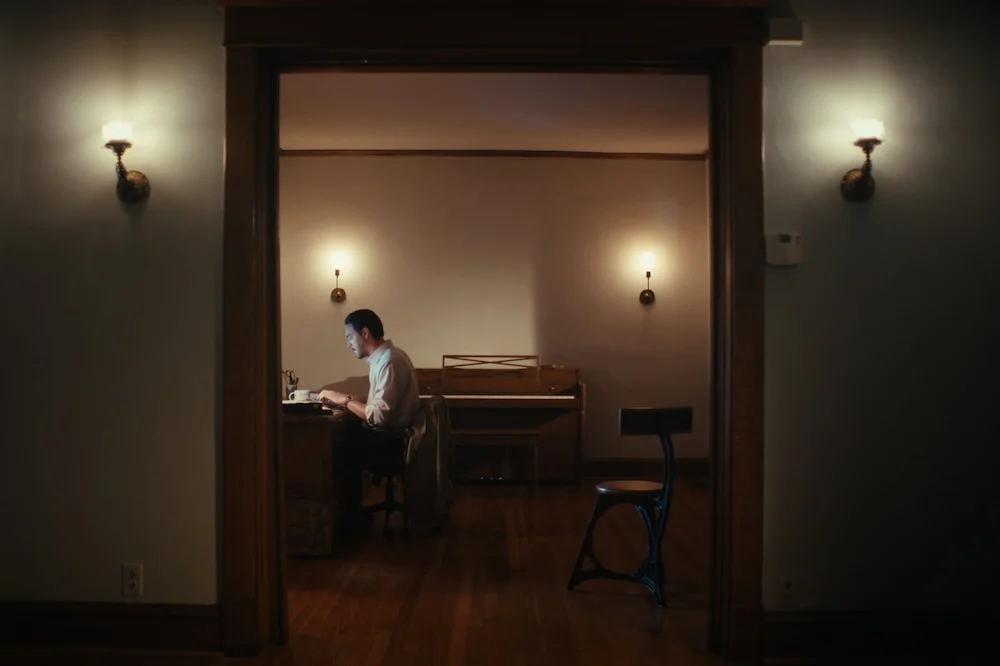
In the landscape of contemporary American cinema, few filmmakers occupy a position as singular—or as polarizing—as Paul Schrader. A master of the "Man in a Room" aesthetic, Schrader has spent the latter half of his career dissecting the anatomy of transgression. With his latest feature, The Basics of Philosophy, he returns to his well-worn thematic terrain: the agonizing, often intellectualized labor of a sinner seeking redemption for a past that refuses to stay buried.
Schrader’s latest project is not a departure, but a deepening. It asks a question that sits at the very edge of the moral abyss: Is it possible for a man to "have been" a predator, or does the stain of such a transgression fundamentally alter the soul in a way that renders true redemption an impossibility?
The Anatomy of a Sinner: Plot and Chronology
The narrative of The Basics of Philosophy centers on Professor John Jorrisen (Jack Huston), a man who seems to have constructed a life of rigid intellectual order. By day, he teaches philosophy at an idyllic, leafy college; by night, he retreats into the cerebral comfort of his research on the rationalist philosopher Baruch Spinoza. His life is further anchored by a relationship with his colleague, Becca (Sofia Boutella), a psychology professor whose young son provides a semblance of domestic stability for John.
The chronology of John’s life, however, is haunted by a singular, catastrophic fracture. The film’s pacing is deliberate, oscillating between John’s sterile present and the jagged, high-contrast black-and-white flashbacks that define his past. Years prior, while serving as a piano tutor, John sexually abused his 14-year-old student, Miguel Vasque.
Following the incident, John’s father, Melvyn (Bill Pullman)—a wealthy, cold captain of industry—orchestrated a lifetime of financial and emotional reparations for the Vasque family. This act served a dual purpose: it was an attempt at atonement, but also a calculated effort to insulate the family name from the fallout of John’s depravity. The film begins with Melvyn’s funeral, a somber affair where the veneer of John’s carefully cultivated life begins to crack. It is here that John encounters the adult Miguel (Daniel Zovatto), now a successful realtor. This meeting serves as the catalyst for the film’s increasingly erratic and knotty narrative trajectory.
The Aesthetic of Asceticism: Supporting Data and Craft
While Schrader has often been criticized for an "unadorned" or "bland" visual style, The Basics of Philosophy benefits from a notable evolution in craft. The collaboration with cinematographer Sean Price Williams brings a heightened visual texture to the proceedings, moving away from the purely functional towards something more evocative.
The film’s atmosphere is further solidified by Eli Kezsler’s score. A restless, haunted collection of compositions, the music acts as a sonic manifestation of John’s internal rot. It is a vital component of the film’s success, as it provides the emotional scaffolding for scenes that might otherwise feel overly didactic.
Jack Huston’s performance is the cornerstone of the film. He portrays John with a calculated intensity, utilizing a cultured, too-smooth vocal delivery that suggests a man constantly monitoring his own performance of humanity. There is a palpable sense that John is "off"—a quality that Huston inhabits with a chilling, yet compelling, precision.
Intellectual Rigor vs. Theatrical Didacticism
Schrader’s work has always existed on a divide: to some, his films are profound meditations on human frailty; to others, they are pretentious exercises in self-seriousness. The opening scenes of The Basics of Philosophy—which feature John standing before a blackboard, lecturing his students on the very title of the film—represent this divide in microcosm.
Whether one finds this approach "damningly clumsy" or "daringly straightforward" depends entirely on one’s tolerance for Schrader’s brand of intellectualism. Throughout the film, characters engage in dialogue that feels less like human conversation and more like a Socratic debate regarding the nature of guilt.
In a bizarre, almost surreal sequence, John wanders through a park, engaging in a dialogue with a figure dressed as Spinoza (Karl Glusman). This interlude, which stands as the film’s only genuine attempt at levity, highlights the idiosyncratic nature of Schrader’s storytelling. The director is less interested in psychological realism and more concerned with the philosophical "event-horizon" of his characters. He does not ask, "How would a man in this situation act?" but rather, "How does this man’s transgression interact with the philosophical frameworks he uses to hide from himself?"
Implications: The Contradiction of Change
The core of The Basics of Philosophy lies in the interplay between John’s self-delusions and his actions. He believes his past crime was a singular aberration; he believes he is not defined by his attraction to the vulnerable; he believes he is, ultimately, a good man who made a bad mistake.
However, as the narrative unfolds, Schrader systematically destabilizes these beliefs. The film forces the audience to confront the uncomfortable reality that John’s intellectualism is not a path to redemption, but a sophisticated defense mechanism.
The Schrader Paradox
There is a distinct tension between the content of the film and the public persona of its director. Paul Schrader has often been a figure of intense controversy, known for his volatile social media presence and his outspoken, sometimes indefensible, views. Yet, within the confines of his films, he exhibits a profound, vulnerable, and sincere curiosity regarding morality.
The Basics of Philosophy asks whether a man can truly be "cured" of his darkest impulses. The conclusion the film reaches is deeply unsettling. While it acknowledges the theoretical possibility of change, it emphasizes the haunting, ever-present reality that a person can just as easily "change back."
Conclusion: A Mirror for the Audience
Ultimately, The Basics of Philosophy is not a film that seeks to comfort. It is a grueling, often uneven, but undeniably powerful examination of the persistence of the past. By placing a predator at the center of his lens, Schrader is not asking for sympathy; he is asking for an engagement with the most difficult questions of human nature.
Is redemption a destination, or is it a process that must be renewed every single day? For John Jorrisen, and perhaps for Schrader himself, the answer is elusive. As the final frame fades, we are left with the lingering suspicion that some stains are permanent, and that the "basics of philosophy" are, in the end, insufficient tools for repairing a soul that has long since crossed the event-horizon. Whether one finds the film a masterpiece or a muddle, it is impossible to walk away without having been confronted by the uncomfortable, messy, and deeply human struggle to reconcile who we were with who we wish to be.










