

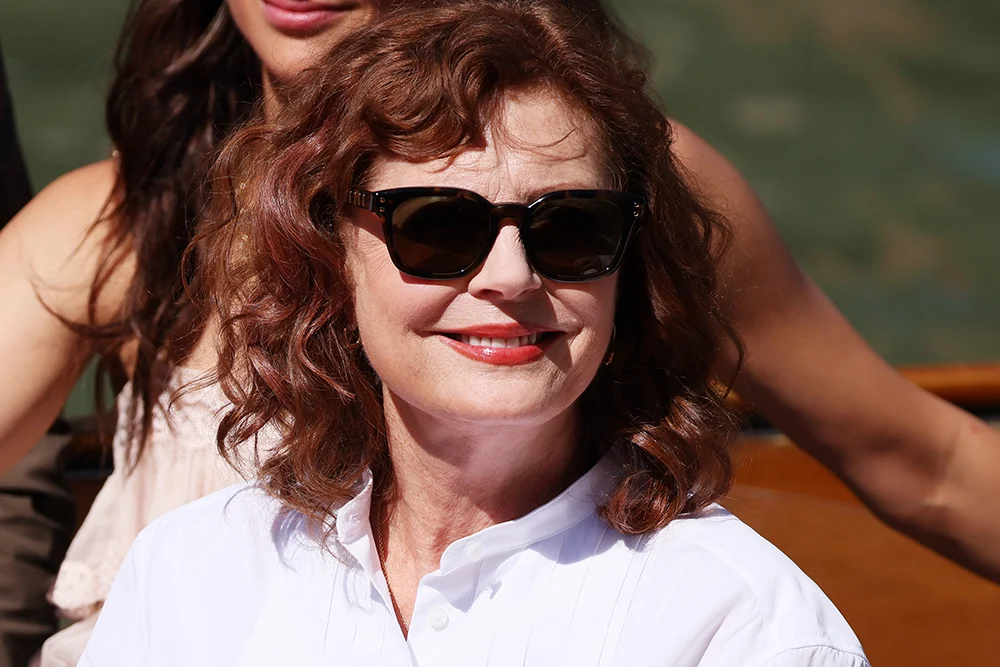
At the 81st Venice Film Festival, the intersection of art and political activism took center stage as Academy Award-winning actress Susan Sarandon addressed the ongoing professional fallout from her vocal support for Palestine. During a press conference for her latest film, The Echo Chamber, Sarandon candidly revealed that she continues to face industry repercussions, claiming that agencies have actively lobbied to prevent her from securing roles in the wake of the October 7th conflict in Gaza.
Her remarks underscore a deepening divide within the entertainment industry, where the tension between creative freedom, political expression, and the entrenched power structures of Hollywood remains a flashpoint for debate.
The Venice Disclosure: A Stark Assessment of Industry Climate
On Sunday, while promoting the romantic drama The Echo Chamber—a project directed by Andrea Pallaoro and based on the final screenplay of the late Bernardo Bertolucci—Sarandon was asked whether she perceived a shift in the Hollywood narrative regarding the conflict in Gaza.
Her response was both measured and damning. “I’ve still had movies taken away recently because there are agencies that are telling people not to hire me still,” Sarandon stated. Despite the alleged blacklisting, she maintained a defiant tone, noting, “That’s the power structure. I think within the people, certainly internationally, I feel welcome.”
Sarandon highlighted that her casting in The Echo Chamber was not without its own friction. She revealed that director Andrea Pallaoro had been pressured to exclude her from the production, a directive he ultimately defied. “I thank Andrea for that, because he doesn’t listen to the warnings,” she said.
A Chronology of Controversy: From Rally to Reprisal
To understand the current professional isolation Sarandon describes, one must trace the timeline of her activism and the subsequent industry response.
2023: The Turning Point
The catalyst for the current situation was Sarandon’s appearance at a pro-Palestinian rally in New York City in late 2023. During her speech, the actress made comments that drew immediate, widespread condemnation from various pro-Israel advocacy groups and segments of the media.
The UTA Severance
Within days of the rally, the United Talent Agency (UTA), which had represented Sarandon for years, took the rare and public step of dropping her as a client. The move served as a signal to the industry that certain forms of political speech, particularly regarding the Israeli-Palestinian conflict, carried significant professional consequences.
The "Shunned" Narrative
Earlier this year, Sarandon publicly stated that she felt effectively "shunned" by major studios. Her comments at the Venice Film Festival serve as an update to this ongoing saga, confirming that the professional friction has not abated, despite the passage of time. Her claim that "movies have been taken away" suggests a sustained, behind-the-scenes effort by industry gatekeepers to minimize her presence in mainstream cinema.
Historical Context and Political Realities
Sarandon’s critique extends beyond her personal plight; she argues that the public’s understanding of the conflict is undergoing a seismic shift, even if the upper echelons of Hollywood remain rigid.
“I think that the narrative has completely changed in terms of historical relevance of Palestine and the ties of Zionists with America and our politics; that has been a major revelation for people,” Sarandon told the press. She emphasized the financial aspect of the relationship, noting that the sheer scale of U.S. financial aid to Israel is a subject that is only now being fully grasped by the broader American public.
This perspective is central to Sarandon’s advocacy. She posits that while the industry’s leadership may hold firm in its political stance, the ground beneath them is shifting as the public increasingly questions the status quo of international relations and domestic lobbying.
The Power Structure: Zionism and Industry Gatekeeping
A critical component of Sarandon’s statement at Venice was her direct reference to the "power structure" within Hollywood. She explicitly identified a perceived ideological blockade.
“There has been a change in terms of the general public, but there are still positions in my industry that are held by Zionists who have not relaxed their feelings towards me,” she asserted. This framing suggests that Sarandon views her professional challenges not as a result of a generic "cancellation" culture, but as a specific, targeted response to her critique of a particular political ideology.
For industry observers, this raises uncomfortable questions regarding the limits of free speech in Hollywood. Historically, the industry has prided itself on being a bastion of progressive thought and dissent. However, the events surrounding the Gaza conflict have revealed that this tolerance has clear, often unspoken, boundaries. When an A-list talent of Sarandon’s stature—who has built a career on political outspokenness—is sidelined, it sends a chilling effect throughout the artistic community.
Supporting Data: The Impact of Celebrity Activism
The case of Susan Sarandon is part of a larger trend of celebrity activists facing professional repercussions. Since the onset of the conflict in Gaza, numerous actors, writers, and directors have found their career trajectories impacted by their political stances.
- Public Sentiment vs. Studio Policy: While social media trends and global protests indicate a high level of engagement with the Palestinian cause, major talent agencies and studios have largely maintained a policy of risk aversion.
- The "Neutrality" Mandate: Many industry insiders report that agents are advising clients to remain silent or neutral on volatile international conflicts to avoid damaging their "brand" or their relationships with financiers.
- The Cost of Advocacy: Data from industry trade publications indicates a decline in the number of high-profile actors engaging in political advocacy outside of traditional "safe" social causes, a direct correlation to the high-stakes environment created by the potential for blacklisting.
Official Responses and Industry Silence
As of the date of this report, the major talent agencies that Sarandon alluded to have not issued specific responses regarding her claims of "warnings" against hiring her. The silence from agency heads is reflective of the broader industry culture, which often avoids public confrontation with talent on political matters, preferring to handle such disputes through quiet non-renewal of contracts or the "freezing out" of project opportunities.
The Venice Film Festival organizers have maintained a position of neutrality, emphasizing that the festival is a platform for artistic expression and open dialogue. By providing the stage for the press conference for The Echo Chamber, the festival indirectly supported the right of its participants to discuss the sociopolitical contexts of their lives and work.
Implications for the Future of Hollywood
The implications of Sarandon’s claims are significant. If, as she suggests, there is a coordinated effort to suppress the voices of artists based on their geopolitical critiques, it suggests a narrowing of the ideological spectrum in mainstream film.
The Erosion of Creative Diversity
If artists feel compelled to self-censor to maintain their livelihoods, the nuance and diversity of perspectives in storytelling may suffer. When controversial, high-profile figures are pushed to the fringes, it limits the industry’s ability to engage with complex, difficult, and urgent global issues.
The Rise of Independent Media
Sarandon’s statement—"I found my family, I found my people and I’m OK"—points to a potential migration of talent away from the traditional "major studio" model. As artists find themselves at odds with the "power structure" of traditional Hollywood, they may increasingly turn to independent productions, international film markets (such as those in Italy or Belgium), or digital platforms that operate outside the influence of the major talent agencies.
The Test of Public Loyalty
Ultimately, Sarandon’s experience acts as a litmus test for the power of the celebrity. Can an icon of cinema survive a concerted attempt to exile her from the industry? If her career continues to flourish through international partnerships and independent films, it may provide a roadmap for other activists who find themselves at odds with the Hollywood establishment.
Conclusion
Susan Sarandon’s appearance at the Venice Film Festival was more than a routine press junket; it was a defiant declaration of independence. By speaking openly about the mechanisms of her industry-imposed isolation, she has forced a conversation that Hollywood has largely tried to keep behind closed doors.
Whether one agrees with her politics or not, her experience highlights a critical tension in the 21st-century entertainment industry: the struggle between the global reach of the artist’s voice and the concentrated power of the institutions that distribute it. As The Echo Chamber prepares for its release, the film will be viewed through the prism of its star’s controversy—a fitting outcome for a project that, by the director’s own admission, was made in defiance of the industry status quo.
The industry remains at a crossroads. As Sarandon noted, the public is changing, and the "power structure" may soon find that its ability to enforce silence is no longer as absolute as it once was. For now, the actress remains in the eye of the storm, seemingly unfazed by the professional exile that has become the hallmark of her recent career.










