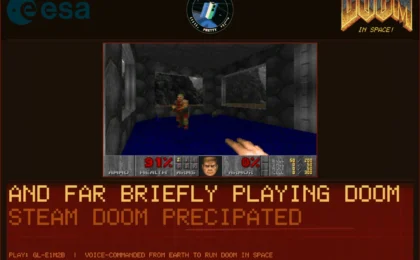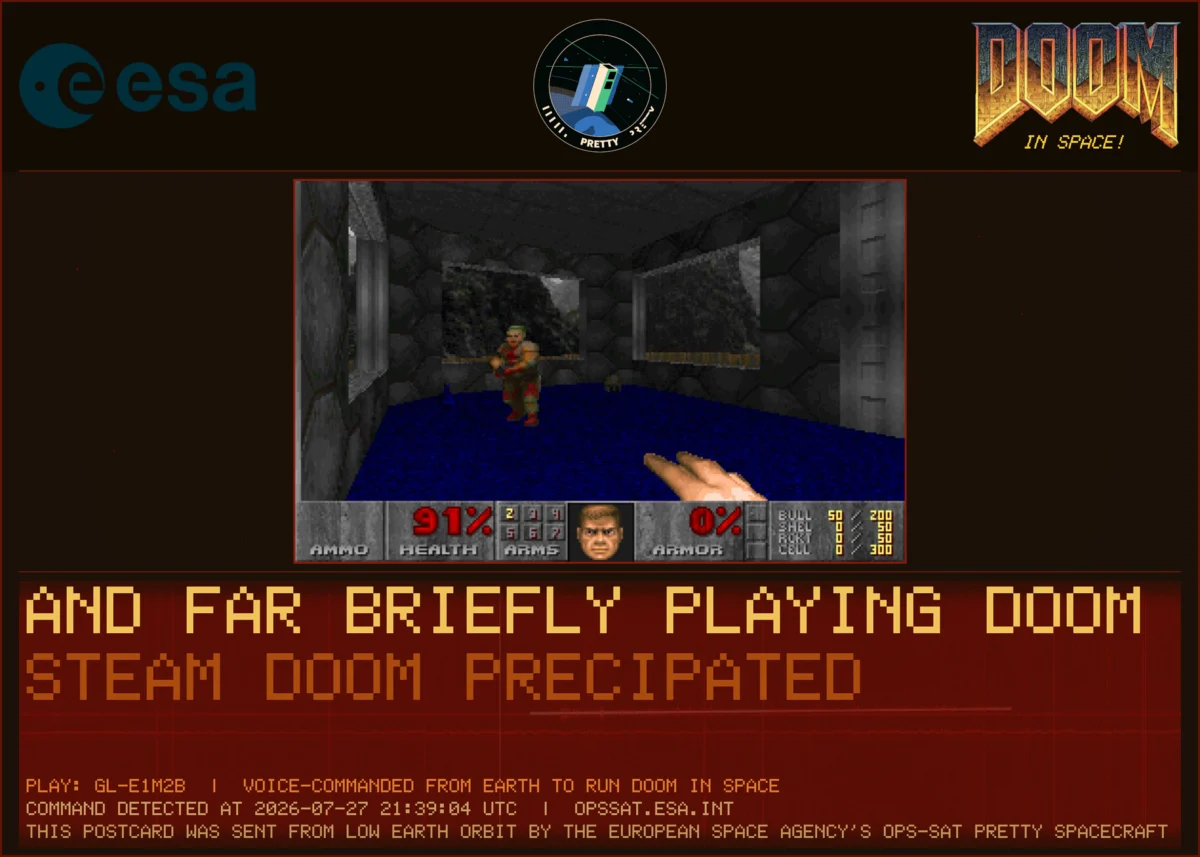
In a feat that merges the nostalgia of 1990s PC gaming with the cutting-edge reality of modern orbital mechanics, a team of Oslo-based radio amateurs, in collaboration with the space-tech firm Tanagra Space, has successfully achieved a milestone in telecommunications history. They managed to transmit a voice command from Earth to a European Space Agency (ESA) satellite, triggering the execution of the iconic 1993 first-person shooter, Doom.
The experiment, dubbed "PRETTY DOOMed," was conducted using the OPS-SAT PRETTY satellite—a small, highly capable platform operating under the ESA’s OPS-SAT Space Lab program. While Doom has famously been ported to everything from smart appliances to ATM machines, this particular iteration marks the first time the game has been initiated via a radio-frequency voice command sent across the vacuum of space.
The Main Facts: A New Frontier for Remote Computing
The successful execution occurred in late July, following a rigorous campaign of trial and error. The team utilized the 23 cm radio band—a common frequency for amateur radio satellite communication—to relay their instructions. The satellite, equipped with an onboard speech-to-text model, was tasked with recognizing the specific verbal trigger: "Doom."
Once the voice command was captured and processed, the satellite’s onboard computer, utilizing a 27 MB speech recognition model, transcribed the audio. A specialized matcher then verified the intent, allowing the system to bypass standard protocols and initiate the game. The satellite subsequently confirmed the successful launch by transmitting a "postcard"—a data packet containing details of the game’s initialization—back to the ground stations.
This accomplishment is more than a mere publicity stunt. It serves as a proof-of-concept for the viability of remote, voice-activated command systems in orbital environments, suggesting that as satellite hardware becomes more sophisticated, our methods of interaction with these machines will move toward more intuitive, human-centric interfaces.
Chronology: The Road to "PRETTY DOOMed"
The project was not a simple "plug and play" operation. It was a methodical, multi-week endeavor that tested the limits of both the hardware and the transmission environment.
The Planning Phase (Early Summer)
The collaboration between the Oslo radio amateur group and Tanagra Space began with the goal of testing the OPS-SAT PRETTY’s onboard processing capabilities. The satellite, designed specifically for testing new flight software and experimental payloads, provided the perfect sandbox. The team spent weeks optimizing the voice model to ensure that it could filter out the significant signal noise inherent in amateur band transmissions.
The Transmission Attempts (Late July)
The team documented seven distinct attempts to trigger the software. The early trials were plagued by atmospheric interference and signal attenuation, common obstacles in amateur radio satellite communication.
- Attempts 1–3: Initial attempts failed to trigger the speech recognition model due to the high noise floor in the 23 cm band.
- Attempts 4–5: Refinements were made to the transmission power and the cadence of the voice command. While the satellite detected the signal, it failed to parse the specific trigger word.
- The Breakthrough (Attempts 6–7): On the final day of the testing window in late July, the team, working in tandem with a support group in Poland, adjusted the modulation and timing. On the sixth attempt, the satellite’s system acknowledged the command, and by the seventh, the game was officially running.
Supporting Data: Technical Constraints and Capabilities
The success of "PRETTY DOOMed" relied on several layers of complex infrastructure.
The 23 cm Band
The 23 cm band (1240–1300 MHz) is a portion of the microwave spectrum allocated to amateur radio. Because this band is susceptible to interference from GPS signals and terrestrial traffic, maintaining a clear signal path to an orbiting satellite requires precise tracking and high-gain antennas. The collaboration between the Oslo and Polish groups allowed for redundant monitoring, ensuring that the voice command was transmitted during the satellite’s optimal "pass" window.
Onboard Processing
The satellite utilizes a robust processing environment capable of handling complex software experiments. The 27 MB speech recognition model is a lightweight but effective tool for processing audio data in orbit. The "matcher" system, a crucial piece of middleware, acted as the bridge between the transcribed text and the executable file for Doom.
Comparing with OPS-SAT-1
It is important to distinguish this event from the 2023 experiment on the OPS-SAT-1 satellite. While that earlier effort proved that Doom could run on a satellite, the execution was initiated through traditional data-uplink methods—essentially sending a command script as a file. By contrast, the "PRETTY DOOMed" experiment relied on a live, spoken voice command, which introduces a layer of latency-sensitive complexity regarding how the system handles real-time audio streams versus static data packets.
Official Responses and Collaborative Spirit
The European Space Agency’s OPS-SAT Space Lab program is specifically intended to foster this type of "high-risk, high-reward" experimentation. By opening their satellite hardware to outside researchers, ESA encourages a level of innovation that would be impossible within the rigid confines of standard mission planning.
"The success of this experiment demonstrates the incredible agility of the OPS-SAT architecture," a spokesperson for the experiment noted. "By allowing community-driven projects, we are able to push the boundaries of what these platforms can do. Using voice commands to trigger complex software is a leap forward in user-interface research for space operations."
The amateur radio community has also lauded the project. For many, this represents a modern "golden age" of hobbyist radio, where individuals can participate in orbital missions that once required the budget of a sovereign nation. The collaboration between Oslo and Poland highlights the international nature of the amateur radio community and the power of distributed ground stations.
Implications: The Future of Orbital Interaction
The implications of running Doom via voice command in orbit extend far beyond the gaming community.
Human-Machine Interaction in Space
As humanity moves toward long-term space habitation, the ability to control hardware through natural language will become essential. Astronauts performing complex tasks—whether in a lunar base or a deep-space habitat—will need to interface with equipment without being tied to a physical keyboard or console. Experiments like "PRETTY DOOMed" provide a testbed for developing robust voice-recognition algorithms that can operate in harsh, noisy environments.
Edge Computing in Orbit
The project showcases the power of edge computing. Instead of relying on a constant, high-bandwidth connection to Earth to interpret commands, the satellite processed the speech locally. This demonstrates that future satellites can be "smarter," capable of making decisions and executing tasks in real-time without waiting for confirmation from ground control.
Democratization of Space
Perhaps most importantly, the project confirms that the barrier to entry for space exploration is shifting. When independent groups can interact with multi-million dollar orbital assets, the potential for innovation skyrockets. It invites a new generation of coders, engineers, and radio enthusiasts to engage with space technology, fostering a culture of experimentation that will undoubtedly lead to more practical applications in the future.
Conclusion
"PRETTY DOOMed" is a playful name for a serious technological milestone. By bridging the gap between retro gaming and advanced orbital communication, the Oslo and Polish teams have proven that the future of space technology will be shaped by those who aren’t afraid to push the limits—and perhaps, have a little fun while doing it. As we look toward the next generation of satellite missions, we can expect to see more intuitive, voice-activated, and decentralized control systems, all built upon the lessons learned from this unique experiment.