

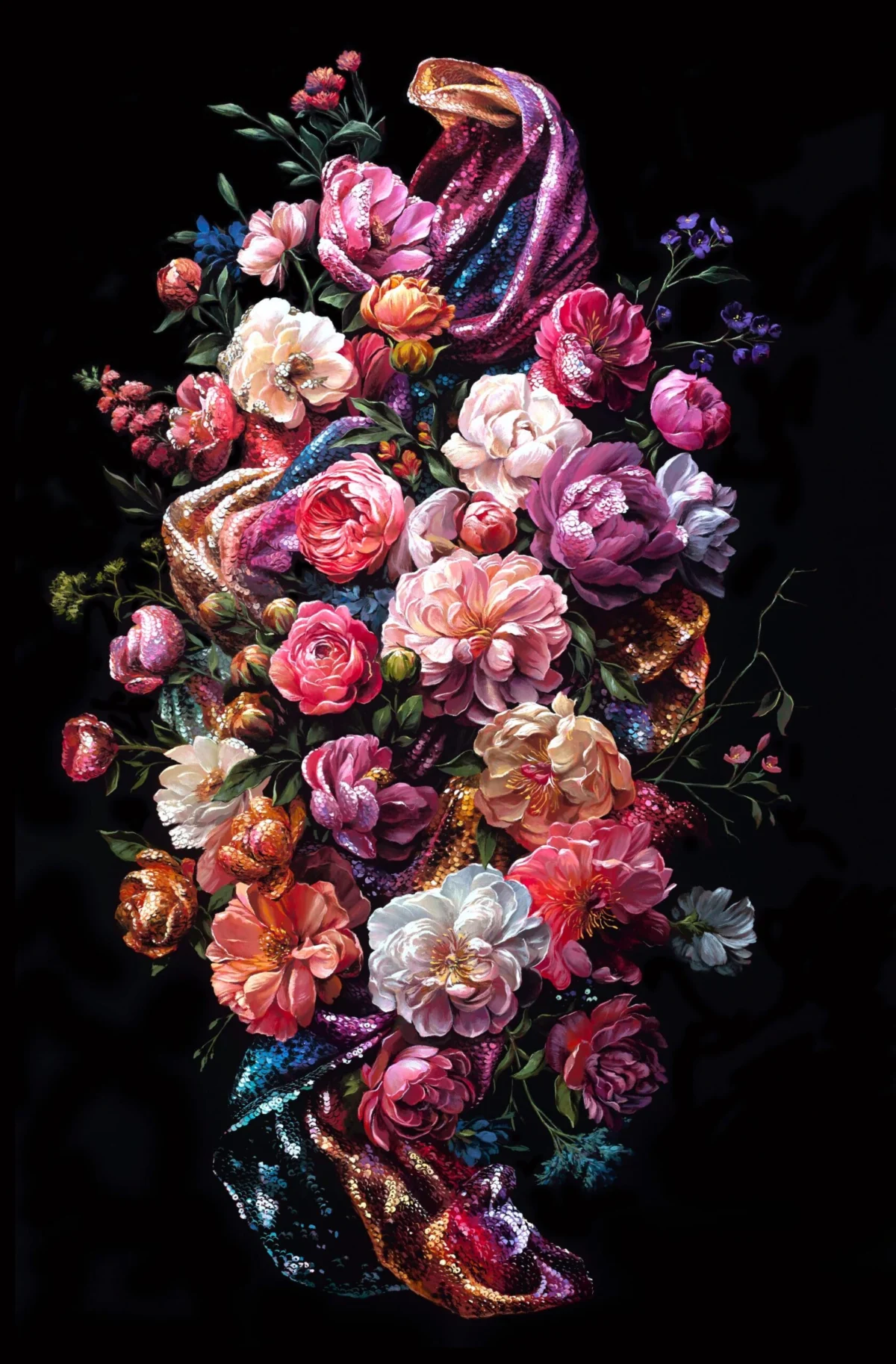
“The world hums with beauty and danger, harmony and discord,” observes Northern California-based artist Jake Messing. “We walk through these shifting currents every day. For as long as I can remember, I have turned toward the natural world—studying its patterns, its relationships, its quiet lessons.”
Messing’s work—a series of hyper-detailed, acrylic-on-canvas vignettes—serves as a visual bridge between the botanical precision of the past and the existential anxieties of the modern era. By layering succulents, insects, avian life, and flora into dense, maximalist compositions, he invites the viewer into a theater of the natural world that feels simultaneously ancient and hyper-contemporary.

Main Facts: The Intersection of Flora and Philosophy
At the core of Messing’s practice is a rejection of the static still life. While his work borrows the technical rigor of classical painting, his subject matter is intentionally surreal. He constructs ecosystems that could not exist in a vacuum, forcing disparate elements—an eagle, a swarm of insects, and delicate petals—into a singular, claustrophobic, yet harmonious frame.
His process is one of intense observation. Messing’s paintings are not merely depictions of plants and animals; they are inquiries into the "fears and unspoken rules that shape us." By utilizing nature as a mirror, he forces a confrontation with the uncomfortable realities of existence: the interdependency of all living things, the fragility of life, and the chaotic beauty of biodiversity.

Chronology: The Evolution of an Aesthetic
The artistic trajectory of Jake Messing has been defined by an increasingly complex dialogue with art history. His early development saw a transition from traditional nature studies to the highly conceptual, immersive compositions that characterize his current body of work.
- Formative Years: Messing’s early work focused on the isolation of natural subjects, honing his technical skill in capturing light, texture, and anatomy.
- The Turn to Complexity: Moving away from singular subjects, he began experimenting with the "maximalist cluster," a technique that requires significant planning to ensure that the depth of the painting does not collapse into visual noise.
- Contemporary Synthesis: In recent years, Messing has integrated modern visual tropes—such as prismatic color gradients, synthetic-looking bubbles, and glossy, metallic fabrics—into his traditionally rooted technique. This juxtaposition grounds his work in the 21st century, distinguishing his "modern Dutch Golden Age" style from mere mimicry of the past.
Supporting Data: The Dutch Golden Age Influence
To understand Messing’s work, one must look at the seventeenth-century Dutch tradition. Painters like Rachel Ruysch and Jan Brueghel the Elder defined the vanitas and memento mori genres, using still lifes to remind viewers of the transience of life. In these historical works, a single wilting flower or a hovering fly often served as a somber reminder of death.

Messing honors this lineage but subverts it. While he utilizes the dark, dramatic backgrounds and meticulous detail characteristic of the era, he refuses to lean entirely into decay. His paintings are, as he puts it, "full-blooded." Where the Dutch masters might have focused on the inevitable rot of the petal, Messing focuses on the sheer, violent tenacity of life—the way a bud pushes through a dark void, or how a bird’s plumage captures light even in a crowded, chaotic space.
His technical approach—working in acrylics—is a deliberate choice. Unlike the slower, more forgiving medium of oil paint, acrylics demand a different level of agility and rapid decision-making, which parallels the "shifting currents" he seeks to capture.

Official Perspectives: The Artist’s Philosophy
In conversation about his process, Messing emphasizes that the act of painting is a ritual of grounding. "Through my work, I seek to bring the outside in," he says. "To honor the wildness that surrounds us, and to reveal the beauty and danger, the decay and renewal, that bind our outer and inner worlds together."
This statement is the cornerstone of his artistic intent. He does not view nature as a passive backdrop for human activity, but as an active participant in our psychological states. When he paints a succulent that looks almost metallic, or a bird that appears caught in a shimmer of artificial light, he is not merely recording nature; he is filtering it through his own lens of experience. The "chaos and grace" he describes is not just an aesthetic choice—it is a worldview. He argues that our inner lives are just as overgrown and layered as the compositions he creates on canvas.

Implications: Nature in the Modern Context
The implications of Messing’s work extend beyond the gallery walls. In an era of climate uncertainty, his focus on ecosystems and interdependency carries a weight that feels both timely and necessary.
The Ecological Mirror
By forcing the viewer to look at the "hidden" beauty of insects and the minute, often overlooked details of a plant’s anatomy, Messing encourages a form of ecological empathy. He highlights the "relationships" within nature—the way things rely on one another to survive. This is not just a study of beauty; it is a study of survival.

The Psychology of Maximalism
The denseness of his work has a specific psychological effect. In a world saturated with digital information and constant stimuli, Messing’s paintings offer a "productive overwhelm." They ask the viewer to slow down and parse the chaos. By spending time with his paintings, one begins to see that what looks like a jumble is actually a carefully ordered set of rules, much like the unspoken rules of human society that he explicitly mentions.
The Fusion of Old and New
Messing’s work is a testament to the fact that realism is not a dead language. By blending the precision of 17th-century techniques with the color palettes and motifs of the modern age, he bridges the gap between historical reverence and contemporary urgency. He proves that the memento mori—the reminder that we all must pass—is still a relevant theme for a generation living through rapid environmental and social change.

Conclusion: The Quiet Lessons of the Wild
Jake Messing’s art does not provide easy answers. He does not paint peaceful landscapes designed to soothe the viewer; he paints landscapes that challenge, complicate, and confront. His works, such as Coccinellidaes Hideaway 2 or Visible Light, are invitations to look deeper into the "shifting currents" of our own reality.
As we navigate an increasingly complex world, Messing’s work serves as a reminder that chaos is not the absence of order, but a different kind of structure—one where life persists, renews, and thrives in spite of the danger. By bringing the outside in, he invites us to bring our own inner worlds to the surface, encouraging a dialogue between the self and the wild that is as beautiful as it is necessary.

Whether it is through the iridescent shine of a bubble or the sharp, defiant gaze of an eagle, Messing’s paintings insist that we pay attention. They insist that, even in the discord of our times, there is a hum of beauty waiting to be heard, if only we are willing to study the pattern.











No comments yet. Be the first to join the conversation!