Suro Senen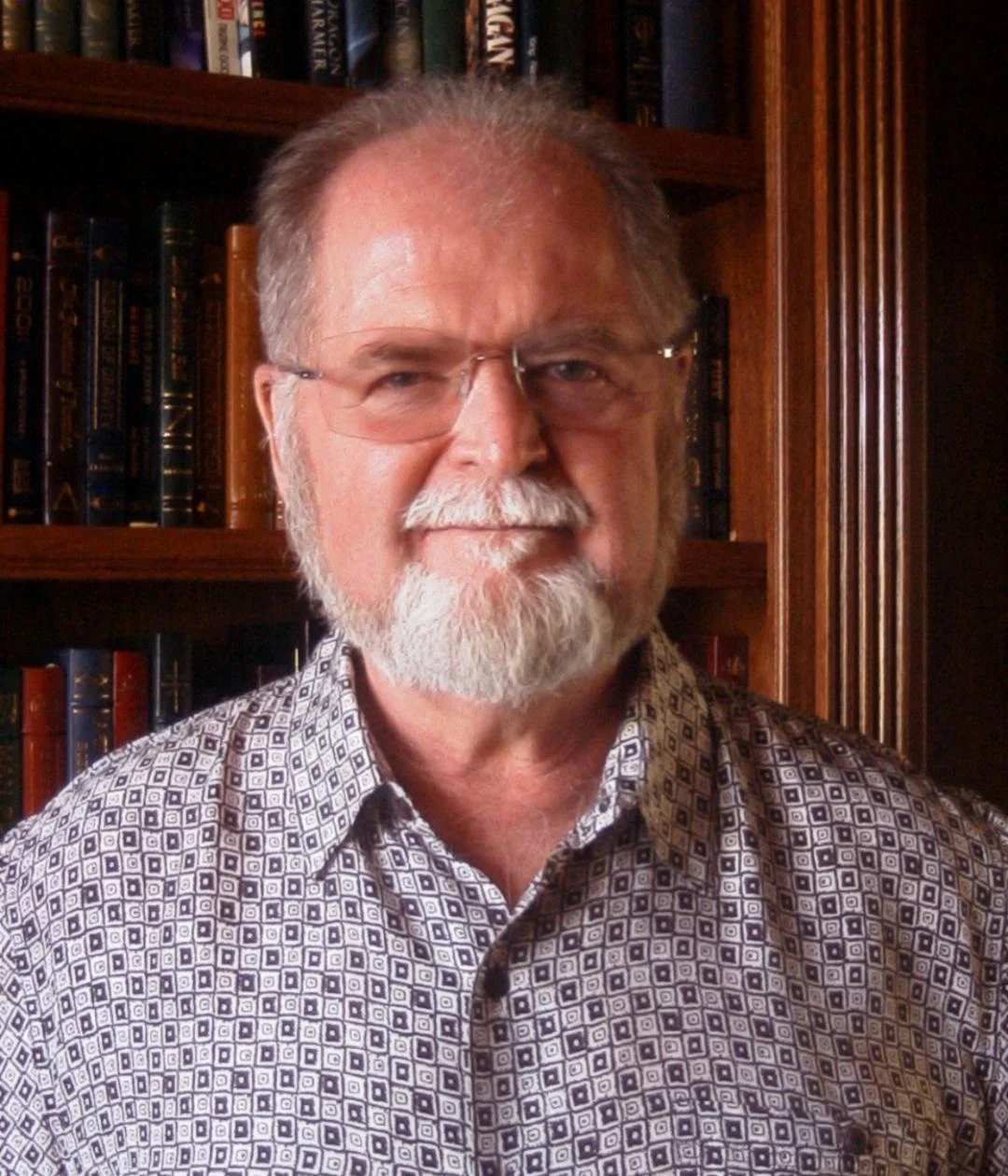
By Editorial Staff
In the annals of science fiction, few names command the respect, intellectual curiosity, and polarizing discourse as that of Larry Niven. Last month, the legendary author celebrated his 88th birthday—a milestone that has prompted fans, scholars, and peers to reflect on a career that spans over half a century. To understand Niven is to understand a writer who refused to be tethered to a single ideology, an "idea-smith" whose works have shaped the very vocabulary of modern science fiction.
In a recent retrospective, critic John Hertz encapsulated the essence of Niven’s appeal: “I suggest that Niven has an independent mind. When the different drummer he was marching to had a beat we liked, we loved him. When he marched to yet a different drummer, we dropped him. In both cases, we’d have done better to notice how well he wrote.”
The Architect: A Chronology of Ideas
Born in 1938, Laurence Van Cott Niven emerged as a titan of the "Hard SF" movement during the 1960s. His ascent was marked by a relentless pursuit of the "Big Idea"—concepts so expansive they redefined the genre’s boundaries.
- The 1960s: Foundations of the Known Space. Niven introduced readers to his "Known Space" universe, a meticulously crafted setting that would host some of his most famous works, including World of Ptavvs (1966) and the seminal Neutron Star (1966).
- The 1970s: The Ringworld Era. The publication of Ringworld (1970) changed the landscape of speculative fiction forever. The concept of a mega-structure encircling a star became a touchstone for scientific inquiry and imaginative engineering.
- The 1980s: Collaborative Heights. Niven’s influence expanded through prolific collaborations, most notably with Jerry Pournelle. Together, they produced The Mote in God’s Eye (1974) and Footfall (1985), works that challenged the conventions of first-contact narratives.
- The 1990s and Beyond: Complexity and Satire. As the new millennium approached, Niven turned his lens toward internal critique and satire, with works like Rainbow Mars and the Bowl of Heaven series, continuing to push the limits of his creative output.
The Craft of the "Idea-Smith"
To categorize Niven simply as a writer is to overlook his role as an "idea-smith." Much like a goldsmith molds metal, Niven molds abstract concepts into tangible realities. His work is defined by a commitment to verisimilitude—what he calls the "appearance of truth."
The Power of Verisimilitude
Niven has long argued that science fiction requires a stable foundation. "You have to give them something," he once remarked, noting that if everything in a story is alien or unrecognizable, the reader loses their tether to the narrative. By anchoring his wildly imaginative settings in familiar human psychology—such as the tobacco-farming roots of Isaac Asimov’s characters—Niven creates a "hang-together" logic that keeps the reader grounded even while orbiting a Ringworld.
Humor and Poetic Satire
Perhaps the most overlooked facet of Niven’s work is his sharp, often biting wit. While critics often focus on the hard science, his prose is peppered with comedic observations. Hertz highlights this by pointing to the divorce cake in "What Can You Say About Chocolate-Covered Manhole Covers?"—a symbol of separation so poetic it borders on the surreal. His ability to weave humor into the high-stakes drama of The Mote in God’s Eye or the satirical Rainbow Mars demonstrates a mastery of tone that elevates his work beyond simple genre fiction.
The Collaborative Spirit
A definitive feature of Niven’s career is his breath-taking willingness to collaborate. His bibliography reads like a "who’s who" of speculative fiction, including Jerry Pournelle, Gregory Benford, Steven Barnes, and Brenda Cooper.
This collaborative nature serves as a testament to his philosophy of "minds as good as you, but different." By working with peers like Poul Anderson, Fred Saberhagen, and Roger Zelazny on projects such as Berserker Base, Niven allowed his own distinct "flavor" to mingle with other masters, creating a synthesis that was always recognizable yet perpetually fresh. As John Hertz noted, “Each tastes different—but the Niven flavor is unmistakable: which is, as a woman I know says, and maybe you do too, as it should be.”

Implications for Modern Science Fiction
As we analyze the impact of an 88-year-old luminary, we must consider what Niven’s career implies for the future of the field.
The Independent Mind vs. The Echo Chamber
In an era where authors are often expected to align perfectly with the prevailing consensus, Niven stands as a reminder of the value of the "independent mind." His willingness to write stories that challenge the reader—rather than merely reinforcing their existing worldviews—has been both his greatest strength and the source of periodic friction with his audience. His insistence that he does not read to be agreed with is a challenge to the modern reader to prioritize the quality of the craft over the comfort of the message.
Defining "Realism"
Niven’s legacy challenges the definition of "realism" in speculative fiction. He suggests that the true goal is not to predict the future with scientific accuracy, but to create a consistent internal logic. When he posits "minds as good as you but different," he is not just talking about aliens; he is talking about the fundamental challenge of human interaction. Whether it is the Mediators in The Mote in God’s Eye or the intricate politics of his space-faring civilizations, Niven’s characters are defined by their ability to out-think, out-maneuver, and out-reason their environment.
A Birthday Reflection
To mark his 88th year, admirers have offered tributes ranging from scholarly essays to original poetry. John Hertz, reflecting on this milestone, shared a tanka—a form of Japanese poetry consisting of 5-7-5-7-7 syllables—to honor the man who has given so much to the imagination:
Laughter. Some rise to it,
And if they haven’t, they might.
Reaching as I can,
Real, comic, and poetic,
Yet painting it as I see.
Final Thoughts: The Niven Standard
Larry Niven’s career is a reminder that the most durable science fiction is that which treats the reader with intelligence. Whether he is building a Dyson sphere, deconstructing the nature of time travel, or simply observing the peculiar way an "elf bottom" points true north, Niven has consistently demanded that we look up from our screens and toward the stars.
As he moves forward, the "Niven flavor" remains a standard-bearer for the genre. He taught generations of writers that science fiction is not just about the gadgets or the physics; it is about the "Idea-smithing"—the art of creating a universe that feels as real as the one we currently inhabit, and perhaps, a little more interesting.
At 88, Larry Niven remains, as ever, a singular voice—a man who once famously answered the question of what he wanted to eat with the simple, profound declaration: "Food. It’s the best thing there is to eat." It is that same straightforward, uncompromising appetite for reality that has made his work a feast for the mind for over half a century.

 Layla Zulfa
 Sagoh
Sagoh