

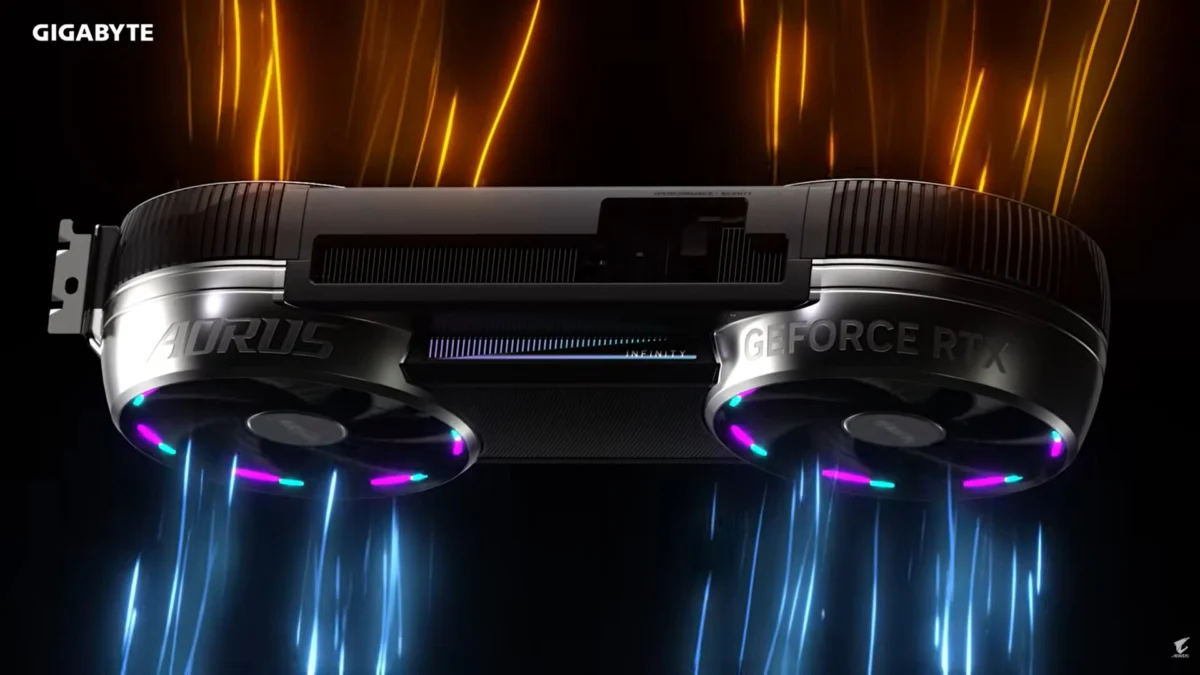
The landscape of high-end graphics cards is often defined by iteration rather than innovation, with most manufacturers adhering to a standardized "three-fan, rectangular shroud" design. However, Gigabyte has officially broken this mold with the market launch of the Aorus GeForce RTX 5090 Infinity. First teased at CES, this card represents a bold departure from traditional thermal engineering, aiming to manage the massive 600W thermal design power (TDP) of the flagship RTX 5090 through a unique "Double Flow-Through" cooling architecture.
Main Facts: Architecture and Design Philosophy
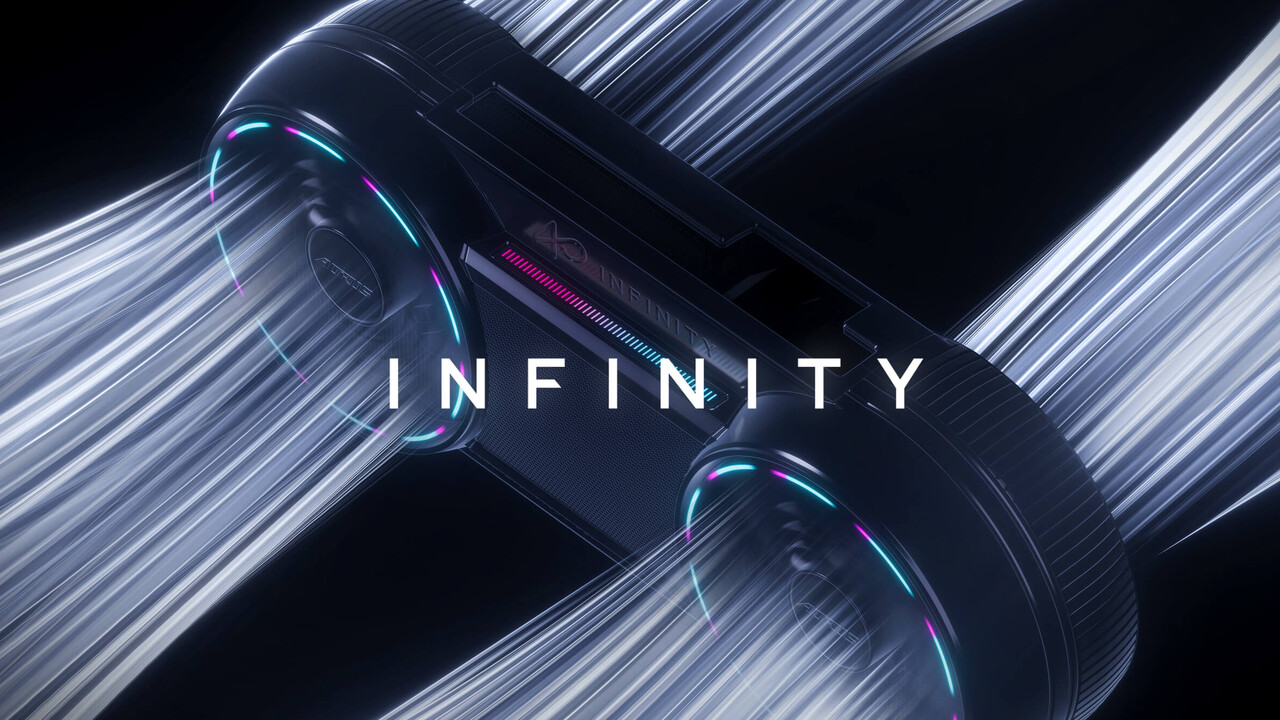
The Aorus GeForce RTX 5090 Infinity is not merely another factory-overclocked card; it is a thermal experiment realized in metal. The most striking visual element is the arrangement of its cooling fans. Unlike the typical linear layout, the two primary fans are positioned widely apart, encased in circular, turbine-inspired housings that lend the card an industrial, aeronautical aesthetic.
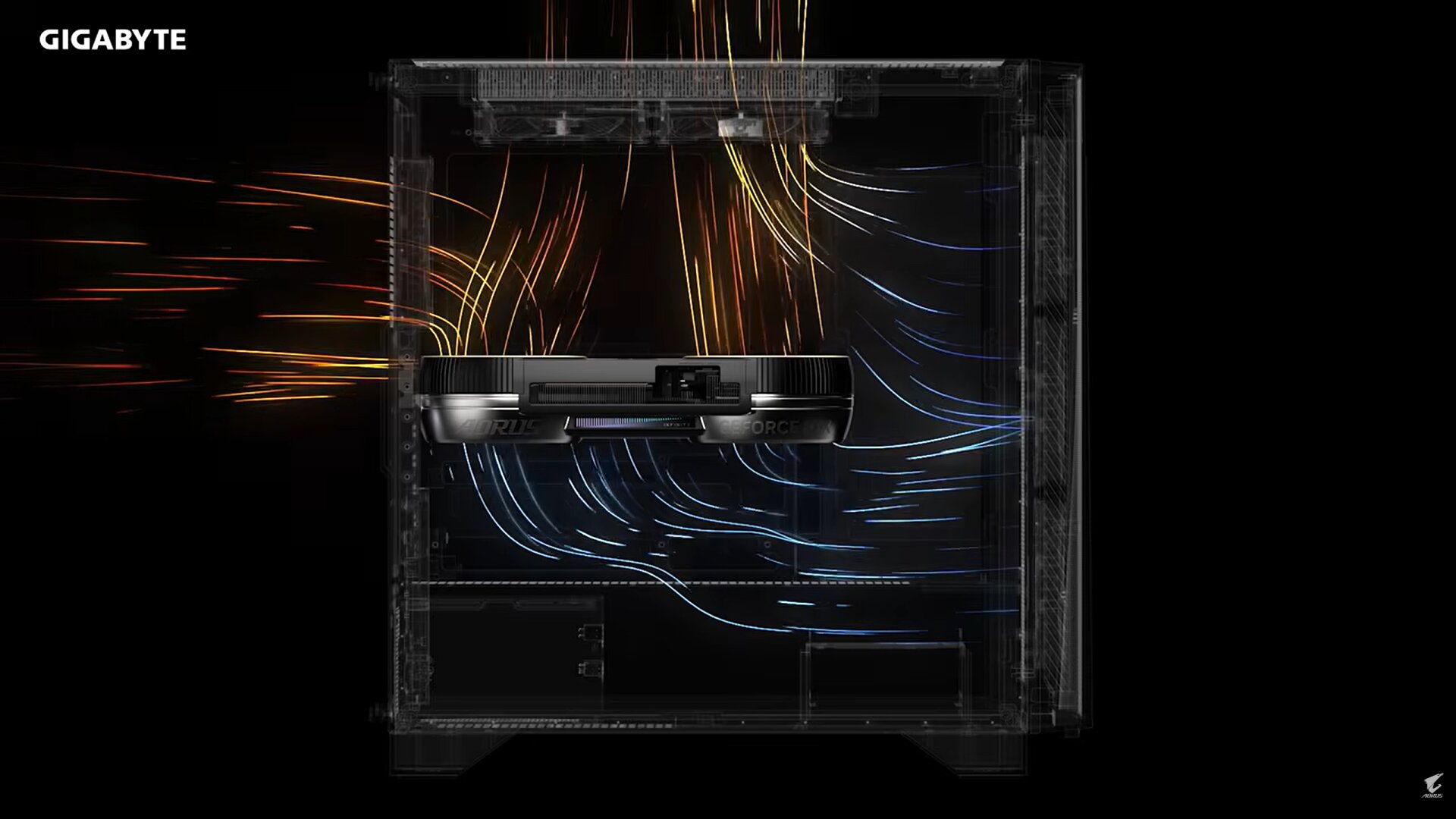
The cooling system, branded by Gigabyte as "Windforce Hyperburst," utilizes a flow-through methodology similar to Nvidia’s Founders Edition but taken to a more aggressive level. The PCB (printed circuit board) is intentionally truncated, allowing air to pass directly through the card’s heat sink. The backplate features two large, circular cutouts that expose the radiator fins, a design choice Gigabyte claims improves total airflow by 58% compared to standard, closed-backplate designs.
The Hidden Third Fan: The "Overdrive" Mechanism
While the two large fans provide a constant stream of air, Gigabyte recognized that the core components—the GPU die and the VRAM modules—require more localized cooling than a general flow-through system can provide. To address this, they integrated a "hidden" third fan, dubbed the Overdrive Fan. Positioned in the center of the card, beneath a discrete perforated mesh, this fan remains idle during light workloads. It activates only when internal sensors detect high thermal spikes, acting as a tactical, high-pressure injection of fresh air directly onto the GPU’s surface.
Chronology: From Concept to Market Reality
The journey of the Aorus RTX 5090 Infinity began with skepticism at CES, where enthusiasts questioned whether a non-liquid-cooled solution could reliably handle a 600W power draw without significant thermal throttling.
- CES Debut: Gigabyte introduced the concept, focusing on the unconventional aesthetics and the "Double Flow-Through" marketing.
- Engineering Phase: Over the months following CES, the company refined the material science behind the cooler, opting for a full metal chassis to act as a secondary heat sink.
- Thermal Validation: Internal testing focused on the integration of the Overdrive Fan, ensuring that the transition between passive and active modes would not create acoustic "buzzing" or harmonic resonance.
- Market Launch: Today, the card hits the retail channel. Despite the launch, Gigabyte has maintained a surprisingly tight lip regarding the final MSRP, likely waiting to gauge initial market sentiment and competitor pricing.
Supporting Data and Technical Specifications
Gigabyte has spared no expense on the internal components to justify the "Infinity" branding. The thermal interface materials (TIM) represent a significant shift toward server-grade standards:
- GPU Cooling: The primary die is treated with a metal-based thermal interface material, which offers significantly higher conductivity than standard silicone-based pastes.
- VRAM and VRMs: These critical components are cooled using a "server-grade thermal gel," designed for high-heat environments where long-term stability is more critical than ease of application.
- Heat Dissipation: While detailed internal teardowns are pending, the specifications list a massive vapor chamber paired with "superconducting" heat pipes, designed to rapidly pull heat away from the GPU before it can saturate the surrounding PCB.
- Clock Speeds: The card is factory-rated for a 2,730 MHz boost clock in "Performance Mode." This puts it in the elite tier of RTX 5090s, matching the high-end offerings from ASUS (ROG Matrix) and MSI (Lightning Z).
Despite the massive cooling apparatus, the card remains surprisingly compact at 33 cm, making it a viable option for high-end builds that might not accommodate the longer liquid-cooled alternatives on the market.
Official Responses and Industry Context
In response to inquiries from technical media outlets, Gigabyte representatives have emphasized that the Aorus RTX 5090 Infinity is designed for the "uncompromising enthusiast." When asked about the 16-pin power connector—a subject of significant controversy in previous generations—Gigabyte maintained that the implementation on the 5090 Infinity meets all safety standards and that the cooling efficiency of the card should, in theory, contribute to more stable power delivery and reduced heat buildup near the connector pins.
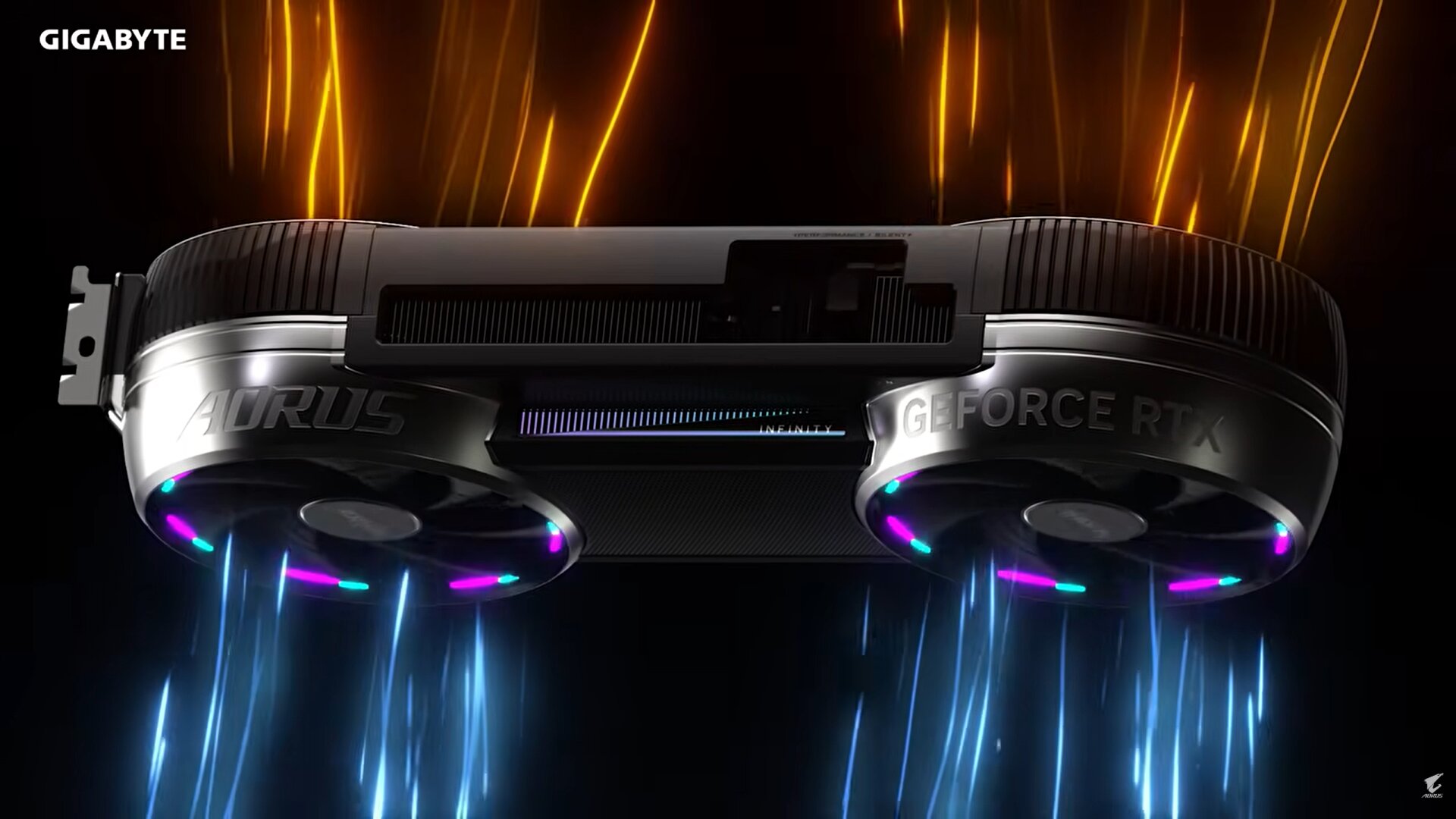
The industry at large views the Aorus 5090 Infinity as a necessary evolution. With GPU power draws reaching the limits of what traditional air-cooling can handle, manufacturers are forced to rethink airflow dynamics. By moving away from the "static shroud" design, Gigabyte is acknowledging that the physical footprint of the GPU is no longer just about the size of the radiator, but about the intelligent routing of air.
Implications for the GPU Market
The release of the Aorus RTX 5090 Infinity has several implications for the future of high-end graphics hardware:
1. The Death of the "One-Size-Fits-All" Cooler
The success of this card could signal a shift in how mid-range and high-end cards are designed. If the "Overdrive Fan" proves effective at keeping the GPU within safe thermal limits during heavy rendering or gaming, we may see more manufacturers adopting hybrid fan layouts. This moves the industry away from aesthetic-first designs and toward performance-first engineering.
2. Rising Costs of Materials
The use of metal chassis, server-grade thermal gels, and superconducting heat pipes suggests that the cost of high-end GPUs will continue to rise. As power draws stay at the 600W threshold, the cost of the cooling solution is becoming nearly as expensive as the silicon itself. Consumers should prepare for the possibility that the "Infinity" branding is a precursor to a higher price bracket for premium air-cooled cards.
3. The Future of 16-Pin Power Delivery
The reliance on the 16-pin connector remains a point of contention. However, by focusing on thermal management around the VRMs (Voltage Regulator Modules), Gigabyte is clearly attempting to mitigate the heat-related issues that plagued earlier iterations of this connector. The performance of the Aorus 5090 Infinity will likely serve as a benchmark for how well air-cooled designs can stabilize this specific power delivery standard.
4. A Shift in Aesthetics
The "turbine" look and the exposed radiator fins represent a shift toward "functional brutalism." In an era where many users want their components to be hidden, Gigabyte is doubling down on the visual presence of the hardware. The "RGB Halo Lighting" provides the necessary flair, but the core appeal remains the raw, industrial aesthetic of the metal and the exposed mechanical components.
Conclusion
The Gigabyte Aorus GeForce RTX 5090 Infinity is a statement piece. It is a product built for a segment of the market that demands the highest possible clock speeds without the complexity of a custom liquid-cooling loop. While the lack of a specified price point at launch leaves a significant question mark, the technical specifications and the innovative "Windforce Hyperburst" cooling architecture suggest that this will be one of the most talked-about cards of the generation.
Whether the "Overdrive Fan" and the "Double Flow-Through" backplate design can truly tame the beast that is the RTX 5090 remains to be seen in independent testing. However, for now, Gigabyte has succeeded in doing the one thing most manufacturers fail at: creating a graphics card that looks, feels, and operates like it belongs in a new era of high-performance computing.









No comments yet. Be the first to join the conversation!