

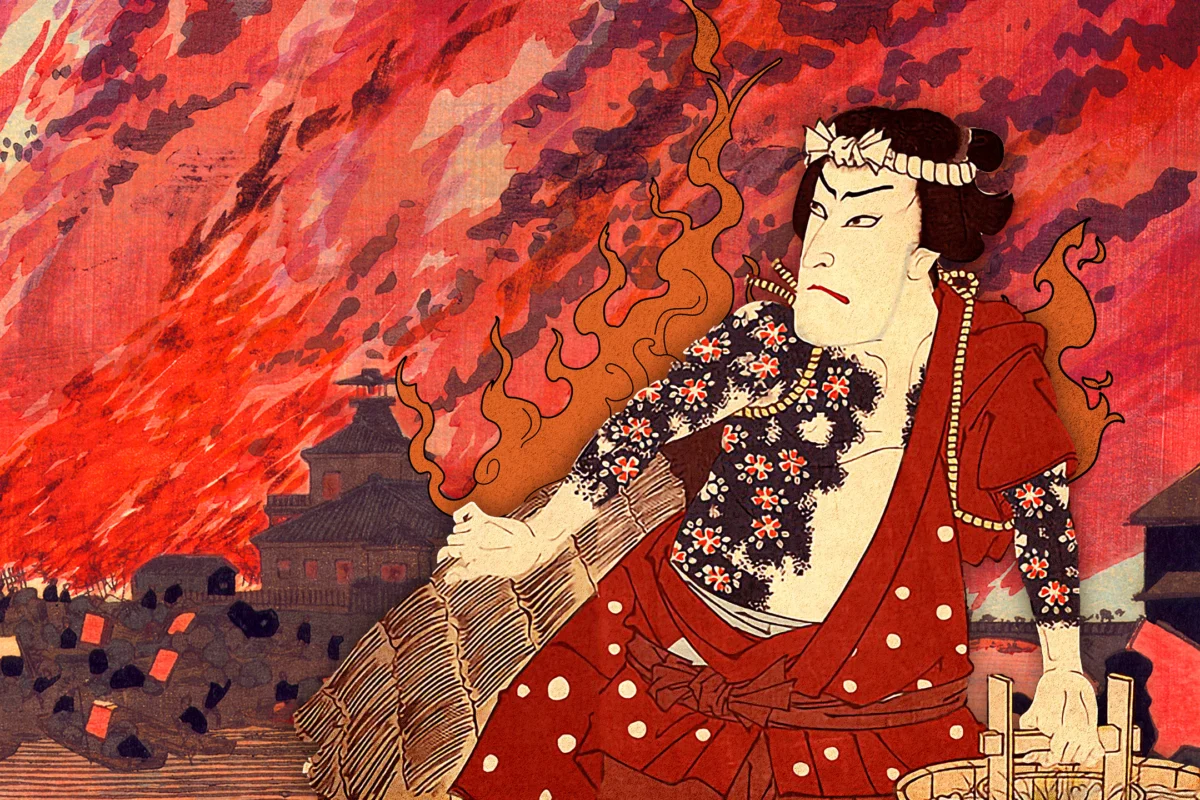
In the crowded, labyrinthine streets of Edo (modern-day Tokyo) during the 17th and 18th centuries, a child’s aspirations were remarkably similar to those of their modern-day counterparts. When asked what they wanted to be when they grew up, the answer was almost invariably a sumo wrestler, a policeman, or a firefighter. While the allure of the athlete and the lawman remains timeless, the profession of the firefighter in the Edo period was a unique, often volatile blend of public service, organized crime, and high-fashion aesthetics. This is the history of the hikeshi—the men who walked through fire and left an indelible mark on the soul of Japan.
The Flowers of Edo: A City Built for Combustion
The hikeshi—literally “fire extinguishers”—emerged from a desperate necessity. By the mid-1700s, Edo had blossomed into one of the world’s most populous cities, housing over a million people within a dense urban footprint. However, this architectural triumph was also a death trap. The city was composed almost entirely of wood, paper, and dry straw mats—a tinderbox waiting for a spark. If modern gasoline had been available in the Edo period, it would have been safer than the reality of the era’s construction.
Fires were so frequent and so devastating that they earned the ironic, poetic moniker of "The Flowers of Edo." These "flowers" bloomed with terrifying regularity, fueled by narrow alleyways and the absence of adequate water infrastructure. Initially, the response to these infernos was disorganized; monks, local commoners, and samurai would form ad-hoc bucket chains, which proved largely ineffective against the massive conflagrations. The shogunate eventually intervened, establishing the jobikeshi—a state-sponsored, highly regulated firefighting force. In response, local neighborhood associations, consisting of artisans, laborers, and merchants, formed their own brigades: the machibikeshi. It is within this civilian volunteer group that the legend—and the infamy—of the hikeshi truly resides.
Chronology of the Flame: From Chaos to Control
- Early 1600s: The rise of the Tokugawa Shogunate brings rapid urbanization. As Edo grows, fire becomes a constant existential threat to the capital.
- 1657 (The Great Fire of Meireki): This cataclysmic event, which leveled nearly two-thirds of the city and claimed over 100,000 lives, forced the Shogunate to overhaul urban planning and firefighting tactics.
- 1700s: The formation of the machibikeshi becomes institutionalized. Neighborhoods take pride in their local brigades, turning firefighting into a social hierarchy.
- 1868 (The Meiji Restoration): As Japan modernizes, the feudal systems are dismantled. The hikeshi are phased out in favor of Western-style municipal fire departments.
- Modern Day: The spirit of the hikeshi persists through the hashigo-nori (ladder acrobatics) tradition, performed during commemorative events like New Year’s and Coming-of-Age Day.
The Tactical Methodology of the Hikeshi
The machibikeshi operated with a philosophy that prioritized containment over mere suppression. Because the city was too densely packed to rely solely on water—which was often scarce—these brigades utilized a scorched-earth policy. Armed with heavy, hooked poles—a design rumored to be influenced by the legendary spear-fighting techniques of the period—firefighters would systematically dismantle roofs, walls, and entire structures to create "firebreaks."
By tearing down a house before the flames reached it, they robbed the fire of its fuel. This was a brutal but effective method of saving a neighborhood. However, these tools served a dual purpose; the hooked poles were just as effective as weapons during the frequent, violent territorial disputes between rival fire brigades.

A Fine Line Between Heroism and Gangsterism
The machibikeshi were defined by a rigid inner hierarchy, headed by a kashira (boss). A member’s status was not determined by wealth or bloodline, but by reputation, bravery, and physical prowess. The culture was intensely performative; to be a hikeshi was to be a spectacle. They rushed into collapsing buildings, scaled fiery roofs, and sought to outdo one another in acts of death-defying machismo.
However, this competitiveness often curdled into conflict. The machibikeshi were organized by neighborhood, and fires rarely respected these arbitrary borders. When two brigades arrived at the same blaze, the race to plant their matoi (a heavy, decorative standard) was a matter of extreme professional prestige. The matoi served as the banner of the brigade; planting it first gave them the authority to claim the fire and, more importantly, the subsequent financial gifts and food provided by the grateful—or terrified—local populace.
If a rival group challenged that authority, the scene would devolve into a brawl. The "symphony" of the city was often the sound of heavy wooden poles and fists colliding in the streets. These groups were not merely public servants; they were often seen as "feudal mafioso." They leveraged their status to extract payments, and if a merchant or homeowner failed to show the proper respect or generosity, their home might be "mysteriously" targeted for demolition during the next fire.
Implications: The Origins of the Yakuza
Historians have long drawn a direct line between the hikeshi and the modern-day yakuza. While the criminal underworld of Japan is a tapestry woven from various strands—including gamblers and dock workers—the hikeshi provided the aesthetic and organizational framework for the yakuza.
The most visible legacy is the practice of full-body tattooing (irezumi). In the Edo period, tattoos were often used as a brutal mark of criminality, with thieves and criminals branded with simple arm bands. The hikeshi, however, reclaimed the art form. They turned their bodies into intricate, painful canvases depicting scenes from classical literature, fierce deities, and epic battles. This served two purposes: it demonstrated an extreme tolerance for pain—a hallmark of the "tough guy" persona—and it served as a badge of tribal affiliation.

After a fire, the hikeshi would often perform dramatic, posturing poses, influenced by the stylized theatrics of Kabuki theater, while stripped to the waist to display these tattoos. This performance served as a warning to rival gangs and an intimidation tactic for the public.
The Aesthetic of the Flame: The Hikeshi-Banten
Beyond their skin, the hikeshi were known for their distinct fashion, most notably the hikeshi-banten (firefighter’s jacket). These garments were masterpieces of functional design. On the exterior, the jacket was a heavy, durable indigo cotton. Indigo was favored not just for its color, but because it was believed to be fire-resistant; when exposed to heat, the fabric would char rather than ignite.
The true artistry, however, was hidden. The inside of the jacket was lined with vibrant, elaborately stitched silk featuring dragons, storms, and mythological figures. Once the fire was extinguished and the adrenaline faded, the firefighter would turn his coat inside out, revealing the brilliant lining as a symbol of his brigade’s status and the pride of his neighborhood.
Official Responses and the End of an Era
The Shogunate’s relationship with the machibikeshi was one of uneasy tolerance. While the government recognized the necessity of these brigades, they were viewed with deep suspicion. The machibikeshi were, in effect, private militias. They operated outside the direct control of the samurai class, and their tendency to engage in protection rackets and gang violence made them a political liability.
The transition to the Meiji era signaled the death knell for the hikeshi. The new government sought to centralize power and modernize the state. The chaotic, competitive, and violent nature of the volunteer brigades was incompatible with the centralized, professional fire departments of the modern state. By the late 19th century, the machibikeshi were disbanded, and their functions were subsumed by a standardized, state-run force.

Conclusion: The Memory of the Ladder
Though the hikeshi have vanished from the streets of Tokyo, their memory remains woven into the cultural fabric of Japan. The tradition of hashigo-nori—acrobatic maneuvers performed on high bamboo ladders—survives as a testament to the agility and fearlessness of these men. Today, it is practiced as a cultural art form, a reminder of a time when the "Flowers of Edo" were fought by men who were part-saviors, part-gangsters, and entirely icons of a bygone era.
The legacy of the hikeshi is a reminder that the history of any great city is rarely tidy. It is a story of fire and water, of service and greed, and of the enduring human need to stand tall in the face of the encroaching flames.












No comments yet. Be the first to join the conversation!