

By Industry Correspondent
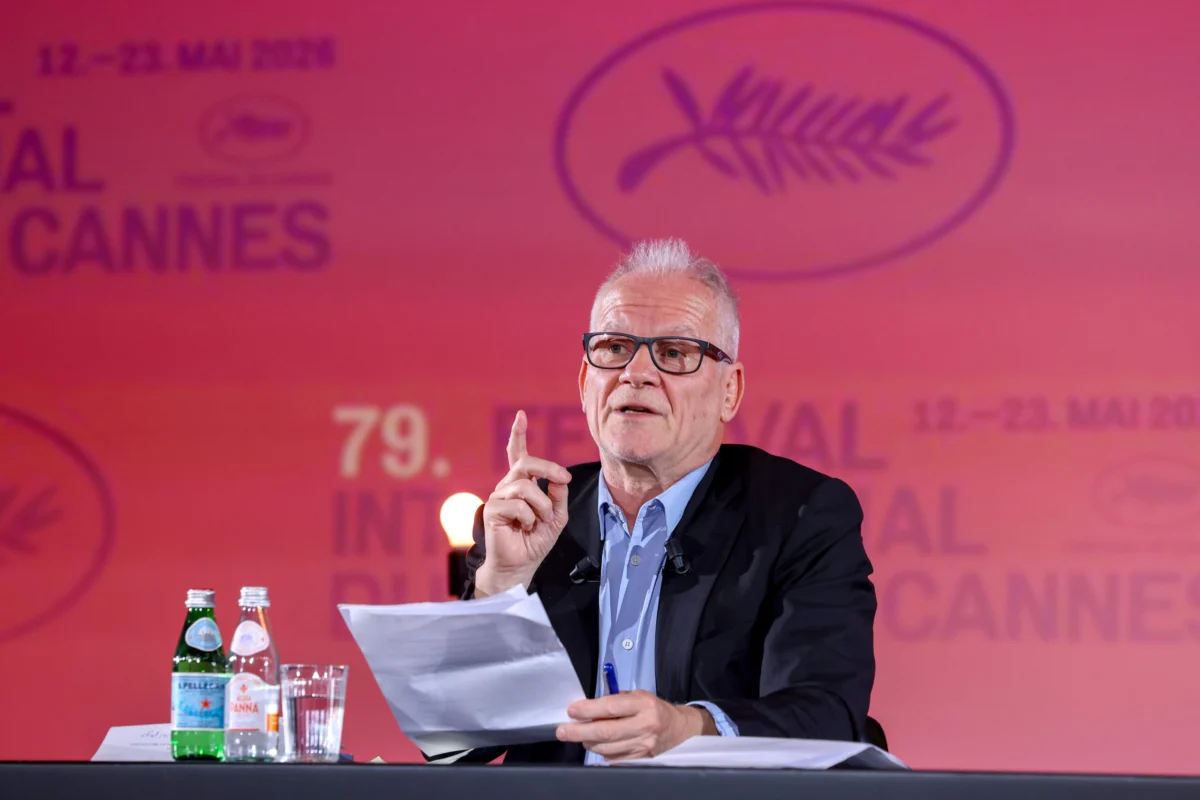
On the eve of the 2026 Cannes Film Festival’s grand opening ceremony, Festival Director Thierry Frémaux took to the stage for his traditional pre-festival press conference. In what has become a high-stakes ritual for the world’s most prestigious cinematic event, Frémaux faced a barrage of inquiries that spanned the existential, the political, and the technological. As the festival prepares to roll out its red carpet, the mood is one of cautious optimism tempered by the sobering realities of a global industry in transition.
From the shifting landscape of Oscar eligibility to the controversial rise of Artificial Intelligence, and from persistent questions surrounding gender parity to the shadow of global political instability, Frémaux sought to navigate a path that maintains Cannes’ status as a temple of “universality” while acknowledging the turbulent waters outside the Palais des Festivals.
A Landscape of Complexity: The Political Tightrope
The backdrop of this year’s festival is undeniably colored by the recent "Berlinale backlash"—a period of intense scrutiny regarding how film festivals manage political discourse. When asked if Cannes had implemented new protocols to protect its jury and visiting film teams from the kind of intense public and political pressure that plagued Berlin earlier this year, Frémaux remained characteristically guarded.
"The question raised in Berlin is one that regularly comes up at the festival, which for a long time was considered a very political festival," Frémaux noted. "Is it more or less than before? We are living in different times; it is hard to make a comparison."
He pivoted to a defense of veteran director Wim Wenders, who recently drew the ire of various activist groups after suggesting at a jury conference that filmmakers should "stay out of politics." Frémaux argued that Wenders’ comments were misunderstood. "I would like to pay tribute to Wim Wenders, because I think he was subjected to criticisms that weren’t really justified," Frémaux stated. "He wanted to say that the politics should be on the screen. That is what we say at Cannes: the festival considers that political questions are primarily those of the artists’ voices and the voices of the artists whose work is being shown."
Frémaux emphasized that while filmmakers in the Official Selection are free to voice their opinions, the festival management and the jury have a different mandate. "We’re in a world partly at war, a world in a fragile state in terms of dialogue between nations. We don’t want to add to the confusion with our analysis of what’s going on," he said, reiterating his belief that cinema remains an "instrument of peace," even when it challenges the status quo.
The Gender Parity Debate: Beyond the Poster
Perhaps the most heated portion of the press conference concerned the festival’s ongoing struggle for gender parity. This year, the Official Selection includes five films directed by women out of 22 in the running for the Palme d’Or—a decrease from the seven featured in 2025. This has drawn sharp criticism from Le Collectif 50/50, a French advocacy group that has accused the festival of "feminism washing," particularly regarding the use of the iconic Thelma & Louise on the official festival poster.
Frémaux, arriving prepared with detailed notes, pushed back against the notion that the poster was a performative gesture. "At no moment would we have chosen an image of Geena Davis or Susan Sarandon or Ridley Scott’s film for the poster to make ourselves look feminist," he insisted.
He acknowledged that the festival’s history was, at times, regressive—citing the notorious 2012 selection where zero women were included in the main competition—but pointed to tangible progress. "We were one of the first festivals to sign up for the equality charter in 2018," he noted. "We have achieved gender parity in our juries and our governing bodies."
However, Frémaux drew a distinction between organizational representation and the selection of films. "There is no clause in the charter demanding parity in the Official Selection," he clarified. Providing a statistical breakdown, he noted that 28% of submissions this year were from female directors, with women accounting for 34% of the overall selection and 38% in the short film competition.
"The figures show it’s moving forward, but also that it’s slow, that it’s not enough," Frémaux admitted. He argued that the burden of parity lies with the entire industry, not just the festival, highlighting the systemic challenges women face in securing funding for second features. "We need the world seen from a female perspective, a woman’s sensibility, to be more present in the world of film."
The Oscar Shake-up: A Global Shift
The press conference occurred in the immediate aftermath of the Academy of Motion Picture Arts and Sciences (AMPAS) announcing a fundamental change to the eligibility rules for the Best International Feature Film category. Henceforth, winning the top prize at qualifying festivals—including Cannes, Berlin, and Venice—provides a direct pathway to Oscar consideration, effectively increasing the global influence of the Palme d’Or.
Frémaux embraced the change, viewing it as a validation of the international nature of modern cinema. "When people say that America is turning inward, it’s not true. Hollywood is opening up to the international scene; that’s what Cannes is all about—it’s about universality," he said.
This change is expected to alleviate some of the bureaucratic headaches for filmmakers like Jafar Panahi, whose work has often been sidelined by the specific political mandates of national selection committees. Furthermore, it allows for a more fluid representation of countries that produce high volumes of quality cinema, such as Japan and Spain, which are well-represented in this year’s Cannes lineup.
When asked if this new rule might influence the jury’s decision-making process—specifically by tempting them to favor "dissident" filmmakers who could gain significant visibility through an Oscar nod—Frémaux was skeptical. "The jury is nine people. There is not one political conscience, there are nine personal positions," he remarked. "Cineastes very often like cinema that is different from their own. I never felt that the favorable opinion that ultimately emerged in favor of Jafar Panahi [in previous years] had the slightest political bias."
The AI Frontier: The Electric Bicycle of Cinema
As the conversation turned to the encroaching presence of Artificial Intelligence in the arts, Frémaux offered a philosophical, if cautious, assessment. He famously compared AI to the "electric bicycle."
"To ride an electric bicycle, you need to know how to ride a bike," he explained. "It’s becoming a bigger subject in cinema. We have to be on our guard, but at the same time understand it."
Frémaux drew parallels to the historical transition from celluloid to digital technology. He mused on the concept of "organic film," citing Francis Ford Coppola’s Apocalypse Now as a benchmark for authenticity. "The number of helicopters that we see in the film is the number of helicopters that he had," Frémaux noted, contrasting this with the modern ability of directors to digitally manufacture spectacle.
Despite rumors to the contrary, Frémaux confirmed that no AI-generated films were submitted to this year’s festival. However, he left the door open for future discourse. "If it had been offered to us, we would have watched the film, and what would we have done? Would it have been important for what it says about the history of cinema or the future of cinema?"
Most importantly, he drew a firm line regarding the protection of human labor. "What I can say with certainty in relation to artificial intelligence is that we are on the side of the artists, the screenwriters, actors, and voice actors. We stand with everyone whose job could be negatively impacted by artificial intelligence. It requires legislation. We need to control this."
Conclusion: A Festival in Flux
As the 2026 Cannes Film Festival commences, it finds itself at a unique intersection of tradition and technological upheaval. Frémaux’s press conference served as a microcosm of these pressures: a director trying to preserve the sanctity of the "auteur" while answering for the inequities of the past, and trying to protect the human soul of cinema while staring down an automated future.
The festival remains, as ever, a battlefield of ideas. As the lights dim in the Grand Théâtre Lumière, the focus will shift from the podium to the screen, where the final judgment of this year’s selection will be left to the jury and the global audience. In the words of Frémaux, the goal remains the same: to find the "universality" in the stories we tell, even when the world itself feels increasingly fragmented.









No comments yet. Be the first to join the conversation!