Jia Lissa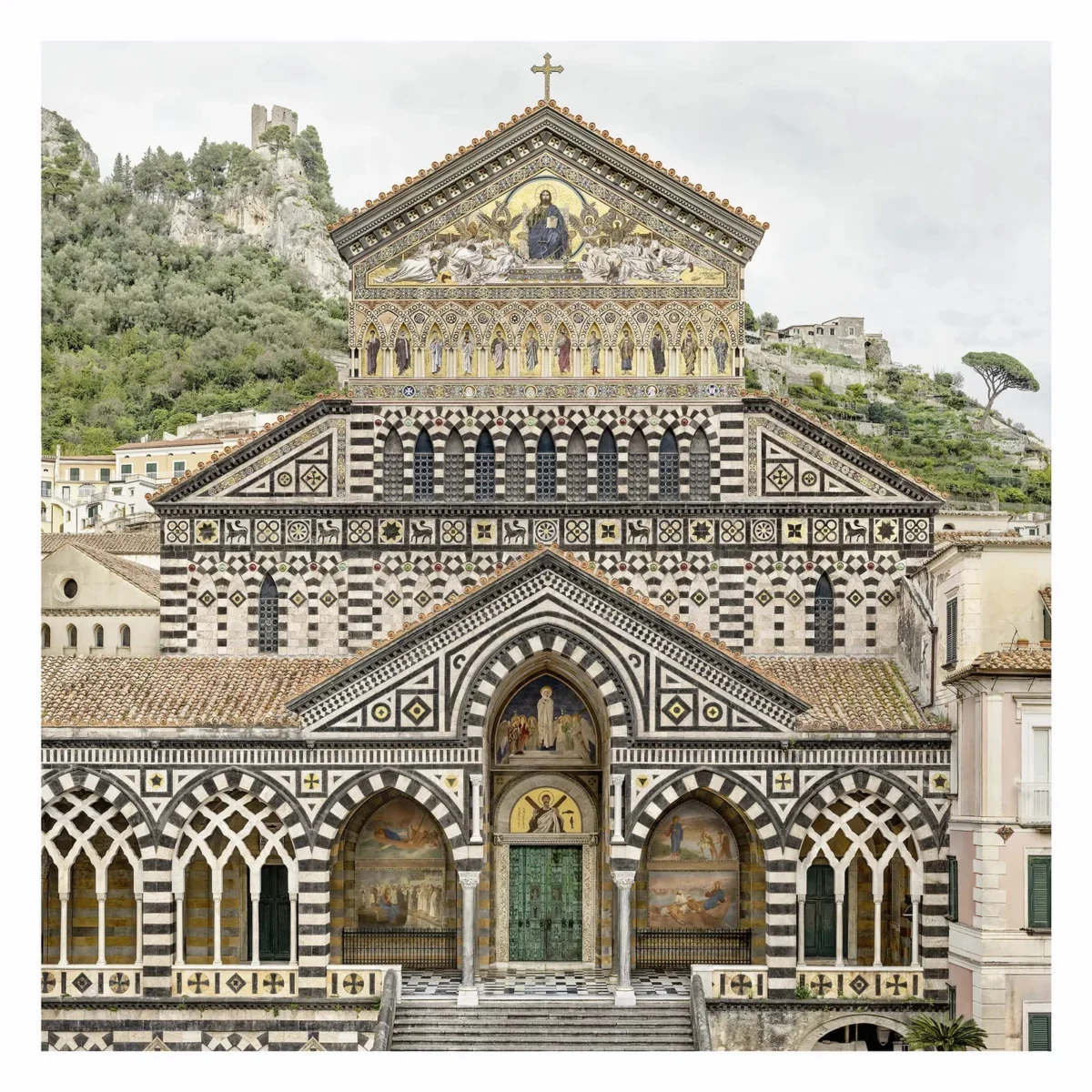
For over twenty years, the Bavarian photographer Markus Brunetti has engaged in an artistic endeavor that bridges the gap between traditional photography, structural engineering, and historical preservation. Alongside his collaborator and partner, Betty Schöner, Brunetti has traversed the European continent in a decommissioned firetruck—a vehicle meticulously retrofitted into a mobile, state-of-the-art photography laboratory. Their mission? To document the continent’s most iconic ecclesiastical landmarks, from sprawling cathedrals to intimate monasteries, with a level of precision that transcends human perception.
The resulting works, currently featured in the solo exhibition Facades IV at Yossi Milo Gallery in New York City, are more than mere photographs. They are monumental, composite visual archives that challenge our understanding of space, perspective, and the passage of time.

The Architecture of the Project: A Study in Persistence
The genesis of Brunetti’s work lies in a rejection of the "decisive moment"—the snapshot-driven ethos that has dominated photography since the mid-20th century. Instead, Brunetti embraces a methodology defined by exhaustion and extreme patience.
Traveling from city to city, the pair identifies a subject and begins a process that can span several years. They capture thousands of individual images of a single structure, breaking the facade down into a grid of meter-by-meter segments. These images are not simply stitched together in the manner of a digital panorama; they are meticulously layered, corrected, and assembled to eliminate the natural distortion of the human eye.

When we stand before a cathedral in real life, our perspective is inevitably "oblique." Because we are tethered to the ground, we see the base of a building as wider and more prominent, while the upper reaches recede and diminish, creating a visual convergence known as "keystoning." Brunetti’s process effectively erases this human limitation. He flattens the facade, creating a perfectly aligned, one-point perspective that allows the viewer to observe the entirety of the building as if they were hovering in space directly in front of the center point of the architecture.
A Chronology of Obsession
The timeline of Brunetti’s work is staggering, often measured in decades rather than days. His methodology requires returning to the same site repeatedly to account for shifting light, environmental changes, and even structural restorations.

- 2004–2007: The inception of the project sees Brunetti and Schöner beginning their systematic surveys of smaller regional churches across Germany and Italy.
- 2007: A pivotal moment occurs with the commencement of the Basilica di San Pietro project in Rome. This would become their most significant challenge, spanning nineteen years of intermittent work.
- 2009–2024: The documentation of the Catedral de Santiago de Compostela in Spain serves as a testament to the endurance of their process, capturing the evolution of the site over fifteen years.
- 2011–2026: The survey of the Duomo di San Corrado in Molfetta, Italy, highlights the duo’s ability to maintain consistency across more than a decade of technical advancement in digital capture and processing.
- 2024–2026: The current Facades IV exhibition showcases the culmination of these long-term projects, marking the finalization of works that have been in progress since the mid-2000s.
The case of the Basilica di San Pietro is particularly illustrative. Being one of the largest and most frequented religious sites on the planet, the sheer scale and the constant influx of tourists made it nearly impossible to capture in a traditional sense. Brunetti and Schöner visited the site seven times over nearly two decades, slowly accumulating the visual data required to synthesize the facade without the interference of crowds or the limitations of standard wide-angle lenses.
Supporting Data: The Scale of the Sublime
The physical output of this project is as imposing as the buildings themselves. The archival pigment prints are produced at a scale that demands a physical response from the viewer.

- Print Dimensions: The works often reach heights of up to seven-and-a-half feet (approximately 90 inches). This scale allows viewers to examine the texture of stone, the weathering of masonry, and the intricate details of bas-reliefs that would be invisible to the naked eye at street level.
- Resolution and Detail: By layering thousands of images, Brunetti creates a "super-resolution" effect. The resulting files are far beyond the capabilities of even the highest-end medium-format digital sensors, as they incorporate temporal depth—the accumulation of light and data over years of observation.
- Exhibition Scope: The Facades IV exhibition, which runs through June 20 at Yossi Milo, presents a curated selection of these portraits, demonstrating the diversity of European ecclesiastical styles, from Romanesque simplicity to Baroque complexity.
Official Perspectives: The Gallery and the Artist
The reception of Brunetti’s work by the art world has been one of awe, specifically regarding the "monumental" nature of the final prints. In a statement regarding the Facades IV exhibition, Yossi Milo Gallery noted that the works "exceed the possibilities of any single photograph, even at the highest possible resolution, creating works that stand as monuments in and of themselves."
This sentiment is shared by critics who observe that Brunetti is not just documenting architecture; he is performing a form of preservation. By creating a standardized, perfectly orthographic view of these buildings, he is providing future historians with a record that is free from the distortions of individual sight.

"The work is about the building, but it is also about the passage of time," says one gallery representative. "When you look at a print that took nineteen years to complete, you aren’t just seeing the stone. You are seeing the persistence of the artist, the changing weather patterns over decades, and the slow, inexorable march of history on these static structures."
Implications: The Future of Architectural Photography
Markus Brunetti’s work forces a confrontation with the limitations of the medium. In an era of instant, AI-generated, or algorithmically filtered imagery, his analog-like dedication to the "long game" is a radical act.

Preservation of Cultural Heritage
The primary implication of this work is its contribution to the preservation of European cultural heritage. As climate change, urban development, and natural erosion threaten these centuries-old cathedrals, Brunetti’s digital composites provide a near-perfect blueprint of their current states. The detail captured is so profound that if a facade were to be damaged, these images could theoretically serve as primary source material for reconstruction.
The Evolution of Perspective
Brunetti’s work also challenges the "truth" of photography. By removing perspective distortion, he creates an image that is technically "false"—no human eye could ever see a cathedral from such a perfectly flat, head-on position without the tapering of height. Yet, this "false" image is more intellectually and aesthetically "true" to the architect’s original intent. He provides a view that respects the geometric purity of the architecture, stripping away the subjective, ground-level bias of the viewer.

The Human Element in Technology
Finally, the project serves as a reminder that the most sophisticated technology remains subservient to human intent. Despite the use of high-tech cameras, complex software, and a repurposed firetruck, the soul of the work lies in the commitment of the two people inside that vehicle. Their willingness to wait, to return, and to iterate over twenty years elevates the work from mere documentation to a profound meditation on the human desire to capture the eternal.
As Facades IV continues its run in New York, it offers a rare opportunity to engage with a body of work that asks the viewer to slow down. In a world of fast-moving images, Brunetti’s cathedrals remain still, waiting for the audience to match the patience of their creator.

 Evan Lee Salim
 Rifan Muazin