Neng Nana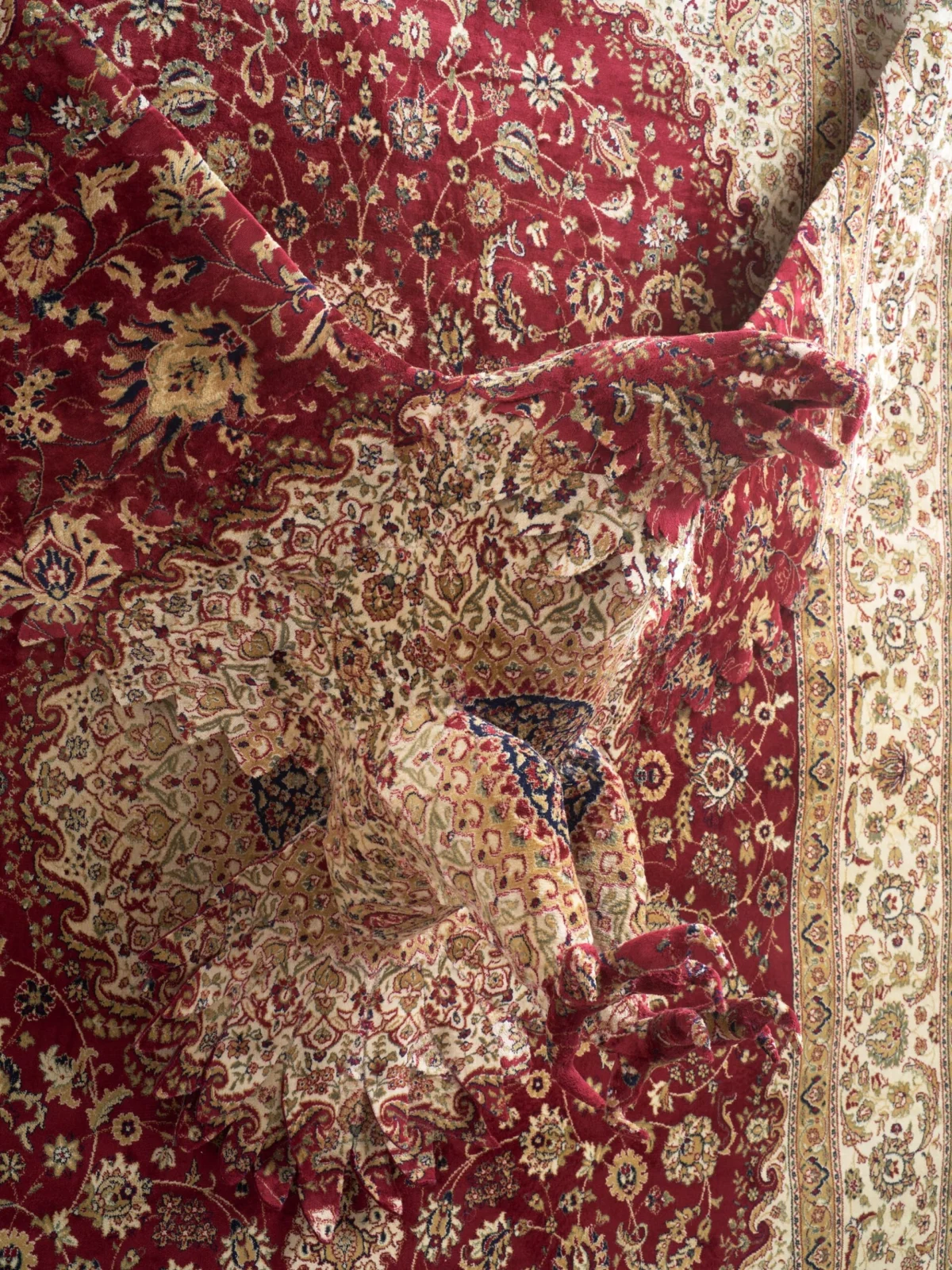
In the hushed, refined atmosphere of New York’s Sargent’s Daughters gallery, a silent migration is underway. Leopards, cougars, bears, and eagles—rendered in breathtaking, life-size detail—appear to be physically erupting from the very surfaces they inhabit. These are the latest works of British artist Debbie Lawson, whose solo exhibition, In a Cowslip’s Bell I Lie, challenges the traditional boundaries between the domestic interior and the untamed natural world. By cloaking sculptural armatures in antique Persian carpets, Lawson creates a surreal hybrid of high art and decorative craft, a testament to the power of transformation.
The Anatomy of Emergence: Crafting the Impossible
Debbie Lawson’s practice is as much about structural engineering as it is about aesthetic vision. To achieve the seamless, unbroken surfaces of her animals, Lawson begins with a complex armature constructed from wire mesh, masking tape, and Jesmonite resin. This foundational skeleton provides the muscular tension and posture required for each beast, whether a cougar in mid-pounce or an eagle in flight.

Once the form is set, the process shifts to the meticulous application of textiles. Lawson sources vintage and antique Persian rugs, cutting and tucking the heavy, woven material over the resin forms with the precision of a master tailor. The result is a seamless continuity; the carpet’s intricate floral and geometric patterns flow across the creature’s haunches and shoulders, suggesting that the animal has not been merely "wrapped" in a rug, but has materialized from within the weave itself.
This act of "tucking" creates a tension between the rigid geometry of the carpet pattern and the organic curves of the animal. When the viewer encounters a work like Wild Dog Sundown (2025), there is an immediate, visceral confusion: is the dog a solid object camouflaged by its surroundings, or is the pattern itself coming to life?

Chronology of a Creative Evolution
Lawson’s trajectory as an artist is deeply rooted in the textile traditions of her native Dundee, Scotland—a city with a profound history of jute and carpet manufacturing. Her fascination with the intersection of art and domesticity is not a recent development but a lifelong exploration of the spaces where "women’s work" meets the gallery pedestal.
- Formative Years: Growing up in Dundee, Lawson was exposed to the labor-intensive nature of textile production. This early immersion instilled a respect for craft that persists in her current practice.
- Early Sculptural Experiments: Before refining the carpet-cloaked technique, Lawson spent years exploring how wildlife motifs historically appear in interior design, from Victorian hearth carvings to Rococo moldings.
- The Development of the "Hybrid" Technique: Over the last decade, Lawson transitioned from traditional sculpture to the integration of reclaimed interior textiles, effectively blurring the lines between decorative objects and fine art.
- 2024–2026: Recent Milestone Works: The current exhibition at Sargent’s Daughters features her most ambitious work to date, including the sprawling Red Eagle (2026) and the delicate, table-bound Prospero (2026), marking a maturation in how she balances negative space and heavy fabric.
Supporting Data: The Language of the "Wild"
The title of the exhibition, In a Cowslip’s Bell I Lie, is borrowed from Shakespeare’s The Tempest. It refers to the spirit Ariel’s song of liberation after escaping the servitude of Prospero. By invoking this text, Lawson invites the viewer to consider the nature of confinement—both the physical confinement of the animal within the pattern and the historical confinement of the domestic sphere.

The Materiality of the Works
- Wild Dog Sundown (2025): 92 1/2 x 61 3/4 x 24 3/4 inches; a commanding example of scale.
- Red Eagle (2026): 116 1/8 x 78 3/4 x 21 5/8 inches; utilizes steel armatures to support the dramatic, outstretched wingspan.
- Alligator (2025): 30 x 43 x 16 inches; showcases the artist’s ability to render reptilian texture through the flat, pile-heavy surface of a carpet.
Lawson’s work references a wide historical lineage. She draws direct inspiration from the frescoes of Pompeii, which often feature hidden animal forms, as well as the lions of the New York Public Library and the whimsical furniture of Les Lalannes. This breadth of influence reinforces her thesis: that nature has always been present in our domestic objects, waiting to be "found."
Official Perspectives: Nature vs. Domesticity
In a statement provided by Sargent’s Daughters, the gallery notes that Lawson’s work is designed to provoke "questions about the relationships between decoration and nature, craft and camouflage." The gallery’s curation emphasizes that these sculptures do not exist in a vacuum; they are, in effect, architectural interventions.

Lawson herself has spoken at length regarding the gendered implications of her medium. "I’m thinking about women, including some of my near ancestors, so often confined by the constraints of the patriarchal society in which they lived," she says. "They were trapped in the daily grind, unable to pursue their own creative talents or fully inhabit the world."
For Lawson, the act of taking a domestic carpet—a staple of the home—and shaping it into a wild predator is an act of reclamation. It transforms the "trap" of the household into a vessel for the untamed, allowing the domestic sphere to regain the power and unpredictability of the wilderness.

The Implications of the "Textile Turn"
The contemporary art world has seen a significant shift over the last twenty years: the elevation of craft, particularly textiles, to the status of high art. Historically, embroidery, weaving, and sewing were relegated to the realm of the domestic or the "lesser" arts. Lawson’s work serves as a powerful disruption of this hierarchy.
By utilizing materials that are inherently domestic, yet crafting them into high-stakes, sculptural statements, Lawson forces the viewer to acknowledge the intellectual labor involved in craft. The "camouflaged" animals are not merely pretty objects; they are technical feats of engineering that command the same respect as bronze or marble sculpture.

The Intersection of Art and Decor
The dialogue between the interior and the exterior remains the primary tension in Lawson’s work. The "domestic" is often associated with refinement, safety, and control. By introducing the "wild"—the leopard, the cougar, the alligator—into this context, Lawson subverts the safety of the living room. She asks us to consider whether we ever truly domesticate our surroundings, or if the wild is simply waiting in the patterns of our rugs to emerge.
Conclusion: A Lingering Presence
As In a Cowslip’s Bell I Lie continues through May 30, the exhibition stands as a compelling reminder of the permeability of boundaries. Debbie Lawson’s animals do not break free from their carpeted prisons; they exist in a state of permanent, beautiful metamorphosis. They remind the viewer that the history of art is not a linear progression, but a layered, woven tapestry where the wild and the domestic are forever entwined.

Whether one views these works as a critique of patriarchal history, an exploration of material science, or simply a breathtaking exercise in trompe l’oeil, the impact is undeniable. Lawson has succeeded in making the inanimate feel alive, and in doing so, has fundamentally altered how we perceive the very floor beneath our feet. Through her eyes, the familiar patterns of our homes become not a setting, but a landscape—a place where the wild is not just welcome, but waiting to be set free.


 Nana
Nana
 Nana Wu