Nana Muazin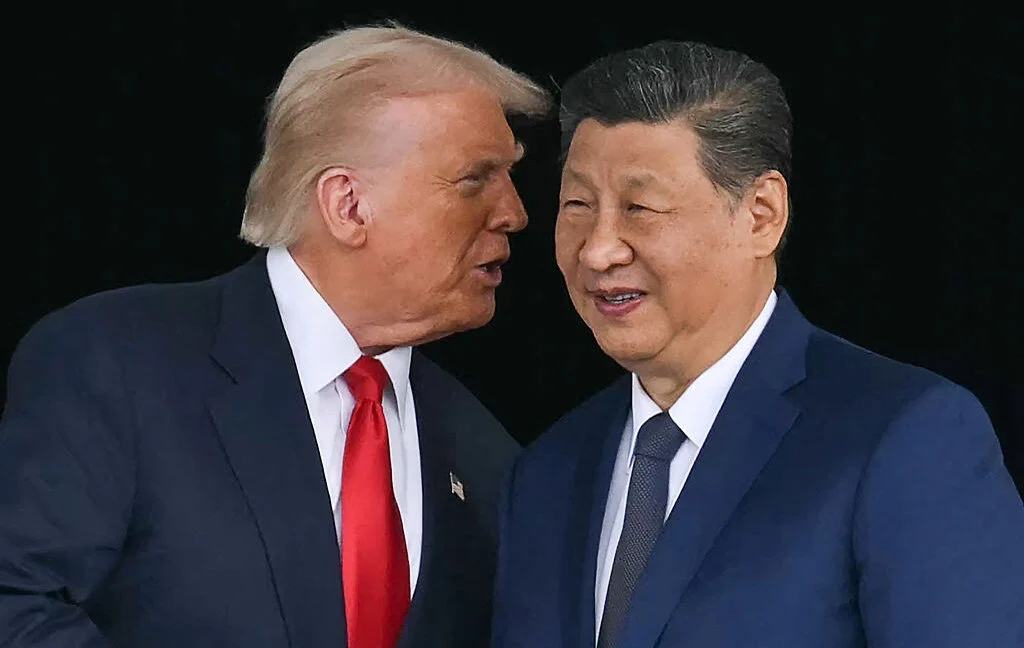
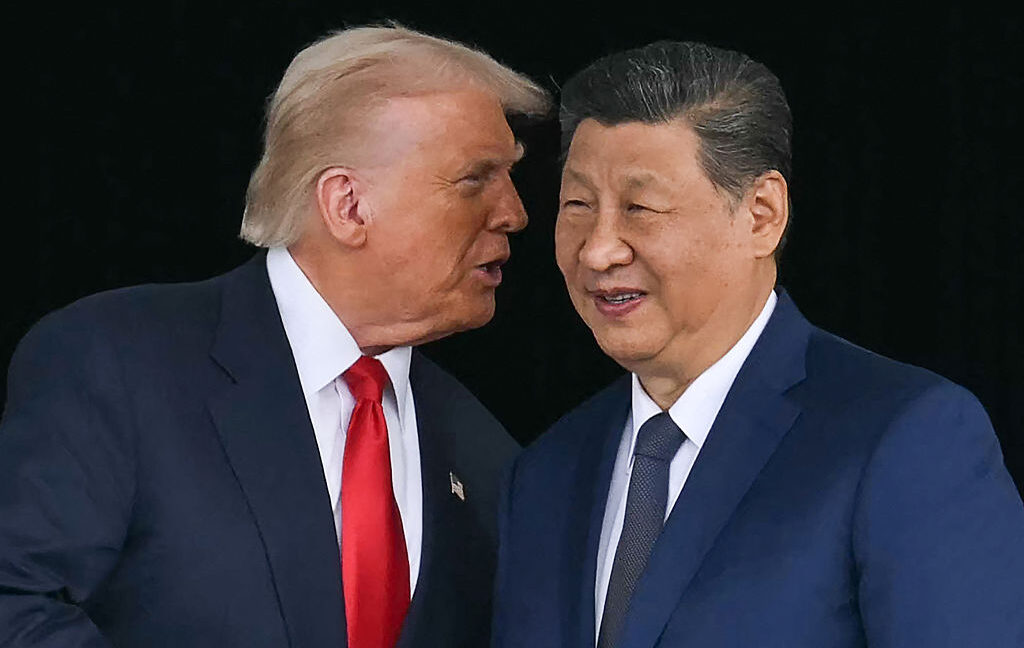
As President Donald Trump arrives in Beijing for two days of critical high-level meetings with President Xi Jinping, the geopolitical landscape is defined less by American strength and more by a desperate scramble for strategic equilibrium. Experts suggest that the President enters these negotiations with remarkably thin leverage, a reality that has forced him to pivot away from aggressive rhetoric toward a reliance on the very tech titans he previously scrutinized.
The summit, long anticipated as a potential reset, arrives after a series of domestic and international setbacks for the administration. Trump’s initial "America First" strategy—which promised a swift resolution to the conflict in Ukraine, stabilization in the Middle East, and a robust, unilateral expansion of tariffs—has largely failed to materialize. Instead, the administration’s escalations in the Middle East have provided Beijing with significant geopolitical breathing room, allowing Xi Jinping to approach the table from a position of relative stability.
A Pivot to the Private Sector: The "Tech Gaggle"
Recognizing that his traditional diplomatic and economic bludgeons have lost their potency, Trump has taken the unconventional step of bringing the titans of Silicon Valley to the negotiating table. The delegation includes Apple CEO Tim Cook—often affectionately dubbed "Tim Apple" by the President—who is widely expected to be embarking on his final major diplomatic mission before his planned departure from Apple’s helm.
Joining him is Elon Musk, whose ongoing role as an informal advisor on foreign policy underscores the blurring lines between American industrial interest and national security. In a last-minute addition that has drawn both scrutiny and hope, Nvidia CEO Jensen Huang has also joined the delegation. For Huang, the summit represents a potential breakthrough: a chance to finally secure Beijing’s blessing for the export of high-end AI chips, a hurdle that has remained a thorn in Nvidia’s side for months.
Trump’s public framing of the delegation on Truth Social was characteristically optimistic, describing it as an "honor" to be flanked by these industry leaders. His stated goal is to convince Xi to "open up" the Chinese market, effectively inviting these corporate giants to "work their magic" and elevate the People’s Republic to a higher tier of technological capability. However, critics argue this move is a thin veil for the administration’s inability to manage the US-China relationship through traditional statecraft.
Chronology of the Failing Leverage
To understand the current volatility, one must look at the timeline of the administration’s policy trajectory over the past year.
- Early 2025: The administration launched an aggressive push to diversify global supply chains, specifically targeting the semiconductor industry. The goal was to decouple from China’s "Silicon Shield" by pressuring firms to move production to the US.
- Mid-2025: The "Liberation Day" tariffs were implemented. However, legal challenges quickly mounted. By early 2026, the Supreme Court struck down the emergency tariffs, and subsequent rulings deemed the broader global tariff strategy illegal. This stripped the President of his primary weapon for forcing Chinese concessions.
- Late 2025: Faced with the failure of his trade strategy, Trump intensified rhetoric against Taiwan, pressuring the island to relocate 50 percent of its chip manufacturing to the US or risk losing American security guarantees. This created profound unease in Taipei and signaled inconsistency to Beijing.
- January 2026: The current summit preparations began. Recognizing the need for a face-saving victory, the White House pivoted to include tech executives, hoping to leverage the interdependence between American chip design and Chinese market access.
The AI Race: A Mutual Dependence
Scott Kennedy, a senior adviser at the Center for Strategic and International Studies (CSIS), who recently returned from a two-week fact-finding mission in Beijing, notes that the summit’s agenda was hastily expanded to include AI risk management. This pivot was spurred by China’s recent decision to block Meta’s acquisition of the Chinese firm Manus, a move that sent shockwaves through the tech sector and highlighted the deepening "AI wall" between the two nations.
Despite the bravado, both Washington and Beijing are trapped in a cycle of mutual reliance. Nvidia’s chips remain the gold standard for global AI development, and China is desperate for them to maintain its own competitive edge. Conversely, US firms rely heavily on China for the processing of rare-earth elements and other critical raw materials.
"It is a delicate dance," says Kennedy. "Both sides are realizing that total decoupling is not only impossible but catastrophic for their own domestic industries. The question is whether they can find a framework for cooperation that doesn’t sacrifice long-term national security."
Official Responses and Washington’s Dissent
The inclusion of Jensen Huang in the delegation has sparked an outcry among "China hawks" within Washington. Chris McGuire, a senior fellow for China and emerging technologies at the Council on Foreign Relations, argues that the move is fundamentally shortsighted.
"Any deal that allows Nvidia to sell more chips to China means fewer Nvidia chips for US firms, and a smaller US lead in AI over China," McGuire stated in a recent briefing. "It is remarkable that President Trump keeps getting convinced to put Nvidia’s interest ahead of America’s. If we trade away our technological edge for short-term corporate profits, we are effectively subsidizing our own decline."
From the Chinese side, the state media has remained cautiously optimistic, focusing on the potential for "pragmatic cooperation." However, beneath the surface, Beijing’s priority remains fixed: they are looking for a definitive pivot on the status of Taiwan.
The Taiwan Question: Strategic Instability
For Xi Jinping, the summit is an opportunity to extract a change in US posture regarding Taiwan. For decades, the US has maintained a policy of "strategic ambiguity." Recently, however, Trump’s rhetoric has shifted toward a more transactional view. His public comments—suggesting that the fate of Taiwan is "up to him"—have caused alarm among US allies and confusion in Taipei.
Michael Schiffer of the Center for American Progress warns that this inconsistency is dangerous. "The administration’s signals on Taiwan have grown so contradictory that neither Beijing nor Taipei can reliably discern American policy," Schiffer writes. "By treating Taiwan’s security as a bargaining chip for semiconductor manufacturing, the President is broadcasting a message that, for the right price, American commitments are expendable."

Taiwan’s government, clearly anxious, has been working behind the scenes to "intensify" dialogue with the US. A deputy minister at Taiwan’s Mainland Affairs Council, Shen Yu-chung, recently noted that the island is watching the summit with extreme vigilance, fearing that a "grand bargain" between Trump and Xi could sacrifice Taiwan’s autonomy.
Implications for the Future
As the summit concludes, the world is waiting to see if anything of substance emerges. Experts largely agree that a "big win" for the US is unlikely. Instead, the most probable outcome is an extension of the existing trade truce, which provides both leaders with the stability they need for their respective domestic political cycles—Trump’s upcoming midterm elections and Xi’s ongoing consolidation of power.
However, the long-term implications are grim if the administration continues to ignore the structural weaknesses in its own policy. By cutting science and research funding in 2025, the US has created a vacuum that China is aggressively filling by poaching top-tier global scientists.
"That is really where the competition is going to be won or lost," Kennedy noted. "If the President focuses solely on the pomp and pageantry of this summit while ignoring the systemic erosion of our research capabilities, the tech executives standing behind him in Beijing will be the only winners of this trip."
For now, the world remains in a state of precarious waiting. Trump has pinned his hopes on the "magic" of Silicon Valley to solve a problem that has become a fundamental struggle for global hegemony. Whether this gamble results in a breakthrough or a further weakening of American strategic standing remains to be seen, but the margin for error has never been thinner.


 Neng Nana
 Sagoh
Sagoh