

In an era defined by rapid technological shifts, environmental unpredictability, and the persistent human yearning for order, the act of creation remains one of our most profound attempts to find equilibrium. This May, Joy Machine invites audiences to explore this tension through Feel Free, a compelling new group exhibition that challenges the illusion of autonomy in an ever-changing world. Featuring the works of Rachel Hayden, Paulina Ho, Hanna Lee Joshi, and Jeremy Miranda, the exhibition serves as a visual meditation on the necessity of surrender.
The exhibition is slated to open with a public reception on May 15, 2026, from 6:00 p.m. to 8:00 p.m., and will remain on display through June 27, 2026.
The Human Instinct for Order: Contextualizing the Exhibition
The central premise of Feel Free rests on a philosophical paradox: while humans have historically strived to map, categorize, and control their environment to secure a sense of safety, the reality of the human condition is characterized by flux. From the cycles of nature to the whims of fortune, change remains the only constant.

The curators at Joy Machine suggest that the four featured artists do not attempt to solve this existential puzzle. Instead, they embrace the limitations of human control. By focusing on the "small instances of understanding"—the fleeting moments where chaos momentarily aligns into a discernible pattern—the artists provide a roadmap for navigating uncertainty. The exhibition asks visitors to consider whether "feeling free" is truly the result of having control, or if it is, in fact, the result of letting it go.
Chronology of the Artistic Process
The journey to Feel Free has been one of quiet, methodical evolution. Each artist involved brings a distinct methodology, yet all are united by a common thread of responding to their personal and professional environments over the last eighteen months.
The Shift in Medium and Philosophy
For artists like Paulina Ho, the preparation for this exhibition involved a significant departure from her standard practice. Traditionally working with controlled acrylics on canvas, Ho’s trajectory shifted during an artist residency in Joseph, Oregon. Influenced by the intricate cream-and-blue Moorish architecture she encountered in Andalusia, Spain, Ho pivoted to working with reclaimed textiles sourced from thrift shops. This process of working with pre-existing, "lived-in" materials mirrors the exhibition’s theme of accepting the "undone" nature of reality.

The Methodology of Impermanence
Jeremy Miranda’s approach to the canvas also highlights a departure from rigid planning. His work, characterized by domestic objects—a stock pot, a bundle of white asparagus, an antique sink—utilizes a unique wet-sanding technique. This process is not merely aesthetic; it is a collaborative effort between the artist and the materials. Miranda acknowledges that he is not the sole architect of the final image; by sanding back layers of paint, he allows the history of the work to dictate its final form, effectively "surrendering" to the process of creation.
Supporting Data and Artistic Profiles
The exhibition brings together four distinct voices, each interrogating the boundaries between the self and the external world.
Rachel Hayden: The Uncanny Synthesis
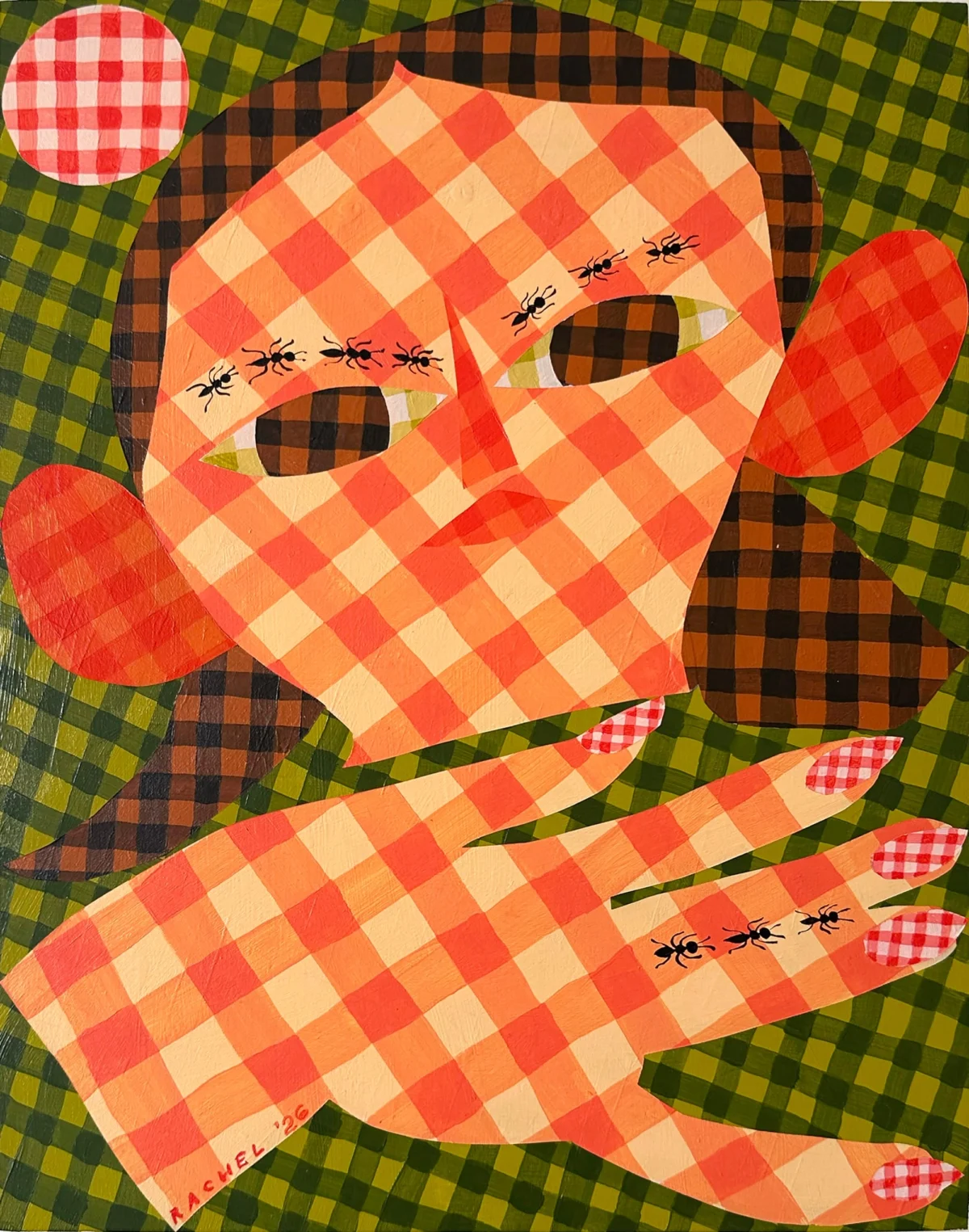
Rachel Hayden is recognized for her ability to project complex human emotions onto the natural world. Her compositions often feature flora and fauna that appear to possess a sentient, sometimes uncomfortable, awareness. In Picnic Bouquet and Self-Portrait as a Picnic Blanket, Hayden utilizes the iconic checkerboard pattern of a picnic blanket to dissolve the boundaries between subject and object. By masking human figures in the same gingham print as the fruit and plants surrounding them, she creates a visual harmony that is both playful and profoundly unsettling. The inclusion of ants crawling across a character’s face to form arched eyebrows is a hallmark of her style: finding a terrifying, yet beautiful, order within a chaotic scene.

Hanna Lee Joshi: Emotional Gradients
Hanna Lee Joshi continues her exploration of the inarticulable through her signature nude figures. Her technique—blending gouache and colored pencil to create soft, textured gradients—lends a dreamlike quality to her work. In the piece Held like a flower, Joshi presents an anonymous woman, her identity obscured by a dense mass of black hair, leaning in to observe a single blossom. The delicate, vine-like lines mimic the anatomy of the subject’s fingers, creating a visual metaphor for the connection between the human spirit and the natural world. Her work serves as a reminder that some of our most "controlled" moments of introspection are, in reality, quiet submissions to our own nature.
Paulina Ho: The Cyclical Pattern
Ho’s use of Japanese indigo on thrifted fabric highlights the cyclical nature of life. Her pieces, such as Spectacle and Restful, capture movement through frayed edges and bold color shifts. By moving away from the rigid structure of traditional canvas, Ho allows the texture of the fabric to influence the composition. Her work suggests that true freedom comes from acknowledging that everything—ourselves included—is in a constant state of becoming and unmaking.
Jeremy Miranda: The Lived Object
Miranda’s acrylic paintings, including Stock Pot and Faucet, offer a grounded counterpoint to the more abstract emotional landscapes of his peers. His focus on mundane objects stripped of their functional context—a faucet without a sink, a pot on a burner—forces the viewer to confront the object as a pure, singular entity. The wet-sanding technique mentioned previously ensures that the work reflects its own lifespan, effectively documenting the time and labor invested in its creation.

Implications for Contemporary Art
Feel Free arrives at a time when the art world is increasingly grappling with the role of the artist as a mediator between human anxiety and global instability. By moving away from the "master" narrative—where the artist exerts absolute control over every stroke—these four creators propose a more humble, perhaps more honest, relationship with their craft.
The exhibition’s implication is clear: the pursuit of perfection is an exhausting, futile endeavor. By embracing the "slippery qualities of memory" and the unpredictability of materials, these artists suggest that the viewer, too, might find a sense of liberty. The exhibition does not provide answers to the chaos of modern life, but it offers a space to breathe within it.
Official Exhibition Details
For those planning to attend, the following details are essential:

- Exhibition Feel Free
- Opening Reception: May 15, 2026, 6:00 p.m. – 8:00 p.m.
- Closing Date: June 27, 2026
- Location: Joy Machine
- Featured Artists: Rachel Hayden, Paulina Ho, Hanna Lee Joshi, and Jeremy Miranda
Interested parties are encouraged to RSVP via the official Luma invitation page to ensure entry to the opening night.
In summary, Feel Free is more than a display of technical skill; it is a timely exploration of the surrender required to truly inhabit one’s life. As the artists demonstrate, when we stop fighting the tide of change, we may find that we are not drowning, but simply floating in a sea of our own making. Whether through the gingham-covered anxieties of Rachel Hayden or the indigo-dyed landscapes of Paulina Ho, the exhibition serves as a poignant reminder that even in a world where nothing is guaranteed, there is a profound beauty in the effort to keep looking, keep painting, and keep feeling.









No comments yet. Be the first to join the conversation!