


In a nation currently grappling with the world’s most acute demographic crisis, the personal decision of one local official has ignited a fierce national debate. Shōko Kawata, the mayor of Yawata in Kyoto Prefecture, recently announced her intention to take maternity leave, marking a historic moment as she becomes the first sitting female mayor in Japan to do so. While her decision aligns with the government’s stated goals of reversing a plummeting birth rate, it has simultaneously exposed a deep-seated cultural rift regarding gender roles, political responsibility, and the systemic barriers facing women in Japan’s professional sphere.
The Intersection of Policy and Personal Life
The tension between Japan’s desperate need to encourage childbirth and the structural challenges inherent in raising children is a recurring theme in contemporary Japanese life. On one side of the ledger, the central government has committed trillions of yen to subsidize childcare and incentivize families, hoping to stave off an impending population collapse. On the other side, reality paints a more restrictive picture: stagnant gender equality, notoriously long working hours, and a corporate and political culture that often demands total, uninterrupted dedication to the office.
Shōko Kawata, elected in 2023, is a figurehead for a new generation of leadership. A native of Nara, her career trajectory began as a welfare case worker and later as a private secretary to a member of Japan’s Upper House. Her election as the youngest female mayor in the country—backed by a broad coalition including the Liberal Democratic Party (LDP), Kōmeitō, and the Constitutional Democratic Party (CDP)—was viewed as a progressive step forward. However, her announcement on May 20th regarding her upcoming maternity leave brought to light the friction that still persists in the corridors of power.
Chronology of the Announcement and Immediate Backlash
The unfolding of events highlights the volatility surrounding this issue:

- May 20, 2026: Mayor Kawata officially informs the Asahi Shimbun of her intent to take maternity leave, signaling a shift in how political office can be managed.
- May 21, 2026: During a formal press conference, Kawata outlines the logistical framework for her absence. She plans for six to eight weeks of prenatal leave and eight weeks of postnatal leave, followed by a period of childcare leave.
- Contingency Planning: To ensure the stability of the Yawata municipal government, Vice Mayor Nose Shigeto has been designated to manage daily operations. However, in a nod to the demands of her role, Kawata emphasized her intent to remain engaged, attending key meetings remotely and staying available via digital communication.
- The Reaction: Within hours of the announcement, the public discourse split. While many citizens applauded the move, a vocal contingent of the “old guard” and online critics demanded her salary be zeroed out during the period, arguing that she could not fulfill her duties while on leave.
The “Old Guard” and the Clash of Generations
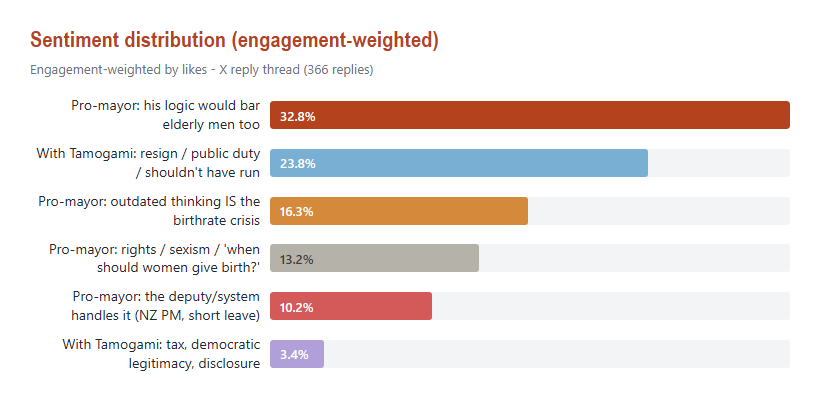
The backlash was perhaps most visibly embodied by Tamogami Toshio, the former chief of staff of the Japan Air Self-Defense Force. Posting on X (formerly Twitter), Tamogami expressed “great unease,” stating, “If a long leave is foreseeable, I don’t think you should run for offices like mayor.”
Tamogami’s commentary reflects a traditionalist view of public office that equates physical presence and continuous, unencumbered availability with the only form of legitimate leadership. His remarks served as a lightning rod, drawing immediate fire from the public. While approximately 24-27% of users in various sentiment analyses sided with his perspective, the overwhelming majority of online engagement was heavily critical.
The response was not merely defensive of Kawata; it was an attack on the logic of the older generation. Critics pointed out the hypocrisy of such standards, noting that if physical continuity were the only metric for public service, many elderly male politicians currently in power—who may face health-related absences—would be equally ineligible to serve.
Supporting Data: Sentiment and Societal Friction
The digital discourse surrounding Kawata’s leave is a window into the changing social fabric of Japan. Engagement-weighted sentiment analysis on major social media platforms reveals a clear generational divide.
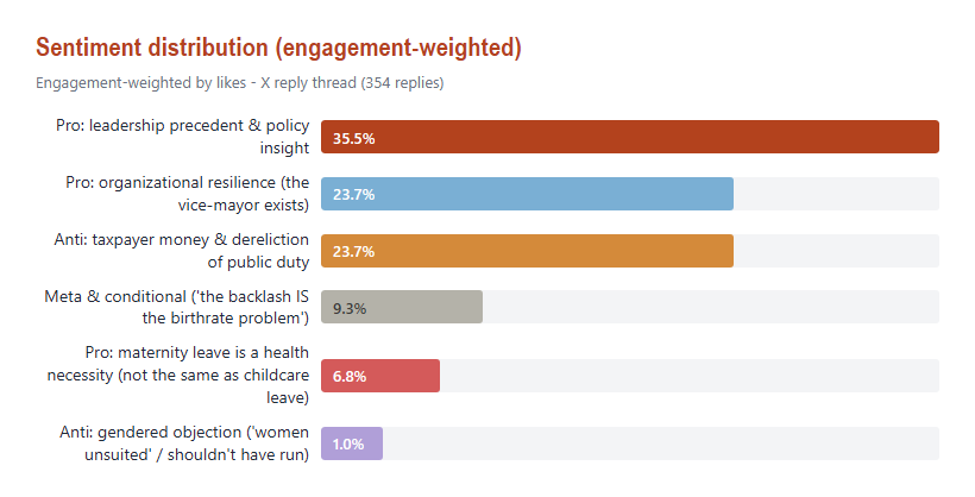
- The Pro-Leave Majority: Over 60% of commentary on platforms like Yahoo! News Japan defended the Mayor’s right to leave, framing it as both a legal entitlement and a necessary societal evolution. One popular comment, garnering thousands of likes, asked, “Anyone can fall ill at any time; why does someone taking maternity leave set you off?”
- The Misogynistic Fringe: Despite the progressive majority, a persistent, aggressive minority remains. Some comments labeled the leave “private use of tax money.” Most jarringly, the ancient Chinese proverb “When the hen crows, the nation falls”—a historical trope used to suggest that women in power lead to national ruin—was invoked by detractors. This underscores that for some, the objection to maternity leave is not about logistics, but about the fundamental challenge to patriarchal norms.
- The “Disruptive” Argument: Even among more moderate voices, a nuance persists: while the right to maternity leave is accepted, the concept of “childcare leave” for a high-ranking official is perceived by some as “disruptive.” This suggests that while Japan is beginning to accept biological necessity, the concept of shared parenting and the prioritization of family life over the political machine is still viewed with skepticism.
Implications for Japanese Democracy
The implications of this debate extend far beyond the city of Yawata. Japan’s systemic gender gap—as noted in the World Economic Forum’s annual reports—is largely a product of the structural, cultural, and political barriers that prevent women from attaining and sustaining positions of power.
The Paradox of Population Policy
The Japanese government continues to push for higher birth rates, yet the environment for parents remains hostile. Mothers frequently report feeling unwelcome on public transit with strollers, and local daycare centers often face noise complaints from neighbors. When major brands, such as Soup Stock Tokyo, attempt to offer free baby food or family-friendly services, they are often met with backlash from those who view such accommodations as improper or an imposition.
The Burden of Inequality
The reality for working women in Japan is a “double burden.” Even in dual-income households, which now constitute roughly 70% of married-couple homes in Japan, the overwhelming majority of domestic labor and childcare falls on the woman. This creates a scenario where women who wish to pursue high-level careers are forced to choose between their professional ambitions and their personal lives—a choice rarely forced upon their male counterparts.
The "Reskilling" Misconception
The problem is not entirely a result of male-led institutions, but rather a lack of systemic support for anyone—men or women—to take parental leave. Men who attempt to take leave often face demotion or forced transfer. Furthermore, official government messaging has occasionally been tone-deaf; for instance, former Prime Minister Kishida Fumio once suggested that employees on parental leave should use the time to “reskill,” rather than focusing on the primary, all-consuming task of raising an infant.
Conclusion: A Path Toward Change
Mayor Kawata’s stance—that she wants to create a society where women can compete at the highest levels without sacrificing their right to be parents—is a direct challenge to the status quo.
The backlash against the “old guard” suggests that the Japanese public is increasingly out of step with the traditionalist gatekeepers of their political system. While the “old guard” still holds the levers of power, the demographic and economic realities of Japan are becoming impossible to ignore. For a nation that faces a shrinking labor force and an aging population, the ability to integrate women into the political and professional workforce—not as honorary men who must sacrifice family life, but as full participants—is no longer a matter of social justice alone; it is a matter of national survival.
If voters continue to elect young, reform-minded leaders like Kawata, the rigid, outdated expectations of the past may slowly give way. However, as the debate over her maternity leave proves, that shift will not come without a fight. The future of Japanese governance will depend on whether it can move from a culture that demands sacrifice to one that fosters sustainability.











No comments yet. Be the first to join the conversation!