

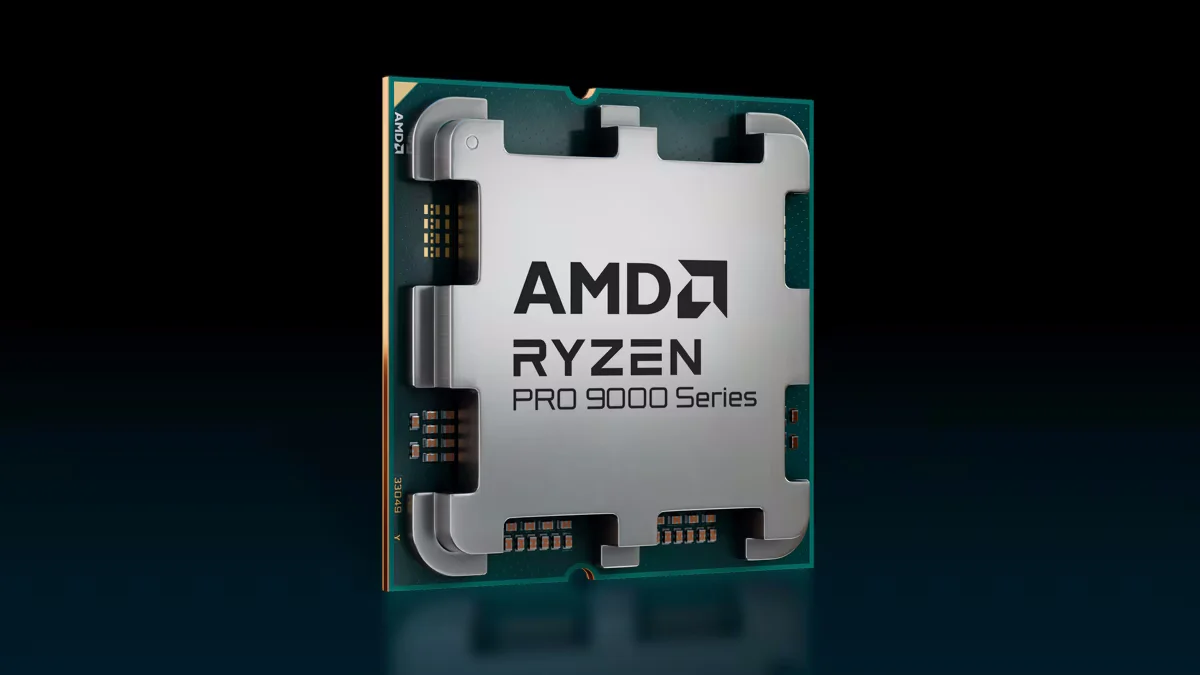
AMD has officially shattered the traditional boundaries of the professional workstation market. In a move that signals a significant departure from its historical focus on strictly power-efficient, low-TDP (Thermal Design Power) business silicon, the company has announced six new additions to its Ryzen PRO 9000 series. Most notably, this release marks the debut of AMD’s proprietary 3D V-Cache technology within the enterprise-grade PRO lineup, bridging the gap between high-performance consumer gaming hardware and mission-critical workstation stability.
Main Facts: A New Tier of Performance
The expansion introduces processors that cater to a broader spectrum of professional needs, ranging from standard business productivity to highly specialized engineering and simulation tasks. By moving beyond the previous 65W constraints, AMD is providing enterprise users with the thermal headroom required to push the Zen 5 architecture to its absolute limits.
At the pinnacle of this new range sits the Ryzen 9 PRO 9965X3D. Boasting 16 cores and 32 threads with a blistering boost clock of up to 5.5GHz, this flagship chip is designed for those who require immense multi-threaded throughput coupled with the massive L3 cache advantages that 3D V-Cache provides. With 128MB of L3 cache, it serves as a professional-grade counterpart to the consumer-facing 9950X3D, but with the added security, manageability, and stability features inherent to the PRO branding.
Complementing the flagship is the Ryzen 7 PRO 9755X3D, an 8-core, 16-thread powerhouse that brings the V-Cache revolution to the mainstream workstation tier. Operating at a 120W TDP, it offers a 5.2GHz boost clock and 96MB of L3 cache, providing a unique middle-ground for developers and data scientists who require cache-sensitive performance without the thermal requirements of the higher-end 170W parts.
Chronology: The Evolution of the PRO Lineup
The evolution of the Ryzen PRO series has been a measured, methodical process. Since the inception of the Ryzen PRO brand, AMD’s strategy centered on "managed business deployments." Historically, this meant prioritizing low power envelopes—typically 65W—to ensure that IT departments could deploy these chips in small-form-factor office PCs without complex thermal management or specialized cooling solutions.
- Early 2024: AMD solidified the Zen 5 roadmap, promising improvements in IPC (Instructions Per Clock) and power efficiency.
- Late 2025: Speculation mounted regarding whether the "X3D" technology, which had dominated the enthusiast and gaming sectors, would ever cross over into the professional sphere.
- Mid-2026: AMD officially breaks the cycle. By introducing the 120W and 170W variants, the company has explicitly acknowledged that the modern professional workstation has evolved. No longer just a word processor or spreadsheet machine, the workstation of 2026 is a hub for AI-assisted design, complex fluid dynamics simulation, and high-frequency data modeling.
This shift suggests that AMD identified a significant segment of its enterprise customer base that was choosing consumer "X3D" chips—sacrificing the stability and remote management features of the PRO series—simply to access the massive cache performance. With this announcement, AMD is reclaiming those users by offering the best of both worlds.
Supporting Data: The Technical Breakdown
The transition to higher TDPs is not merely a marketing decision; it is a technical necessity. To maintain the high boost clocks of the Zen 5 cores while simultaneously powering the stacked 3D V-Cache, these processors require significantly more electrical current than their 65W predecessors.
| Processor | Cores/Threads | Max Boost | TDP | L3 Cache Type |
|---|---|---|---|---|
| Ryzen 9 PRO 9965X3D | 16/32 | 5.5 GHz | 170W | 128MB (3D V-Cache) |
| Ryzen 9 PRO 9965 | 16/32 | 5.5 GHz | 170W | 64MB (Standard) |
| Ryzen 7 PRO 9755X3D | 8/16 | 5.2 GHz | 120W | 96MB (3D V-Cache) |
| Ryzen 9 PRO 9955 | 12/24 | 5.4 GHz | 120W | 64MB (Standard) |
| Ryzen 7 PRO 9755 | 8/16 | 5.4 GHz | 120W | 32MB (Standard) |
| Ryzen 5 PRO 9655 | 6/12 | 5.4 GHz | 120W | 32MB (Standard) |
The integration of 3D V-Cache significantly lowers memory latency for workloads that rely heavily on frequently accessed data sets. For software compilers, CAD (Computer-Aided Design) applications, and financial modeling tools, the massive L3 cache acts as a high-speed buffer that minimizes the need for the CPU to fetch data from the slower system RAM, resulting in significant performance gains in latency-sensitive applications.
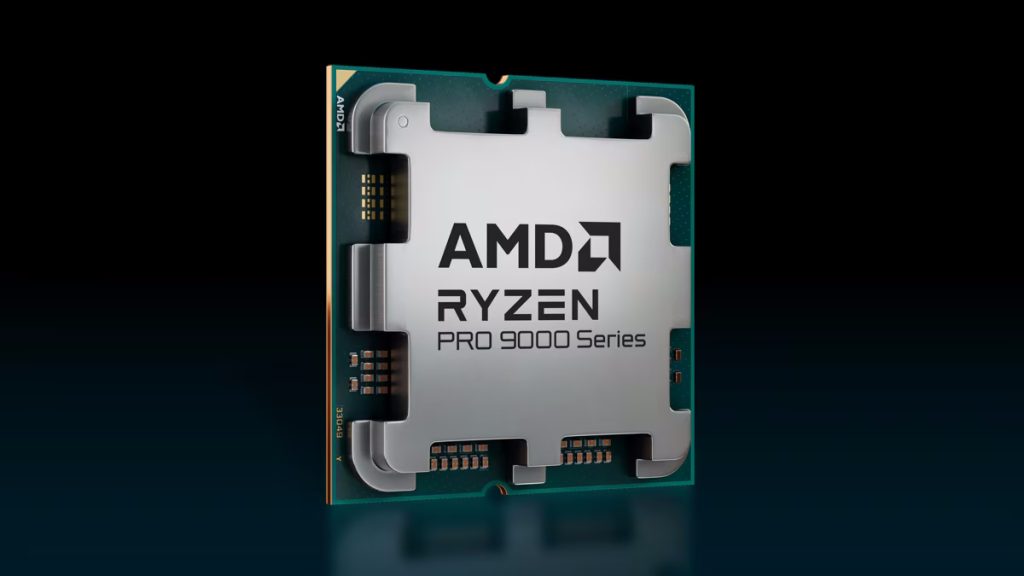
Official Responses and Strategic Positioning
While AMD has yet to release full benchmark suites for the PRO 9000 series, industry analysts suggest that the company’s pivot is a direct response to the increasing demands of AI-integrated workflows. In briefings, AMD representatives emphasized that "professional reliability is no longer synonymous with low power consumption."
The decision to retain the "PRO" designation signifies that these chips come with the full suite of AMD PRO technologies:
- AMD Memory Guard: Providing full system memory encryption to protect sensitive data.
- AMD PRO Manageability: Enabling remote, out-of-band management that is vital for large-scale enterprise IT infrastructure.
- Extended Platform Stability: Ensuring that these processors receive long-term driver and firmware support, a crucial factor for companies with 3-to-5-year hardware refresh cycles.
By bundling these features with the high-performance X3D architecture, AMD is effectively creating a new product category: the "High-Performance Secure Workstation."
Implications: What This Means for the Market
The introduction of these processors will likely force a change in how workstation manufacturers approach system design. OEMs will now need to provide more robust cooling solutions for the PRO line, potentially leading to larger chassis designs and more sophisticated liquid cooling options in standard business environments.
For the end-user, the implications are profound. Developers who work in environments like Linux-based kernel compilation, or architects running real-time ray-traced previews in Revit or Maya, will see direct benefits from the 3D V-Cache. Previously, these professionals had to balance their need for speed with the requirements of corporate security policies. Now, the performance bottleneck of memory latency can be bypassed without compromising the enterprise-grade stability features required by their IT departments.
Furthermore, this move puts pressure on competitors. Intel’s vPro platform has long been the standard for enterprise security and manageability. However, by adding the "X3D" performance differentiator, AMD is attempting to frame their solution as superior for the modern, computationally intensive professional workload.
Conclusion: A New Standard for Enterprise
As the launch date approaches in the second half of 2026, the industry is watching closely. The Ryzen PRO 9000 series with 3D V-Cache is more than just a spec-bump; it is an admission that the professional workspace is changing. As AI, machine learning, and high-fidelity simulation become standard tools for the modern office, the hardware must keep pace.
Most traditional office workers will continue to find the 65W Ryzen PRO 9000 variants more than sufficient for their needs. However, for the segment of the workforce that pushes silicon to its breaking point, the Ryzen 9 PRO 9965X3D and its siblings represent a long-awaited realization of performance and professional-grade security. AMD has officially blurred the line between the enthusiast’s dream and the enterprise’s necessity, ensuring that the next generation of professional workstations will be the most capable ever produced.










No comments yet. Be the first to join the conversation!