

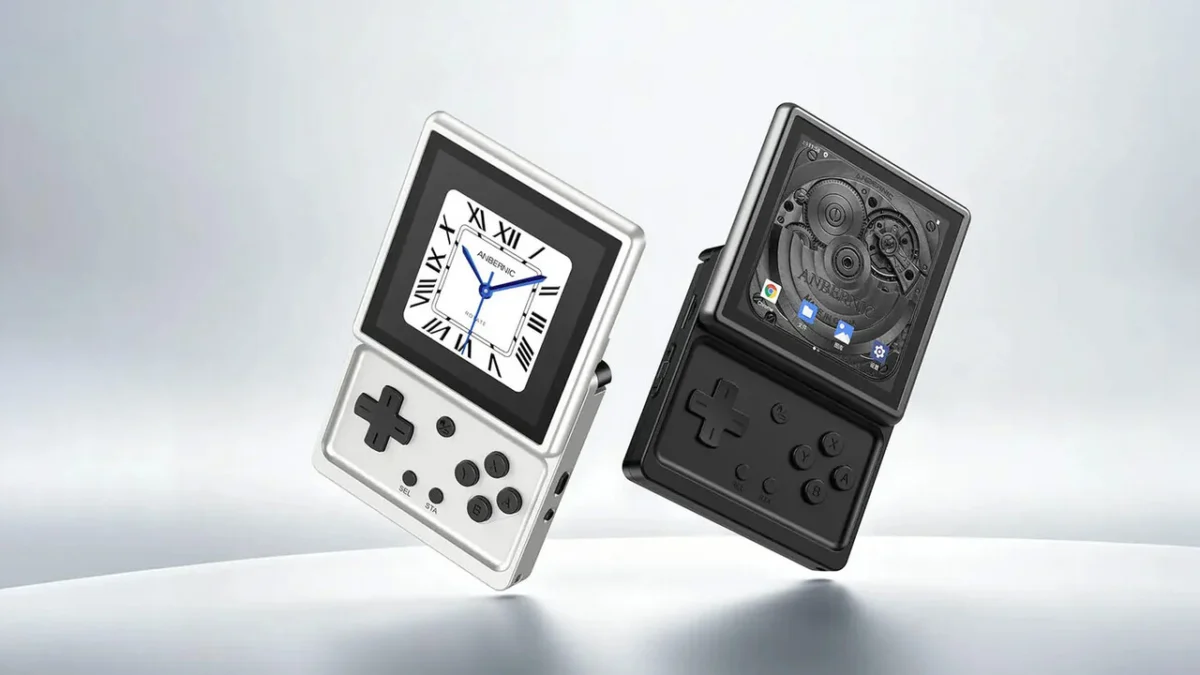
The handheld gaming market, long dominated by high-powered emulation giants and sleek, modern form factors, has just received a curious addition. Anbernic, a brand synonymous with the rapid-fire release of budget-friendly retro consoles, has officially launched its latest device: the RG Rotate. First teased roughly a month ago, the device sparked immediate intrigue within the gaming community due to its unconventional mechanical design. Today, the curtain has been pulled back entirely, revealing full technical specifications, pricing tiers, and the specific design philosophy behind this rotating curiosity.
The Core Concept: Portability Over Verticality
At first glance, the most striking feature of the RG Rotate is its 3.5-inch fully laminated IPS display. Unlike traditional handhelds that lean into wide-screen or standard vertical orientations, the RG Rotate features a strictly square 1:1 aspect ratio, boasting a resolution of 720 x 720 pixels.
Many enthusiasts initially speculated that the device’s rotating screen mechanism was engineered to accommodate "Tate mode" (vertical) arcade shooters or specific Game Boy titles. However, Anbernic has clarified that the primary objective is far more utilitarian: portability. By incorporating a hinge mechanism that allows the screen to fold or rotate into a protected position, the device becomes significantly more compact. This design choice aims to address the common "pocketability" complaint associated with handhelds that have protruding analog sticks or exposed screens prone to scratching. The RG Rotate essentially transforms into a sleek, manageable slab that can be slipped into a pocket with minimal risk to the display or the control surfaces.
Chronology: From Rumor to Retail
The trajectory of the RG Rotate follows the classic Anbernic release cycle. Approximately four weeks ago, leaked images and cryptic social media posts began to circulate within niche emulation forums, depicting a mysterious device with a pivoting frame. For weeks, speculators debated whether the device would run Linux or Android and whether it was designed for specific vertical-scrolling retro games.
As the weeks progressed, Anbernic leaned into the anticipation, slowly confirming the hardware specifications. The official launch date was set for May 11, 2024, at 3:00 AM PDT (12:00 PM CET). The rollout was timed to coincide with a global promotional event, where early-bird pricing was finalized to entice the company’s dedicated "day-one" fanbase.
Technical Specifications and Hardware Architecture
While the rotating screen is the headline-grabbing feature, the internals of the RG Rotate tell a story of tried-and-true, if slightly aging, technology.
The Processor and Performance
Under the hood, the device is powered by the Unisoc Tiger T618 SoC. This octa-core processor, which has become a staple in the mid-range emulation market, features two Cortex-A75 cores and six Cortex-A55 cores, all clocked at up to 2 GHz. Graphics processing is handled by the Mali G52 GPU running at 850 MHz.
While the T618 is more than capable of handling 8-bit, 16-bit, and even many 32-bit console titles, it represents a conservative choice in 2024. The device comes equipped with 3 GB of LPDDR4X RAM and 32 GB of eMCP storage. For power users, the storage limitation is mitigated by an external microSD card slot, which supports expansion up to 2 TB, allowing for massive libraries of ROMs.
Connectivity and Battery Life
The RG Rotate does not skimp on modern connectivity, featuring WiFi 5 (802.11ac) and Bluetooth 5.0 for wireless controller support and audio peripherals. Despite its compact footprint, Anbernic has managed to pack in a 2,000 mAh battery. The manufacturer estimates a run-time of approximately five hours, depending on the intensity of the emulation and screen brightness. Audio is output through two integrated stereo speakers, though the device retains a 3.5mm headphone jack for those seeking a more private, nostalgic experience.

The Software Conundrum: A Legacy OS
Perhaps the most debated aspect of the RG Rotate is its operating system. Anbernic has opted for Android 12. In the fast-moving world of mobile operating systems, Android 12 is now considered a legacy platform.
Industry analysts suggest this choice is likely forced by the limitations of the Tiger T618 chipset. Because the chip is several years old, modern driver support for newer Android versions is virtually non-existent for this specific silicon. While this limits the device’s utility as a modern mobile device—such as running the latest high-end Android gaming titles or productivity apps—it is largely sufficient for the purpose of emulation. Anbernic claims the system is optimized to run titles across more than 30 classic platforms, ranging from 8-bit handhelds to 128-bit era home consoles.
Pricing, Bundles, and Market Positioning
Anbernic is offering the RG Rotate in two distinct chassis configurations, reflecting different build qualities:
- Polar Black: A hybrid build combining aluminum and high-grade plastic, priced at $87.99 USD.
- Aurora Silver: A premium, full-aluminum chassis, priced at $107.99 USD.
To sweeten the deal, the company is offering tiered storage bundles. Users can add a 128 GB memory card for an additional $30 or a 256 GB card for $50. In a bid to secure initial sales volume, Anbernic has implemented an early-bird discount: customers who purchase the device within the first 72 hours of its release receive an $8 discount on the Silver model and a $5 discount on the Black model.
Implications for the Retro Handheld Market
The launch of the RG Rotate signals a broader shift in the retro handheld industry. For years, the race has been strictly about "power"—who can run GameCube or PlayStation 2 games the fastest? However, the market is beginning to show signs of saturation.
By pivoting toward experimental hardware design—such as rotating displays and pocketable form factors—Anbernic is attempting to carve out a new niche: the "lifestyle" emulator. The RG Rotate is not designed to be the ultimate powerhouse; it is designed to be a convenient companion.
The Durability Question
The use of a mechanical rotating hinge introduces a new point of failure that the community will be watching closely. In the world of budget hardware, moving parts are often the first to fail. If the hinge mechanism proves robust over time, it could set a new standard for compact gaming devices. If, however, the mechanism proves fragile, it may discourage future experimentation with moving parts in this price bracket.
The Software Gap
Finally, the reliance on an aging OS highlights a persistent issue: the industry’s dependence on legacy chipsets. As the pool of available, affordable, and high-performing SoCs dries up, manufacturers like Anbernic are increasingly forced to balance performance with software compatibility. The RG Rotate is a testament to the fact that while hardware is becoming more creative, the software foundation remains tethered to the past.
Ultimately, the RG Rotate is a bold, if technically safe, release. It prioritizes the "cool factor" and everyday utility over raw processing muscle. For the collector, it is a fascinating piece of hardware. For the average gamer, it offers a specific value proposition: a highly portable, aesthetically pleasing way to carry a library of thirty years of gaming history in a single pocket. As the first units begin to ship, the verdict will rest in the hands of the community, who will determine if this mechanical experiment is a harbinger of a new design trend or merely a one-off novelty.










No comments yet. Be the first to join the conversation!