In the heart of Singapore, a city-state renowned for its futuristic urban planning and high-tech infrastructure, a quiet revolution is taking place—one that challenges the very notion of what it means to grow older. While the common perception of aging often involves a gradual retreat from physical exertion and a growing fear of accidental falls, a specialized fitness initiative is flipping that narrative on its head.
Movement Singapore, a company that has been operating since 2018, is teaching individuals aged 50 to 70 the art of parkour. While the term may conjure images of adrenaline junkies leaping between skyscrapers, this "Geriatric Parkour" is a calculated, scientifically-backed approach to functional longevity. By mastering the ability to vault, roll, and navigate urban obstacles, the city’s seniors are reclaiming their physical autonomy and rewriting the rules of the golden years.
The Genesis of a Movement: Challenging the Status Quo
For most people, the physical decline associated with aging is accepted as an inevitable decline in quality of life. By the time many hit their mid-60s, the focus of their physical activity shifts—if it exists at all—toward low-impact, sedentary routines. The fear of falling, which can lead to life-altering injuries such as hip fractures, often becomes a self-fulfilling prophecy. As mobility decreases, the muscles atrophy, and the sense of balance required to stay upright begins to fade.
Movement Singapore identified a critical gap in the traditional wellness market: a lack of functional, confidence-building movement for the aging population. Rather than focusing on static gym machines, the company pivoted toward the principles of parkour—the discipline of moving from one point to another as efficiently and fluidly as possible.
Founded on the belief that the body is an instrument designed for navigation, the program treats the urban environment not as a series of barriers, but as a training ground. Since its inception in 2018, the initiative has grown from a niche experiment into a robust community, proving that agility is not a trait reserved for the young.
Chronology of a Physical Transformation
The journey for a student at Movement Singapore does not begin with high-octane stunts. The curriculum is meticulously structured to ensure safety while gradually pushing the boundaries of what these seniors believe their bodies can do.
Phase 1: Foundational Mobility and Awareness
In the first weeks, the focus is entirely on proprioception—the body’s ability to perceive its position in space. Instructors introduce basic movements that mimic daily tasks, such as squatting to pick up objects or shifting weight from one leg to another. This is the stage where participants overcome the psychological hurdle of "being too old" for movement.
Phase 2: The Art of the Fall
Perhaps the most crucial component of the training is "break-falling." In the event of an accidental slip, the natural instinct is to reach out with stiff arms, which often results in fractures. Movement Singapore teaches participants to distribute the force of an impact across the body’s larger muscle groups through controlled rolls and pivots. This technique effectively turns a potentially catastrophic fall into a controlled descent.
Phase 3: Urban Navigation
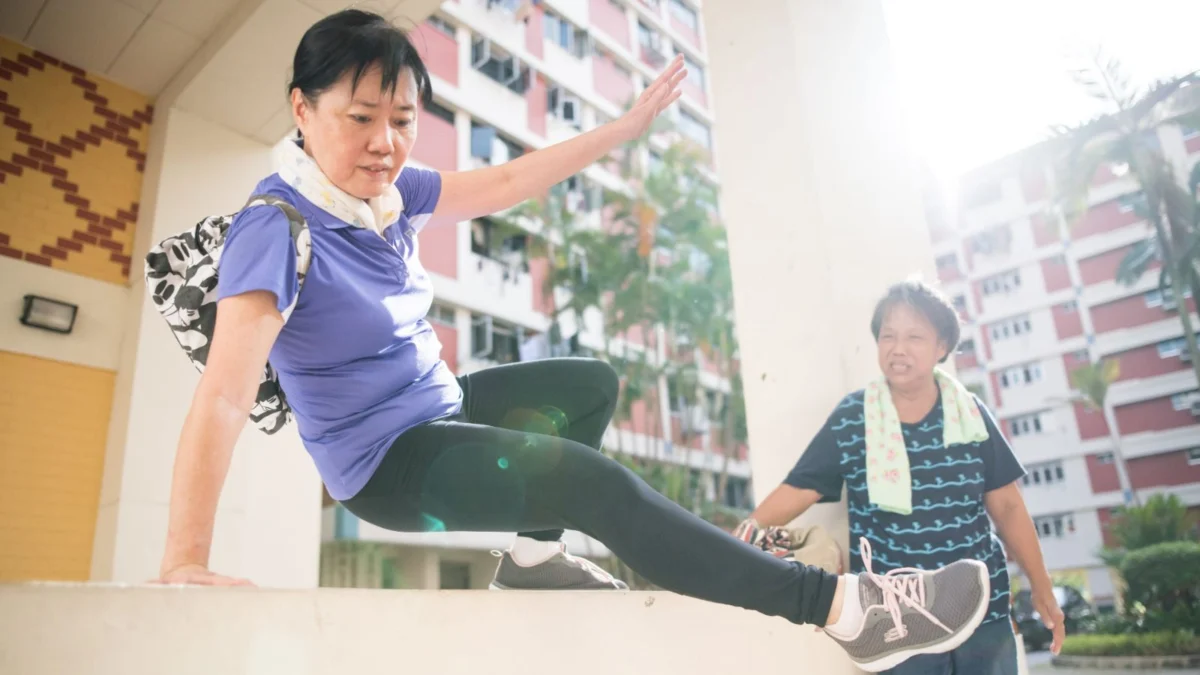
Once balance and falling techniques are mastered, students move to the obstacle courses. This involves navigating low-rise walls, swinging under railings, and hopping between platforms. It is here that the transformation is most visible. A 65-year-old student who arrived in the program struggling to climb stairs is soon seen vaulting over low barriers with the grace and confidence of a much younger individual.
Supporting Data: Why Parkour Works for Seniors
The effectiveness of this program is grounded in the principles of geriatric physical therapy. Studies have long suggested that "fear of falling" is a major contributor to immobility in the elderly. By systematically exposing participants to obstacles in a controlled environment, Movement Singapore utilizes a psychological principle known as "graded exposure."
- Bone Density and Strength: The weight-bearing nature of these exercises encourages the maintenance of bone density, a critical factor in preventing osteoporosis-related complications.
- Neuromuscular Coordination: Unlike linear exercise (like walking on a treadmill), parkour is multidirectional. It forces the brain to constantly adjust to uneven surfaces, which sharpens reflexes and improves vestibular function.
- Confidence Metrics: Internal reporting from Movement Singapore indicates that participants report a significant increase in their "Activities-specific Balance Confidence" (ABC) scale after just six months of training.
The Perspective from the Floor: Official and Participant Responses
The impact of this program extends far beyond physical health; it is a community-building endeavor.
"When I first joined, I was terrified of tripping on the sidewalk," says one participant in his early 60s. "Now, I don’t just walk; I navigate. I know how to move my body if I lose my footing. It’s given me back my freedom to walk through the city without fear."
Movement Singapore’s instructors emphasize that their goal is not to produce stunt performers, but to create "capable humans." They advocate for a shift in the healthcare paradigm: moving away from reactive medicine—treating the injury after the fall—to proactive movement—training the body to never hit the ground in the first place.
Public health experts in Singapore have taken note of the initiative. While there is no official government mandate for parkour in senior centers, the success of private entities like Movement Singapore has sparked conversations about integrating functional movement training into public community centers. The consensus among local physiotherapists is clear: the more "active" the elderly are, the lower the long-term burden on the national healthcare system.
Implications for Global Healthcare and Aging
The success of the "Geriatric Parkour" movement in Singapore serves as a blueprint for the rest of the world. As global populations age, the strain on healthcare systems due to fall-related injuries is expected to skyrocket.
1. Shifting the Narrative of Aging
If we can change the societal expectation that "old age equals frailty," we can unlock a massive amount of human potential. By teaching seniors that their bodies remain adaptable well into their 70s and beyond, we encourage lifelong physical engagement.
2. Urban Design and Accessibility
This movement also challenges how we design our cities. If senior citizens are being trained to vault over railings and navigate complex obstacles, urban planners should consider how these environments can be made both safer for the general public and more stimulating for the elderly.
3. The Future of Preventive Care
Movement Singapore represents the vanguard of "prehabilitation." By investing in the physical literacy of the aging population, we aren’t just extending lifespans; we are extending "healthspans." The ability to remain mobile, independent, and confident is the ultimate indicator of a high quality of life.
Conclusion: The Path Forward
The image of a 62-year-old gracefully vaulting over a railing is not just a viral news story; it is a profound testament to the plasticity of the human body and the resilience of the human spirit. While Movement Singapore may be the outlier today, their methods provide a compelling argument for a future where aging is not a process of waiting for decline, but a process of refining one’s movement.
As the program continues to grow, it serves as a reminder that the only true barriers are the ones we place on ourselves. By embracing the principles of balance, strength, and spatial awareness, the elderly in Singapore are proving that, no matter your age, you can always learn to move better. The goal of "staying agile" and "falling unharmed" is a modest one, but the implications—a generation of seniors who are confident, capable, and vibrant—are nothing short of transformative.