

In the modern era of high-fidelity computer-generated imagery (CGI), where entire galaxies are rendered in virtual space, a quiet revolution is taking place within the halls of Lucasfilm Animation. While the industry pushes toward the photorealistic limits of digital assets, Joel Aron, the Director of Lighting, Cinematography, and Visual Effects, has looked to the past to solve a contemporary production bottleneck.
For a pivotal, high-stakes moment in the eighth episode of Star Wars: Maul – Shadow Lord, the production team required a cargo ship to serve as the centerpiece of a tense confrontation. Rather than spinning up a new digital model from scratch—a process both time-consuming and labor-intensive—Aron opted for a return to the roots of the franchise: the scratch-built practical miniature.
The Genesis of an Idea: A Legacy of Practical Magic
The inspiration for this return to form stems from a moment of serendipity roughly seven years ago. Aron, a veteran of Industrial Light & Magic (ILM), found himself in the office of John Knoll, the Executive Creative Director and Senior Visual Effects Supervisor. Knoll, a legendary figure in the visual effects industry, beckoned Aron to a basement studio to reveal a motion-control rig and a physical miniature of the Razor Crest from The Mandalorian.
“I’ve built this rig and John Goodson built the model and we are shooting it for The Mandalorian,” Knoll told him. That moment proved to be a watershed for Aron. Having spent years as a digital artist at ILM—often wandering into model bays to observe legends like Goodson and Bill George—Aron felt a visceral, long-dormant desire to preserve the tactile art of model-making.
“It’s something that I want to keep alive,” Aron reflects. This philosophy has permeated his work at Lucasfilm Animation, where he and his team consistently seek ways to infuse digital environments with physical texture, whether through matte paintings, practical smoke effects, or, in the case of Maul – Shadow Lord, a bespoke, hand-built freighter.
Chronology: From Concept to Cinematic Destruction
The decision to build a practical ship was born of necessity. During the initial planning for the eighth episode of Maul – Shadow Lord, the story reel utilized a Black Sun vessel as a placeholder. The creative team quickly realized that a Black Sun ship would be too recognizable to the audience, breaking the immersion of the scene.
Phase 1: The Design Strategy
Facing a tight production deadline, Art Director Andre Kirk and Joel Aron faced a dilemma: building a new digital asset would take too long, and repurposing an existing one felt dishonest to the narrative. “I jokingly said, ‘What if we just built one? We could build a miniature and shoot it,’” Aron recalls. The “joke” quickly became the team’s primary production strategy.
Phase 2: Scratch-Building and "Kit-Bashing"
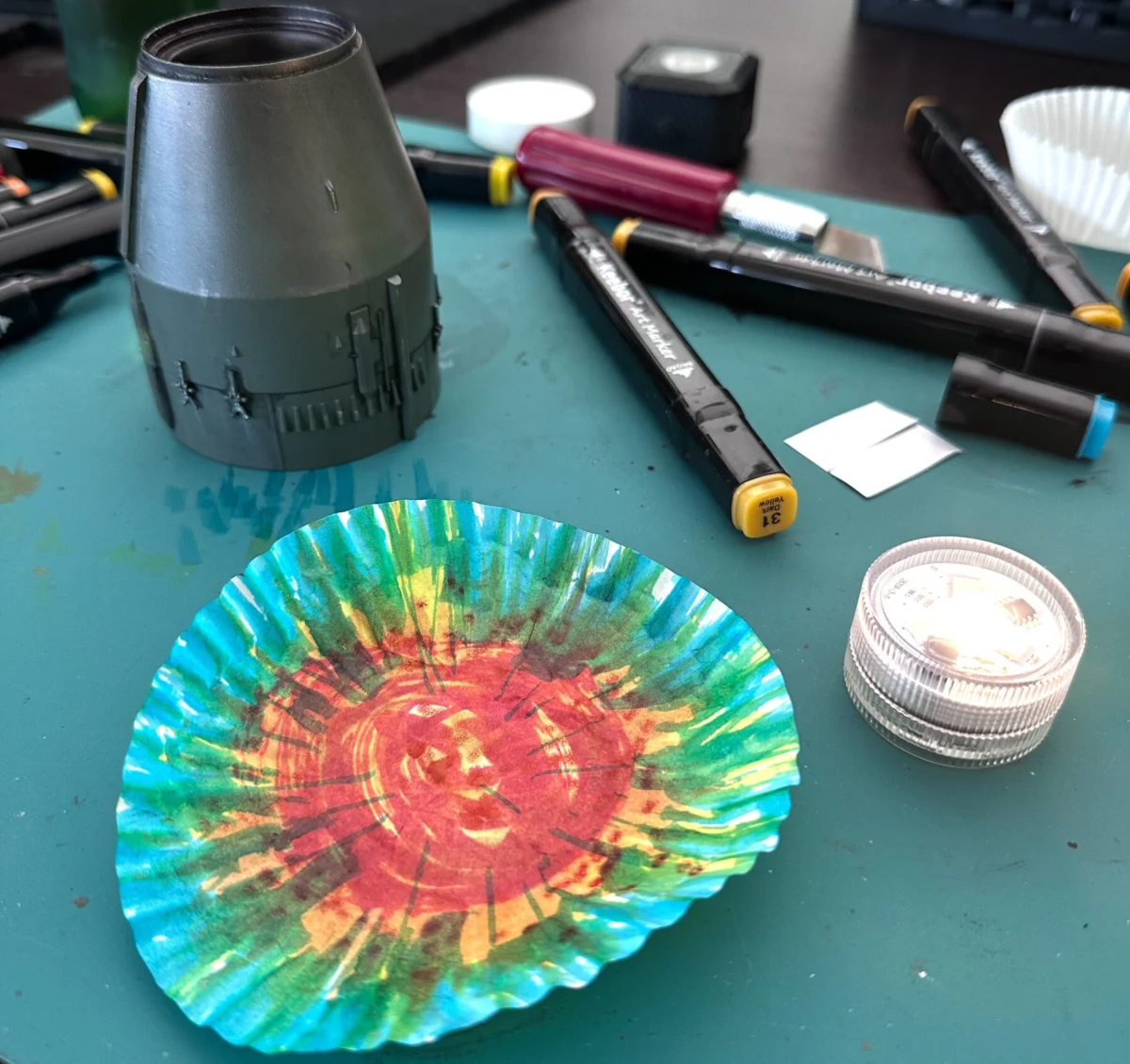
Throughout a month-long build process, Aron operated with what he describes as an “obsession for making things look as real as possible.” He began with a pinched, organic silhouette, envisioning the ship as a weary, commercial freighter rather than a sleek, pristine craft.
Aron’s materials were a mosaic of Star Wars history:
- Legacy Components: He utilized resin-printed parts originally intended for a Rebel snowspeeder project from his earlier experiments.
- The Core: The center component was fashioned from the base plate of a Gundam model kit.
- Structural Elements: The fuselage was carved from foam, with specific attention paid to the rear engines, landing gear, and boarding ramp—the only parts of the ship visible to the camera.
- Greebling: To achieve the iconic Star Wars “lived-in” aesthetic, Aron employed the technique of “greebling”—the addition of small, complex details to the surface. He utilized 3D-printed components from the shared Lucasfilm/ILM digital library, which included scans of the original Millennium Falcon and Imperial Star Destroyer models.
- The "Virago" Influence: In a nod to the deep cuts of Star Wars lore, Aron repurposed components from a vintage Virago model kit (Prince Xizor’s ship from Shadows of the Empire).
Phase 3: The Lighting Pass
Once the structure was complete, Aron turned his home workshop into a miniature soundstage. Using natural light—specifically the ambient, west-facing light from his windows—he conducted multiple lighting passes, an approach that mirrored the high-end techniques used at ILM. He used long exposures (20 to 60 seconds) to “paint” the ship with light, capturing distinct elements like engine flares and landing gear illumination in separate takes.
Supporting Data: Efficiency Through Hybridization
While the model was built physically, the final result was a hybrid of traditional craftsmanship and digital efficiency. Art Director Andre Kirk played a vital role in integrating the physical model into the digital workflow.
“I suggested that we paint it digitally since it’s going to be a still shot,” Kirk notes. By opting for digital paint and texturing—adding the iconic yellow striping and weathering—the team bypassed the unpredictable nature of physical paint, which might not have translated well under the studio lights.
The efficiency of this approach cannot be overstated. By combining physical lighting passes with digital compositing, the team saved significant time compared to building a fully rigged digital freighter from scratch. The process was not only more cost-effective but allowed for a collaborative, iterative design process that brought the animation team closer to the finished asset.
Official Responses and Creative Philosophy
The project serves as a testament to the collaborative culture fostered by the Lucasfilm Animation leadership. “Joel was very open to everyone’s input,” says Kirk. “It was very much a group effort.”
Aron views the success of the cargo ship not just as a one-off solution, but as a blueprint for the future of animated production. By allowing designers to provide feedback on a physical model, the team experienced a sense of ownership that is often lost in purely digital pipelines.
“There’s a lot of pressure to just produce the show,” Aron explains, “and as a result, there are gaps where we need to think creatively to solve problems.” For Aron, those gaps are the perfect places to reintroduce the tactile, light-responsive quality of physical miniatures. He believes that even when the final product is heavily modified by digital tools, the starting point of a physical object adds a layer of depth and imperfection that algorithms struggle to replicate.
Implications: The Future of Hybrid Production
The successful deployment of the Maul – Shadow Lord cargo ship raises an interesting question about the trajectory of visual effects in the Star Wars universe. As digital technology advances, there is a recurring irony: the more realistic our computers become, the more we crave the physical “reality” of objects that exist in three-dimensional space.
The implications of this experiment are three-fold:
- Workflow Flexibility: The project demonstrates that traditional modeling is not an antiquated relic but a high-speed alternative for certain production needs. When faced with a bottleneck, physical builds can offer a tactile solution that feels more grounded than rushed CGI.
- Creative Synergy: By bridging the gap between ILM’s legacy model-making and modern digital compositing, Lucasfilm is effectively training a new generation of artists to appreciate both worlds. This creates a "hybrid artist" capable of thinking in terms of physical light, texture, and digital rendering simultaneously.
- Audience Engagement: There is an inherent, subconscious appreciation audiences have for the "weight" and lighting of real-world objects. Even in a brief, exploding cameo, the cargo ship possesses a tangible presence that anchors the scene in the established Star Wars visual language.
As the age of Maul unfolds on Disney+, the cargo ship stands as a small but profound monument to the dedication of the team behind the screen. It is a reminder that in the galaxy far, far away, the best way forward often involves reaching back to the tools, techniques, and philosophies that defined the medium from the very beginning.
The ship’s explosive end in the eighth episode may be short-lived, but the precedent it sets for hybrid production is likely to endure, ensuring that the spirit of the practical miniature remains a vital part of the Star Wars story.










No comments yet. Be the first to join the conversation!