

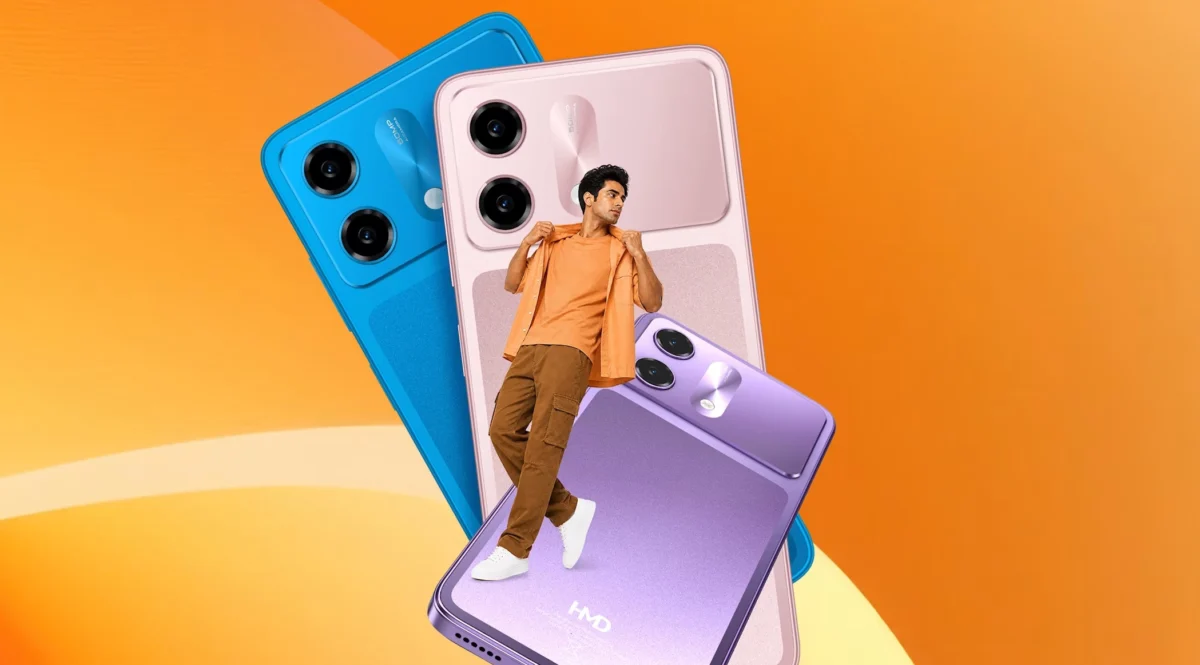
In a strategic maneuver aimed at capturing the unique linguistic landscape of the Indian market, Finnish smartphone manufacturer HMD Global has officially launched its latest device, the Vibe 2 5G. The launch is notable not just for the hardware, but for the integration of "Indus," a sophisticated AI chatbot developed by the Indian startup Sarvam. By pre-loading this locally-tuned AI onto a mid-range device, HMD is positioning itself to bridge the digital divide in one of the world’s most linguistically diverse nations.
The Convergence of Hardware and Localized Intelligence
The Vibe 2 5G, priced at ₹10,999 ($114), arrives at a critical juncture for HMD. As a mid-range Android smartphone featuring a robust 6,000mAh battery, the device is clearly aimed at value-conscious consumers who prioritize battery life and essential utility. However, the true differentiator lies in the software. The Indus chatbot, powered by Sarvam’s proprietary 105-billion-parameter model, is designed to handle the complexities of the Indian linguistic landscape, which often stumps global, English-centric AI models.
The Indus app supports 22 Indic languages and, perhaps most impressively, features advanced "code-switching" capabilities. This allows the AI to fluidly navigate conversations where users mix English with regional languages like Hindi, Marathi, or Tamil mid-sentence—a common pattern in daily Indian communication. By enabling this level of nuance, HMD and Sarvam are aiming to make AI an intuitive utility rather than a foreign, clunky interface.
A Chronology of Collaboration
The partnership between HMD and Sarvam did not emerge in a vacuum; it is the culmination of a deliberate strategy announced earlier this year.
- February 2026 (The India AI Summit): During the India AI summit in New Delhi, HMD and Sarvam formally announced their partnership. At the same event, Sarvam showcased its 105-billion-parameter model, emphasizing its commitment to open-source AI and domestic scalability.
- March–April 2026: Following the announcement, reports emerged regarding Sarvam’s financial trajectory, including a massive $300 million funding round that valued the startup at approximately $1.5 billion.
- May 2026: The official market release of the Vibe 2 5G signals the transition from conceptual partnership to commercial reality. HMD has indicated that the Vibe series will receive the chatbot, with plans to expand integration into feature phones in the coming months.
Supporting Data: The Scale of the Challenge
While the collaboration between HMD and Sarvam is ambitious, the market data highlights the magnitude of the uphill battle they face.
According to market intelligence firm IDC, HMD’s presence in the Indian smartphone market remains peripheral. As of 2025, the company did not rank among the top 15 smartphone manufacturers in India. While HMD maintains a more stable 4% share of the feature phone market, its smartphone ambitions require a unique "hook" to compete with established giants like Xiaomi, Samsung, and Vivo.
Furthermore, the adoption rates of the Indus app demonstrate the early-stage nature of the product. Data from Appfigures suggests that nearly three months post-launch, the Indus app has garnered approximately 293,000 downloads. While this is a respectable start for a niche, India-specific tool, it pales in comparison to global behemoths like ChatGPT, which has amassed over 43.9 million downloads in the country.
However, analysts suggest that download numbers are a metric of the past. The success of the HMD-Sarvam partnership will not be measured by mass-market viral growth, but by the "stickiness" of the AI within a specific, underserved demographic.
Official Perspectives: The Path to Traction
Ravi Kunwar, HMD’s CEO and Vice President for India and APAC, views the pre-loading of the Indus app as a foundational step. In an interview with TechCrunch, Kunwar framed the current launch as "Phase One."
"With this partnership, the first thing we want to do is get the Indus app to consumers," Kunwar stated. "Once they start using it, we will move to phase two to focus on driving more traction and stickiness. Right now, by pre-loading the app, we want to be more accessible to users."
This phased approach acknowledges the limitations of the current implementation. As it stands, the Indus app requires an active internet connection, and the device lacks a dedicated hardware shortcut to trigger the AI assistant. These are significant hurdles to friction-less usage, but they are also areas where future iterations of the Vibe series could innovate.
The Strategic Implications for the Indian AI Ecosystem
The HMD-Sarvam deal is a bellwether for the future of AI deployment in emerging markets. It represents a pivot away from the "one-size-fits-all" model used by Silicon Valley companies and toward "hyper-localization."
1. The Power of Distribution
By bundling AI directly into hardware—especially at the price point of the Vibe series—HMD is bypassing the traditional app-store acquisition funnel. In India, where data costs are low but storage and device performance can be constraints for entry-level users, having a "native" AI assistant is a significant distribution advantage.
2. The Feature Phone Opportunity
The most significant potential for this partnership may not be in the smartphone space at all, but in the feature phone market. If Sarvam can successfully optimize its 105-billion-parameter model to function on the limited hardware of a feature phone, it could bring AI to the millions of Indians who are not yet smartphone users. This would be a massive democratization of technology, potentially providing information, banking assistance, and educational tools to a demographic that has historically been excluded from the AI revolution.
3. Enterprise vs. Consumer
Sarvam AI has built its reputation on enterprise-grade, voice-enabled solutions. By diversifying into the consumer smartphone space with HMD, the company is testing whether its models can handle the chaotic, unscripted nature of everyday consumer inquiries. If successful, this data will be invaluable for training future iterations of their LLMs.
4. Valuation and Capital
With reports of a $1.5 billion valuation, Sarvam is signaling to the global investor community that Indian AI infrastructure is a viable, high-growth asset class. Investors are looking closely at how these startups move beyond the "proof of concept" phase and into actual, hardware-integrated consumer products.
Conclusion: A Testbed for the Future
The Vibe 2 5G is more than just a smartphone; it is a laboratory. For HMD, it is a chance to reclaim relevance in a fiercely competitive market by offering something that the incumbents are not: a device that speaks the user’s language—literally and culturally. For Sarvam, it is an opportunity to prove that locally trained, large-scale AI models can perform effectively in the hands of the general public.
The current gap between the download numbers of Indus and those of ChatGPT is wide, but it may be misleading. In a country as linguistically diverse as India, the utility of an AI that understands the nuances of local dialects and mixed-language communication will likely outweigh the brand recognition of global giants. Whether this partnership can translate that utility into long-term market share remains to be seen, but for those tracking the evolution of AI in emerging markets, this is a development of significant consequence.
As HMD continues to roll out the Vibe series and prepares to introduce AI-integrated feature phones, the industry will be watching to see if this "distribution-first" strategy can turn the tide. If the Indus app becomes a daily necessity for the Vibe user, HMD may have found the blueprint for surviving and thriving in the next generation of mobile computing.












No comments yet. Be the first to join the conversation!