

Editor’s note: This review was originally published during the 2025 Toronto International Film Festival. Vertical will release the film in select theaters and on-demand beginning Friday, May 15.
In the landscape of modern teen comedies, there is a delicate balance between capturing the raw, chaotic energy of adolescence and delivering a narrative with genuine emotional stakes. In his latest outing, "Driver’s Ed," director Bobby Farrelly attempts to bridge this gap, casting The White Lotus breakout Sam Nivola as Jeremy, a lovesick high school senior with a cinematic eye and a penchant for documenting his life through the lens of a handheld video camera. However, the film ultimately serves as a stark reminder that even the most seasoned comedy veterans can lose their touch, resulting in a project that feels less like a polished feature and more like a student film project that was never quite finished.
Main Facts: The Premise and the Players
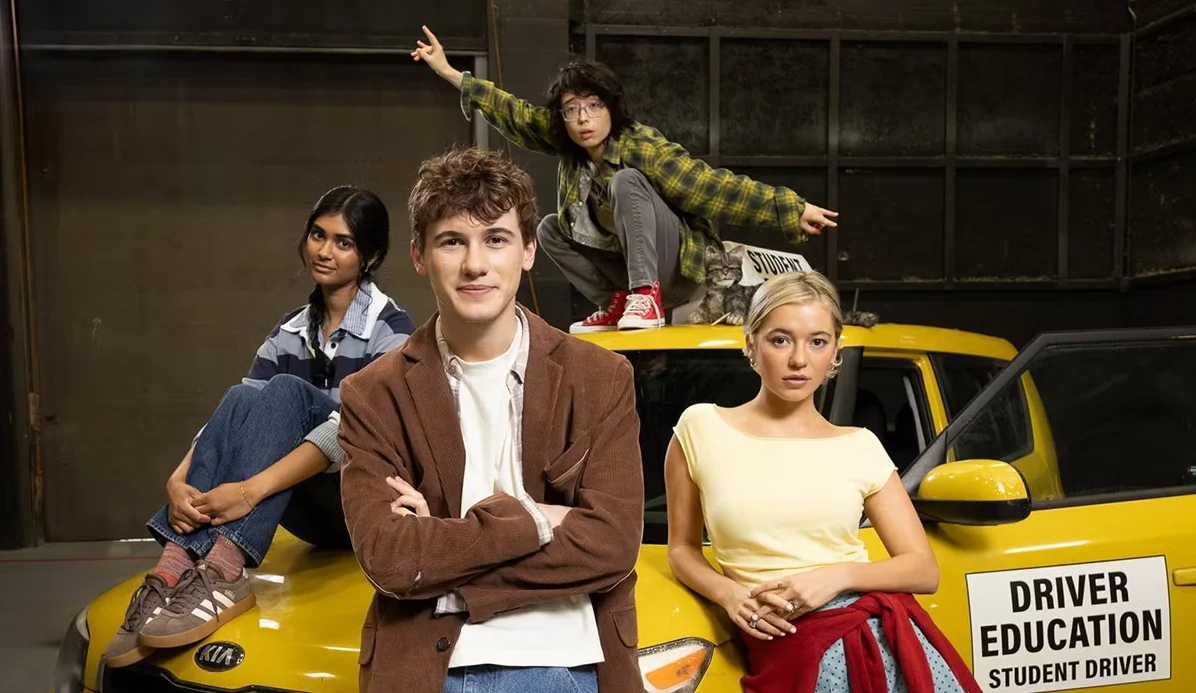
"Driver’s Ed" centers on the quintessential high school trope of the romantic obsession. Jeremy, an aspiring filmmaker, finds his world upended when his girlfriend, Samantha (Lilah Pate), leaves for her freshman year at the University of North Carolina at Chapel Hill. Fearing the distance and the inevitable “temptations of college life,” Jeremy initiates a desperate, misguided road trip to the Carolina backcountry.
His plan? To win her back through a grand gesture, fueled by the impulsive confidence of a teenager who thinks he knows how the world works. To execute this plan, Jeremy “borrows” a driver’s education vehicle—a choice that serves as the film’s titular metaphor for his lack of experience and control—and brings along three mismatched classmates to round out the ensemble.
The film is directed by Bobby Farrelly, one half of the iconic duo responsible for era-defining comedies like Dumb and Dumber and There’s Something About Mary. With a screenplay penned by Thomas Moffett, the film carries the weight of a pedigree that it unfortunately fails to live up to. Despite the participation of heavyweights like Molly Shannon and Kumail Nanjiani, the movie struggles to find a rhythm, resulting in a 98-minute runtime that feels significantly longer.
A Chronology of Creative Stagnation
The trajectory of the film is as predictable as the suburban landscape it traverses. It begins with the setup of Jeremy’s “cinematic” perspective—his tendency to frame his life as a series of movie scenes—which sets an expectation for meta-commentary that the film never actually delivers.
As the journey progresses, the film leans into the traditional road-trip structure: a series of vignettes designed to build character but which instead act as roadblocks to the pacing. We are treated to a meet-cute with a dog owner, a tense encounter with a thief boasting impossibly white veneers, and an inexplicable sequence involving the back of a refrigerated truck filled with fur coats. Each of these moments is intended to provide comedic levity, but instead, they highlight a lack of cohesion.

The narrative zig-zags haphazardly, touching on themes of unrequited love and the transition to adulthood, only to abandon them in favor of tired gags. By the time the group arrives in Chapel Hill, the “climax” of the journey feels like an afterthought. The resolution is the most obvious conclusion one could imagine, leaving the audience with a sense of déjà vu that permeates the entire experience.
Supporting Data: The Talent vs. The Material
While the screenplay by Moffett and the direction by Farrelly often falter, the film is bolstered by a genuinely charismatic cast that deserves better material. Sam Nivola proves himself to be a capable lead, bringing a sense of sincerity to Jeremy that stops the character from becoming insufferable. He manages to breathe life into dialogue that often feels stale, finding human moments in a script that seems terrified of genuine vulnerability.
The supporting cast is similarly underutilized but effective. Aidan Laprete plays the “affable slacker” with a natural ease, while Mohana Krishnan portrays the “Type A” overachiever with enough sharpness to cut through the clichés. Sophie Telegadis, known for her digital presence, brings a surprising amount of specific, grounded energy to the mix, echoing the teen archetypes of early 2000s dramas like The O.C. without feeling like a mere caricature.
Conversely, the adult cast members are stranded in roles that demand little more than broad, strained performances. Molly Shannon, an actress of immense comedic versatility, is relegated to a “Bad Principal” role that offers zero depth. Kumail Nanjiani, arguably one of the most gifted improvisational comedians of his generation, struggles to find humor as a substitute teacher. Their presence feels like a missed opportunity—two titans of comedy left to tread water in a script that refuses to give them anything of substance to work with.
Official Responses and Industry Context
The film’s reception at the 2025 Toronto International Film Festival was lukewarm at best. Critics noted a sense of disconnect between the film’s attempt to appeal to a modern Gen Z audience and the sensibilities of its 67-year-old director. While the film incorporates modern vernacular—peppered with “lit” and “no cap”—it feels like an attempt to mimic a culture rather than inhabit it.
There have been no official responses from the studio or the director regarding the critical consensus, though industry insiders suggest that the project was intended to be a “back to basics” comedy. However, the result serves as a cautionary tale about the evolution of the genre. Where once the Farrelly brothers were the arbiters of “gross-out” humor and irreverent wit, the landscape of comedy has moved toward something more nuanced and self-aware. "Driver’s Ed" ignores this evolution, opting for a style that feels stuck in the post-American Pie era of the early 2000s.
Implications: The Death of the “Boilerplate” Teen Comedy?
The failure of "Driver’s Ed" to resonate has broader implications for the future of the mid-budget teen comedy. As audiences increasingly turn toward platforms like TikTok for short-form, authentic creative content, the traditional, long-form teen road-trip movie faces an existential crisis.

If a film is to succeed in this space today, it must offer something more than just a "nerdy boy, dream girl, and stoner friend" formula. It must reflect the anxieties and the hyper-connected nature of the modern teenager. "Driver’s Ed" attempts to use iPhones and digital cameras as props, but it doesn’t understand the nature of digital identity. It treats the internet as a background aesthetic rather than a defining force of the characters’ lives.
Furthermore, the film’s reliance on “arbitrary comedy”—the idea that randomness is inherently funny—is a relic of a bygone era. Modern audiences demand jokes that are rooted in character dynamics rather than surreal, disconnected vignettes. When the film tries to force a laugh through a weird situation rather than a witty line or a relatable observation, it fails to connect.
Ultimately, "Driver’s Ed" is not a "bad" movie in the sense of being malicious or poorly produced. It is simply a "hollow" one. It is well-intentioned and kindhearted, but it lacks the soul required to leave an impact. Its 98-minute runtime acts as a barrier, with every scene feeling like a missed opportunity to explore the genuine heart of its premise.
For those who grew up on the classic comedies of the 90s, this film will feel like a ghost of the past—an echo of a time when this formula worked. For the current generation, it will likely feel like an outsider looking in, trying to speak a language it doesn’t quite understand.
Final Verdict: Grade C
"Driver’s Ed" is a film that highlights the necessity of evolving with one’s audience. While the cast shows glimmers of promise, they are ultimately let down by a directionless script and a director who seems to have lost his compass. Perhaps in the next iteration of the teen road-trip movie, the industry will trust the younger generation to tell their own stories, rather than asking veterans of a previous era to imagine them from the outside. For now, this is a road trip that would have been better left untaken.











No comments yet. Be the first to join the conversation!