

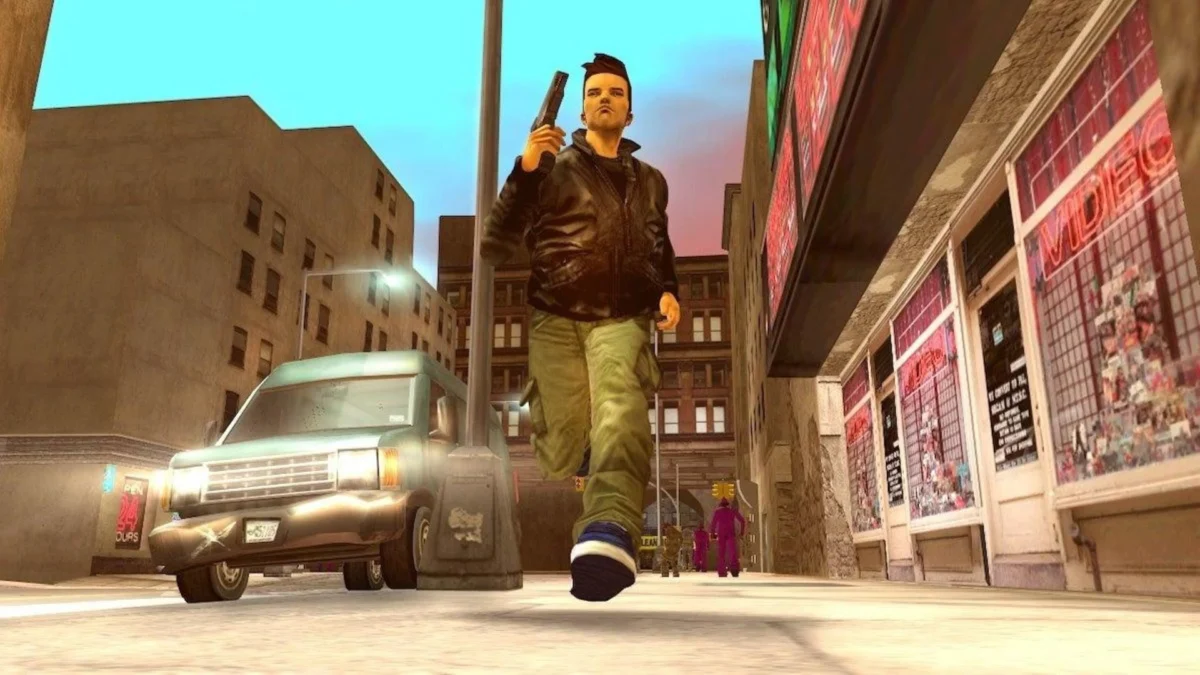
London, UK – [Date] – In the annals of video game history, few titles resonate with the transformative power of Grand Theft Auto III. Released in 2001, it wasn’t merely a game; it was a paradigm shift. For those who experienced its revolutionary open world firsthand on the PlayStation 2, the sheer scale and ambition of Liberty City remain etched in memory. But the true marvel lies not just in what Rockstar Games achieved visually and thematically, but in the sheer technical wizardry that allowed such a sprawling, living metropolis to exist within the constraints of the PS2’s modest hardware.
The PS2, a powerhouse of its era, was equipped with a mere 32MB of RAM. To comprehend the magnitude of Rockstar’s achievement, one must understand that this limited memory had to accommodate not only the intricate architecture of Liberty City, its bustling streets, its diverse population, and its dynamic weather systems, but also the complex AI governing thousands of non-player characters, the sophisticated physics engine, and the game’s extensive audio library. The question that has long captivated gamers and developers alike is simple yet profound: how did they do it?
A recent deep-dive video, expertly curated by Mark Brown of the Game Maker’s Toolkit, has illuminated the ingenious techniques employed by Rockstar. While some of the underlying principles might be familiar to those within the development sphere, the brilliance of Brown’s presentation lies in its clarity and accessibility. He breaks down incredibly complex technical hurdles into digestible concepts, revealing the sophisticated engineering that underpinned GTA III’s immersive experience.
The Genesis of an Open World Revolution
Prior to Grand Theft Auto III, the concept of an open-world game, where players could deviate from a linear narrative and explore a vast environment, was not entirely novel. Games like Shenmue, which predated GTA III by a couple of years in Japan, had already demonstrated the potential for expansive, explorable spaces. However, Shenmue’s ambition was contained within more focused, albeit still impressive, environments. GTA III, on the other hand, presented players with Liberty City – a fully realized, breathing urban sprawl where the possibilities felt almost limitless. This was a quantum leap in scale and interactivity, a true sandbox that invited players to forge their own paths, unbound by strict narrative confines.
The impact of this freedom cannot be overstated. Players were not just playing a game; they were inhabiting a digital world. They could steal cars, engage in high-speed chases, embark on a myriad of side missions, or simply explore the intricate details of the city. This unprecedented level of player agency was the cornerstone of GTA III’s success, and it was made possible by an extraordinary feat of technical ingenuity.

Deconstructing Liberty City: The Art of Dynamic Asset Loading
The core of Rockstar’s solution to the PS2’s memory limitations lay in a sophisticated approach to asset management and world streaming. Instead of loading the entirety of Liberty City into memory at once, which would have been an insurmountable task, the development team devised a system that dynamically loaded and unloaded assets as the player navigated the game world.
H2: The Grid System: Divide and Conquer
At the heart of this system was the division of Liberty City into a grid of squares. This spatial partitioning allowed the game engine to meticulously manage what was being rendered and what was being stored. As the player’s character moved through the city, the game would constantly assess their proximity to different sectors.
H3: Proximity-Based Asset Streaming
When the player approached a particular square, the necessary assets – such as building models, textures, vehicle models, and character data – for that specific area would be loaded into the PS2’s RAM. Crucially, as the player moved away from a sector, the assets associated with that now-distant area would be unloaded, freeing up valuable memory for incoming data. This constant, intelligent repopulation and flushing of RAM was the linchpin of the entire operation. It was akin to a highly efficient digital librarian, only pulling books from the shelves when a reader was nearby and returning them once they had moved on.
This technique is a fundamental principle in modern open-world game development, but in the early 2000s, implementing it on the PS2, with its limited resources and unique architecture, was a monumental undertaking. It required a deep understanding of memory management, efficient data structures, and clever programming to ensure a seamless and immersive experience.
Tackling the Headaches: Pop-In and Texture Streaming
This dynamic loading system, while brilliant, was not without its challenges. The most visually apparent of these was "pop-in," where objects and textures would suddenly appear as the player approached them. This was a direct consequence of assets being loaded only when necessary. While Rockstar worked to mitigate this as much as possible through careful design and loading algorithms, some degree of pop-in was an unavoidable byproduct of the memory constraints.

Texture streaming, the process of loading and unloading textures dynamically, was another critical element. The game had to be adept at fetching the appropriate high-resolution textures for objects in the player’s immediate vicinity while relying on lower-resolution or placeholder textures for distant elements. This constant back-and-forth between the game’s storage medium (the PS2’s DVD drive) and its RAM was a delicate balancing act.
H3: Overcoming the PS2’s DVD Drive Limitations
The PS2’s DVD drive, while a significant upgrade from the CD-ROMs of the previous generation, was still relatively slow compared to modern storage solutions. Rockstar had to develop ingenious methods to mask this latency. This included pre-fetching data in the background, using efficient compression techniques, and carefully optimizing the order in which data was requested to minimize waiting times. The illusion of a continuous world was maintained by ensuring that the loading process was as unobtrusive as possible, often occurring during moments when the player was naturally occupied, such as during a car chase or a transition between areas.
The Legacy of GTA III’s Technical Prowess
The techniques employed by Rockstar in Grand Theft Auto III were not simply stopgap measures; they laid the groundwork for many of the open-world development methodologies still in use today. While modern hardware boasts vastly superior RAM capacities and processing power, the fundamental principles of efficient asset management, spatial partitioning, and dynamic loading remain central to creating expansive and believable game worlds.
The success of Grand Theft Auto III paved the way for its equally acclaimed successors, Grand Theft Auto: Vice City and Grand Theft Auto: San Andreas. These titles built upon the foundation laid by GTA III, refining the gameplay, expanding the scope, and further pushing the boundaries of what was possible on the PlayStation 2. Together, they became some of the best-selling games in the console’s history, cementing Rockstar’s reputation as a pioneer in the industry.
Rockstar Games has consistently demonstrated a commitment to pushing the envelope of technological innovation. From the groundbreaking open world of GTA III to the breathtaking realism of Red Dead Redemption 2, and with the highly anticipated Grand Theft Auto VI on the horizon, the studio continues to redefine player expectations and showcase the incredible potential of interactive entertainment.

The wizardry employed by Rockstar to craft Liberty City within the confines of the PS2 is a testament to human ingenuity and a deep understanding of game development principles. It serves as a powerful reminder that even with significant technical limitations, creative vision and masterful execution can result in experiences that are not only enjoyable but truly revolutionary. The video from Game Maker’s Toolkit offers a fascinating glimpse into this digital alchemy, allowing a new generation of players and aspiring developers to appreciate the sheer brilliance behind one of gaming’s most iconic achievements.
H2: Player Reflections and the Enduring Impact
The release of Grand Theft Auto III was a watershed moment for many players. The sheer freedom and immersive quality of Liberty City captured the imaginations of millions, leading to countless hours of exploration and emergent gameplay. The question posed to the community – whether they were blown away by GTA III’s initial release and if they understood the technical concepts explained in the video – invites a wave of nostalgia and appreciation for a game that truly changed the landscape of interactive entertainment. The enduring legacy of GTA III is not just in its sales figures or critical acclaim, but in the indelible mark it left on the cultural zeitgeist and its foundational role in shaping the open-world genre as we know it today.












No comments yet. Be the first to join the conversation!