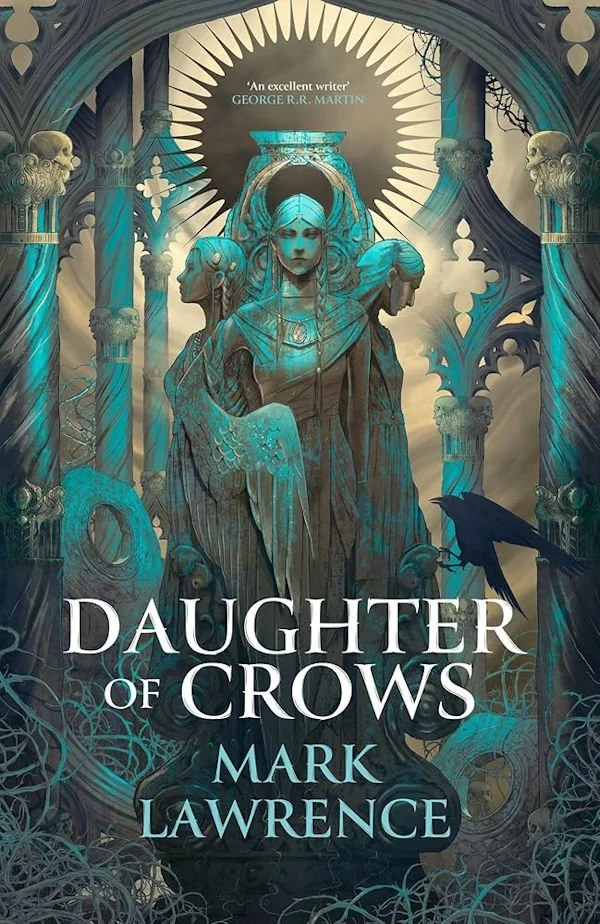
In the landscape of modern grimdark fantasy, few authors possess the surgical precision of Mark Lawrence. Known for his unflinching exploration of morality and violence, Lawrence has returned with the first installment of a new trilogy, Daughter of Crows. The novel introduces readers to the "Academy of Kindness"—a chilling, state-sanctioned institution designed to forge young girls into the ultimate avatars of retribution. Drawing inspiration from the Furies of classical antiquity, the Academy operates on a brutal Darwinian principle: a hundred enter, but only three survive the decade-long crucible to emerge as the "Kindly Ones."
Daughter of Crows is not merely a tale of survival; it is a profound meditation on the scars left by time, the elasticity of identity, and the heavy price of vengeance.
The Core Narrative: A Life Forged in Blood
The story centers on Rue, a woman whose life is defined by three distinct, intersecting timelines. When readers first meet her, she is an old woman—bitter, weary, and desperately attempting to carve out a quiet existence in a world that has already taken too much from her. Her attempt at peace is shattered when war encroaches upon her village, forcing her to abandon her seclusion and reclaim the lethal skills she had spent decades suppressing.
The narrative deftly pivots between this hardened, elderly protagonist and her younger selves. We see her indoctrination into the Academy of Kindness, where she is known as Mollandra. This section of the book is visceral and unrelenting, depicting the "Wound Garden" and the "Bone Garden"—horrific environments where young girls are pitted against one another, their humanity stripped away until only the capacity for violence remains.
A third, equally disturbing narrative thread explores her early childhood. Before the Academy, Rue was a prisoner in a home of absolute depravity, held captive by parents who were monstrous in both body and spirit. As the "Eldest," she assumed the role of protector for the other trapped children, a period of her life that remains the darkest, most emotionally taxing, and psychologically revealing segment of the trilogy.
Chronology and Structure: The Three Faces of Rue
The structural brilliance of Daughter of Crows lies in its non-linear approach to character development. Lawrence avoids the common fantasy trope of the "coming-of-age" journey. Instead, he presents a character who has already lived, broken, and rebuilt herself, only to be dismantled once more.
- The Childhood Narrative: Explores the formative trauma of Rue’s youth. This segment provides the foundation for her later resilience and establishes the "Eldest" role that would define her sense of duty.
- The Academy Years: The central, high-stakes arc where 100 girls are subjected to the horrors of the Academy of Kindness. Here, Lawrence explores the formation of bonds under duress—how friendship and loyalty can sprout even in the most necrotic soil.
- The Elder Years: The present-day timeline. It is here that Lawrence tackles the physical limitations of aging. Rue is as sharp as ever, but she must grapple with a body that no longer obeys her mind’s commands. This offers a rare, grounded perspective in fantasy: an elderly woman who is not a mentor or a side character, but a force of nature in her own right.
Supporting Data: Why This Trilogy Defies Genre Conventions
While Daughter of Crows is unequivocally grimdark, it transcends the sub-genre’s common pitfalls. Lawrence utilizes an eloquent, blunt prose style that avoids the excessive nihilism often found in the genre, opting instead for a "pulsing," intimate emotional core.
The Role of Memory
A central theme of the novel is the function of memory. Lawrence posits that we are not the sum of our experiences, but rather the sum of what we choose to remember and what we are forced to forget. The book asks a fundamental question: Can an individual ever truly outrun their past, or are we destined to become the very thing we once sought to escape?
The "Academy" Concept
The irony of the "Academy of Kindness" name serves as a masterful narrative device. By co-opting the title given to the Furies—the "Kindly Ones"—the state creates a psychological barrier for its victims. It is a brilliant example of institutional gaslighting, framing state-sponsored murder as a noble, ancient calling.
Pacing and Narrative Flow
Readers familiar with multi-POV structures often fear "narrative fatigue," where the quality of one thread suffers in comparison to others. Lawrence avoids this by ensuring that the transitions are deliberate. The occasional lulls in action allow the reader to process the psychological weight of the story, preventing the reader from becoming desensitized to the violence.
Official Responses: Insights from Mark Lawrence
Following the publication, we sat down with Mark Lawrence to discuss the genesis of Rue and the thematic underpinnings of the series.
When asked about the inspiration for an older protagonist, Lawrence noted that his decision was a direct response to a recurring critique in the fantasy community. "The idea to show her old came from forums and social media where the desire to see older female main characters is frequently voiced," Lawrence stated. "I was either meeting that desire or calling their bluff."
Regarding the psychological weight of the story, particularly the survival of friendship in horrific conditions, Lawrence emphasized the duality of human connection. "Friendships and relationships are a big part of being human, being both a strength and a weakness. I’ve always been interested in how those early chance encounters help form our foundations."
Lawrence also addressed the fluidity of his genre-blending, noting that he does not view his work through the lens of strict categorization. "I just write the story. I never worry about where it fits into any categorization. I’ll veer from fantasy to sci-fi, and trample over any lesser sub-genre boundaries without a care."
Implications: The Future of the Trilogy
Daughter of Crows sets a high bar for the remainder of the trilogy. It leaves the reader with a sense of understanding regarding Rue, but it is a fragmented understanding—much like her own memory. The trilogy promises to be an exploration of what comes next for a woman who has already spent a lifetime being someone else’s weapon.
The implications for the fantasy genre are clear: there is a growing appetite for stories that move beyond the "young hero on a quest" model. Readers are increasingly seeking narratives that reflect the complexities of aging, the long-term impacts of childhood trauma, and the nuanced ways in which identity shifts over decades.
A Final Assessment
Daughter of Crows is an emotionally ruthless, visceral piece of fiction. It is a work that demands the reader’s full attention and rewards them with a character study that is as beautiful as it is brutal. Mark Lawrence has once again proven that he is not just a master of the "grim" or the "dark," but a master of the human heart under extreme pressure.
For those who have finished the book, the wait for the second installment will undoubtedly be the hardest part. As Lawrence himself suggested, the journey is not just about uncovering the past—it is about the agonizing choices that must be made when there is no path forward, only the path you carve for yourself.
Daughter of Crows is currently available through all major book retailers. For more information on the series, readers are encouraged to visit Mark Lawrence’s official website or follow his updates across social media platforms.