Lina Hope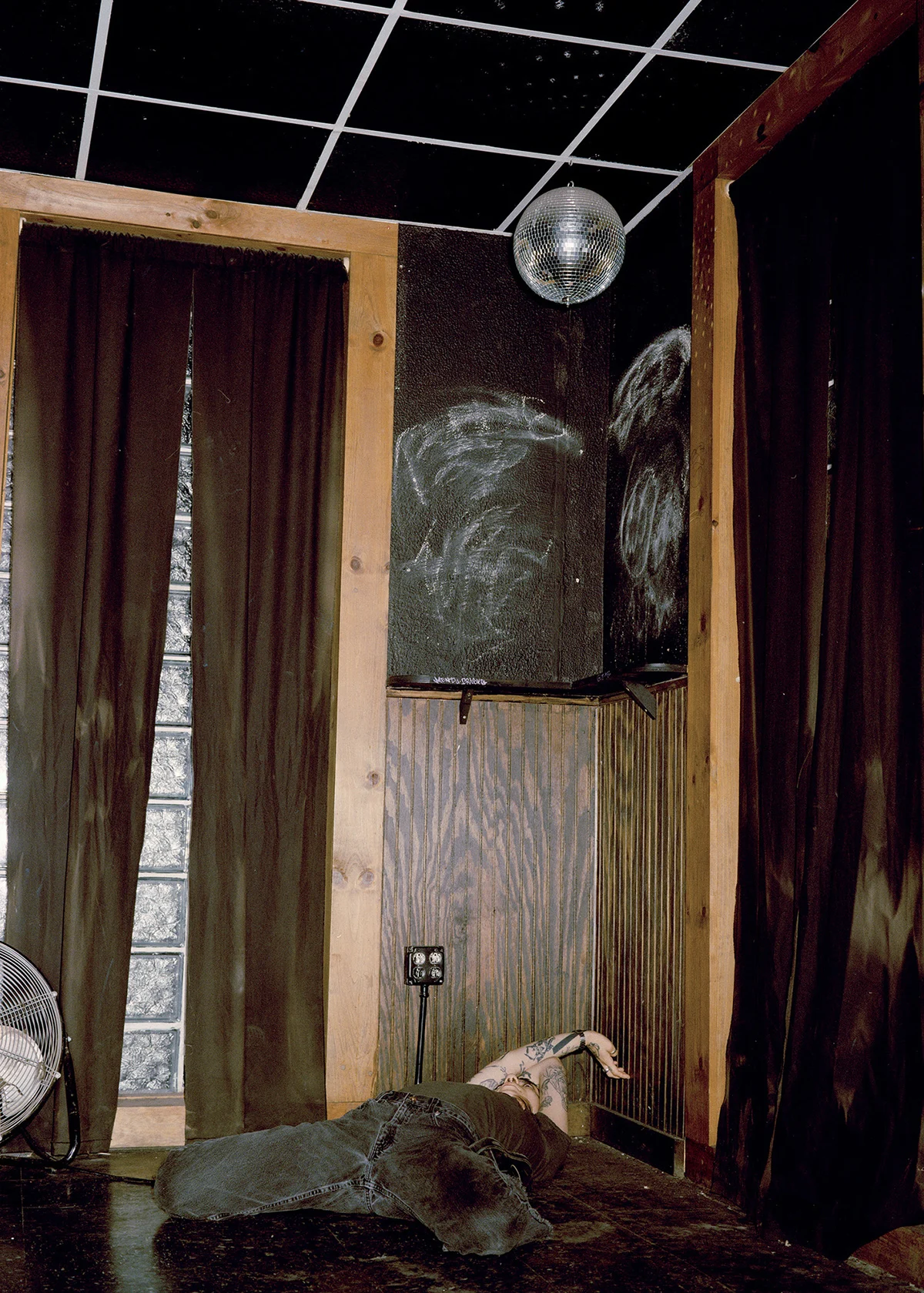
In the sprawling, gritty, and deeply textured landscape of contemporary American photography, few voices capture the friction between personal identity and urban environment as poignantly as Christopher Postlewaite. A polymath who navigates the dual worlds of music and visual art, Postlewaite has emerged as a significant chronicler of the Philadelphia experience. His practice—a deliberate synthesis of the staged and the serendipitous—offers a nuanced examination of how we define ourselves through the spaces we inhabit and the communities we cultivate.
Main Facts: The Artistic Philosophy of a Philadelphia Chronicler
Christopher Postlewaite’s work serves as a visual diary that transcends mere documentation. Currently based in Philadelphia, his photographic output is defined by an intimate proximity to his subjects. Whether capturing the visceral energy of a local after-hours club or the quiet, existential weight of a South Philadelphia street corner, Postlewaite operates at the intersection of portraiture and landscape.
His formal training is rooted in prestigious institutions, holding a BA and BFA from SUNY Purchase and an MFA from the Yale School of Art. This academic rigor is subtly present in his work, which demonstrates a sophisticated understanding of art history, composition, and the semiotics of the image. However, it is his departure from traditional academic detachment that defines his current trajectory. Postlewaite’s images are deeply collaborative; they are not pictures of his friends and spouse, but pictures made with them. This distinction is vital to understanding his methodology, which treats the camera as a medium for shared performance rather than a tool for voyeuristic capture.
Chronology: The Evolution of a Visual Language
To understand the trajectory of Postlewaite’s work, one must trace the evolution of his relationship with his environment.
The Formative Years: His early academic journey at SUNY Purchase provided the technical foundation for his practice. During this period, Postlewaite began experimenting with the boundaries of the frame, moving away from the rigid structures of commercial photography toward a more fluid, narrative-driven approach.
The Yale Influence: His tenure at the Yale School of Art acted as a crucible for his theoretical development. It was here that he began to refine his interest in "self-presentation." He began to view the photograph not as an objective truth, but as a site of negotiation—a place where the subject’s internal reality meets the photographer’s external lens.
The Philadelphia Era: Since relocating to Philadelphia, Postlewaite’s work has sharpened its focus on the "adhoc patina" of urban life. A defining moment in this timeline was the tragic destruction of the Foto Club, a members-only after-hours establishment that burned down in April. The loss of this space—a hub for his social circle—crystallized his desire to document the ephemeral nature of subculture. His work from this period captures everything from the mundane (a neighbor’s dog) to the monumental (the architectural decay of former institutions like Cousin Danny’s strip club), marking his transition into a chronicler of the "now."
Supporting Data: The Anatomy of a Scene
Postlewaite’s portfolio acts as a sociological map of South Philadelphia. His work is characterized by several recurring motifs that anchor his narrative:
- The Domestic Collaboration: By working with his spouse and close friends, Postlewaite eliminates the "stranger-photographer" power dynamic. The data points here are the expressions—the ease and the performative vulnerability that only exist between people who share a history.
- Urban Artifacts: From the letterboard at Cousin Danny’s to the "transcendent puddle" near his home, his work elevates the discarded and the forgotten. These objects serve as anchors for the human presence that preceded them.
- The Photobooth Analogy: Postlewaite himself describes his process as akin to a photobooth. In a photobooth, the subject is both the creator and the consumer of the image. By applying this logic to his professional photography, he creates a space where "fictions, realities and adhoc patinas orbit as one."
Official Responses and Theoretical Perspectives
While Postlewaite remains a modest figure within the gallery circuit, his work has garnered significant attention from peers and critics who view his "photobooth" methodology as a radical departure from the "stolen shot" aesthetic of mid-century street photography.
Critics often point to the "intentionality of the accidental" in his work. Unlike photographers who hunt for the "decisive moment," Postlewaite seems to wait for the "negotiated moment." In a recent reflection, he noted: "I’m interested in my work like that of a photobooth—as a space where performance and self-presentation dovetail." This statement has been widely interpreted by academics as a manifesto against the commodification of candidness. He argues that the camera is not a mirror, but a stage—a place where the subject performs their identity for the benefit of the viewer, and ultimately, for themselves.
Implications: The Future of Observational Photography
The implications of Postlewaite’s practice extend beyond his individual portfolio. He is part of a growing movement of photographers who are rejecting the "fly on the wall" approach in favor of radical transparency.
The Death of the Candid Myth
For decades, the "candid" photograph was treated as the gold standard of documentary integrity. Postlewaite’s work challenges this, suggesting that there is no such thing as an un-staged interaction when a camera is present. By embracing the performance, he achieves a higher level of truth—an emotional honesty that is often missing from more detached, observational styles.
Memory as an Urban Asset
Postlewaite’s documentation of sites like the Foto Club and Cousin Danny’s highlights the fragility of subculture. As urban development continues to homogenize American cities, the work of photographers like Postlewaite becomes a vital repository of social history. He is not just photographing people; he is cataloging the ghost-spaces of a disappearing urban culture.
The Intersection of Music and Visuals
Given his background as a musician, Postlewaite’s images possess a rhythmic quality—a visual cadence that reflects the improvisational nature of jazz or the layered complexity of electronic music. His work suggests that the future of photography may lie in this interdisciplinary approach, where the "beat" of a city is captured as much by its silence as by its movement.
Conclusion: A Mirror to the Self
Christopher Postlewaite stands at a unique vantage point in contemporary photography. By merging the intimacy of the domestic sphere with the raw, decaying beauty of the urban landscape, he creates a body of work that is as intellectually challenging as it is aesthetically arresting.
His commitment to the "photobooth" philosophy—the idea that every photograph is a collaborative performance—invites the viewer to question their own relationship with the images they consume. Are we looking at a reality, or are we looking at the patina of a fiction? In the work of Postlewaite, the answer is irrelevant. What remains is the undeniable, haunting, and beautiful record of life as it is lived, negotiated, and performed in the corners of a changing Philadelphia.
As he continues to build this archive, one thing is certain: Postlewaite is not just taking pictures of the world around him; he is building a mirror in which his subjects—and his viewers—can see the complex, often messy, and deeply human truth of their own existence. Whether through the lens of a camera or the strings of an instrument, his pursuit remains the same: to find the transcendent in the mundane, and to hold it there, just long enough for us to recognize ourselves.


 Asro
Asro
 Sagoh
Sagoh