In the landscape of modern media, there exists a rare, uncompromising breed of creator: the artist who possesses an idea and follows it with the relentless, singular focus of a predator. This phenomenon—what one might call "committing to the bit"—is the driving force behind some of the most memorable cultural touchstones of the last decade. Whether it is Andy Warhol’s obsessive multiplication of Brillo boxes to critique the intersection of art and commerce, or the structural labyrinths of Mark Z. Danielewski’s House of Leaves, the most enduring art is often that which refuses to cater to conventional expectations.
It is a commitment to this specific, surreal frequency that has defined the career of filmmaker Casper Kelly. Following the viral, nightmarish success of his 2014 Adult Swim short Too Many Cooks, Kelly has returned with a feature-length project, Buddy. By pivoting from the parody of 90s sitcoms to the unsettling, over-lit world of children’s edutainment, Kelly has once again demonstrated that when a creator drills deep into the "dark heart of television," the result is nothing short of a masterpiece.
The Legacy of the "Bit": From Too Many Cooks to Buddy
To understand the cultural weight of Buddy, one must first revisit the phenomenon of Too Many Cooks. When the 11-minute surrealist sketch debuted on Adult Swim in 2014, it functioned as a Trojan horse. It began as a chirpy, nostalgic parody of 90s TGIF-style sitcoms—complete with a saccharine family unit, an inexplicably large house, and that trademark oversaturated, flat television lighting.
Over the course of its runtime, the sketch expanded its cast count to impossible numbers, introducing chefs, talking puppets like the nightmarish "Smarf," and nosy neighbors, all within the context of a perpetually looping opening credits sequence. The "bit"—the relentless expansion of the cast—eventually curdled into a slasher-horror nightmare as a machete-wielding murderer began stalking the ensemble. The genius of the work lay in its refusal to stop. It deconstructed every trope of the medium, from cop shows to sci-fi dystopias, only to tear its own fabric apart.
Buddy acts as a spiritual successor, taking that same level of commitment and applying it to the uncanny, claustrophobic genre of children’s educational programming.
Chronology of an Uncanny Valley: The World of Buddy
Buddy does not ease the viewer into its premise. From the first frame, the audience is dropped into a fenced-in, idyllic backyard that serves as a Purgatory of pure, unadulterated "wholesomeness."

The Setup: The "Barney" Archetype
The film draws its aesthetic DNA from the pantheon of children’s television: Dora the Explorer, Thomas the Tank Engine, Pee-Wee’s Playhouse, and, most notably, Barney the Dinosaur. For many, the aesthetic of these programs—the cloying songs, the forced lessons, and the "migraine-inducing" lighting—is a source of deep-seated discomfort.
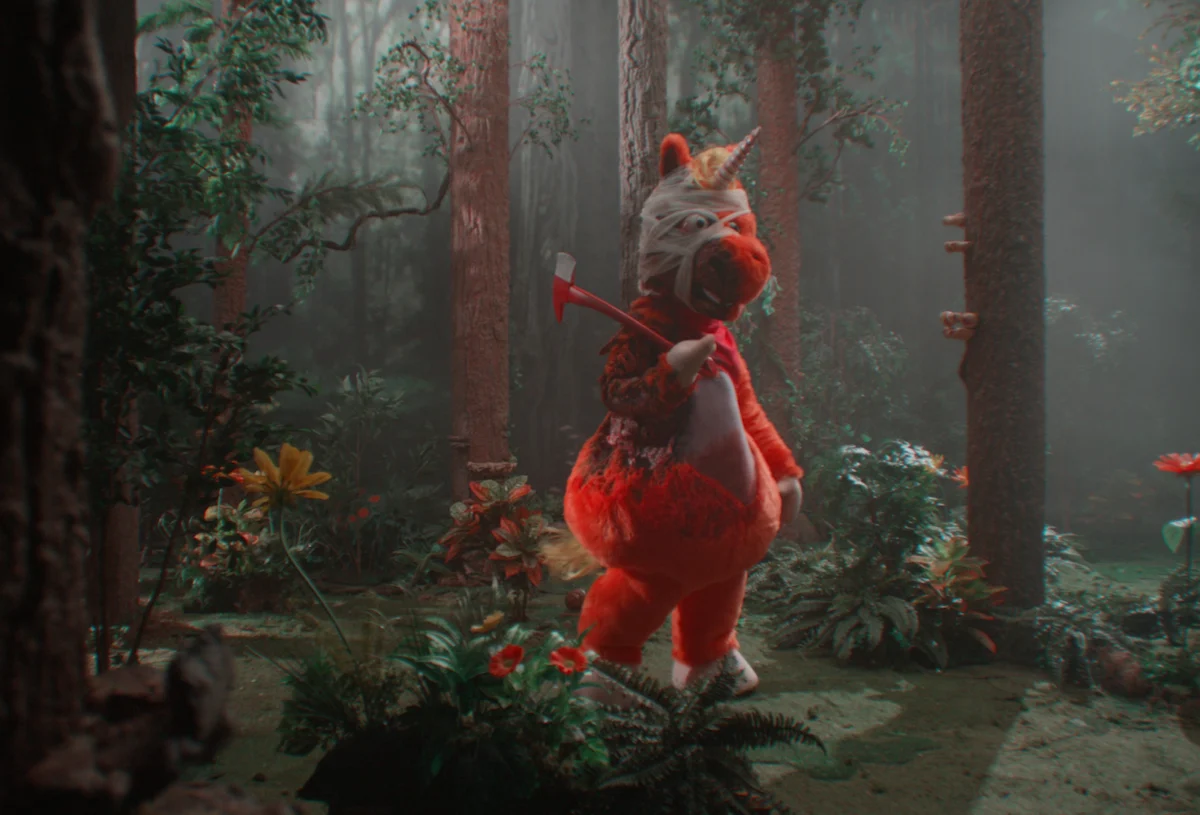
In the film, a group of young children plays in a world that features a talking mailbox, a treehouse, and a wishing well. When they chant the film’s title, "Oh, Buddyyyy!", a giant plush unicorn animatronic lumbers into existence to teach them lessons on social anxiety, chores, and the processing of fear.
The Shift: The Incursion of Reality
The first act of Buddy remains firmly within this "cheap TV" aesthetic. The colors are too bright, the set design feels flimsy enough to collapse, and the acting is a precise, grating performance of "wholesome" enthusiasm. However, the tension breaks when one child, Josh, refuses to participate, choosing instead to retreat into a book.
This act of defiance acts as a catalyst. The film transitions from a psychological exploration of childhood trauma into a picaresque adventure-horror. This shift is a bold narrative choice by Kelly and co-writer Jamie King. While some critics might argue the transition dilutes the "maddening tone" of the first act, it serves a practical purpose: it prevents the audience from suffering the same existential exhaustion as the characters. It is a pivot toward sustainability without sacrificing the film’s underlying dread.
Supporting Data: A Cast of Exceptional Range
The efficacy of Buddy relies heavily on a cast that can oscillate between the "cloying child-star" archetype and the "victim of a hell dimension."
- Keegan-Michael Key as Buddy: Key’s performance as the voice (and soul) of the unicorn is a masterclass in duality. He shifts effortlessly between saccharine jollity, cold, homicidal rage, and the raw, unadulterated panic of a character whose reality is disintegrating.
- Cristin Milioti: As one of the co-stars caught in the machinery of the show, Milioti proves once again why she is one of the most versatile actors working today. She brings a grounded, weary humanity to a world that is inherently artificial.
- The Child Ensemble: The younger cast—Delaney Quinn (Freddy), Caleb Williams (Wade), Tristan Broders (Oliver), Madison Skyy Polan (Hannah), Tory Jacqui Malone (Tyler), and Luke Speakman (Josh)—are nothing short of miraculous. They perfectly capture the "90s kid actor" aesthetic, only to peel back those layers as the horror sets in, revealing the nuanced, frightened reactions of children in genuine peril.
Official Responses and Industry Context
The film has emerged during a fascinating year for "nostalgia-trauma" cinema. Alongside works like The Bone Temple (which explores the darker, exploitative histories of Teletubbies and the Jimmy Savile era) and Backrooms (a project dedicated to the uncanny aesthetic of 90s-era liminal spaces), Buddy fits into a larger cultural reckoning.

Audiences are currently obsessed with taking the "wholesome" imagery of their youth and recontextualizing it through a lens of horror. While many of these films rely on gritty, modern sensibilities, Buddy stands out for its purity. It avoids the crutch of social media or modern technology, opting instead to tell a timeless story about mothers, daughters, and the courage required to look behind the curtain of the stories we are told.
Implications: Media, Loneliness, and Gaslighting
Beyond the gore and the winking genre references, Buddy is a poignant commentary on how we use media as a coping mechanism. The show-within-a-show functions as a form of gaslighting, where the characters are forced to perform joy even as their environment becomes increasingly hostile.
The film posits that the stories we are fed as children—the ones designed to "help" us process fear—can themselves become the source of our deepest anxieties. The "sentient backpack" (voiced with existential exhaustion by Patton Oswalt) provides the film with its most poignant moments, serving as a surrogate for the viewer who can clearly see the cracks in the facade.
The Verdict
Buddy is, at its core, a film about the necessity of breaking the "bit." Casper Kelly has succeeded in creating a work that functions on two levels: as a terrifying, blood-soaked horror film for the uninitiated, and as a sophisticated, psychological study for those whose brains "light up at the phrase ‘blood-soaked Barney episode’."
While it remains an open question whether a version of the film that never allowed reality to "break in" would have been more effective, the version we have is a triumph. It is funny, dark, and profoundly aware of its own artificiality. Buddy does not just demand to be watched; it demands to be interrogated. It is a rare example of a film that understands the power of its own premise and commits to it until the very last frame, leaving the audience both horrified and deeply, existentially satisfied.