For over a millennium, chess has served as the quintessential emblem of intellectual rigor. It is a game of perfect information, stoic strategy, and unwavering rules. It is a bastion of order in an unpredictable world. Enter Pippin Barr, an experimental game designer and university professor who has dedicated a significant portion of his creative output to systematically dismantling that order.
With the recent launch of Chesses 4, Barr has now introduced 36 distinct, browser-based variations on the game. These are not mere quality-of-life updates or engine tweaks; they are, by his own admission, playful assaults on the dignity of the game. For the traditionalist, Barr is an agent of chaos. For the experimentalist, he is a vital disruptor, proving that even the most "solved" and sacred systems are ripe for absurdity.
The Chronology of Disruption: A History of Chesses
The project began in 2019, when Barr released the first iteration of Chesses. His stated objective was noble yet iconoclastic: to "allow non-players of chess to get a kick out of the game." By stripping away the intimidating aura of professional tournament play and replacing it with whimsical, often broken mechanics, Barr lowered the barrier to entry.
2019: The Initial Shock
The inaugural collection featured eight variants that challenged the fundamental physics of the board. From randomized piece appearances to slippery surfaces that defied the grid-based movement of the pieces, the first set established the "Barr aesthetic." It wasn’t about winning; it was about navigating a logic-defying environment.
2020: Expanding the Absurdist Horizon
Undeterred by the bewildered reactions of the chess community, Barr returned with Chesses 2. This installment introduced thematic crossovers, such as "Fog of War"—which restricted the player’s vision, forcing them to navigate a board of hidden dangers—and a minimalist variant inspired by the wall drawings of Sol LeWitt. The scope had shifted from simple mechanical tweaks to conceptual art.
2021: The Third Wave
By the time Chesses 3 launched, the project had gained a cult following. This collection saw the introduction of increasingly bizarre scenarios, including "Chess: Psionic Edition" and a dressage-themed variant that added layers of aesthetic performance to the standard movement of knights and bishops.
2024: Chesses 4 and the Present
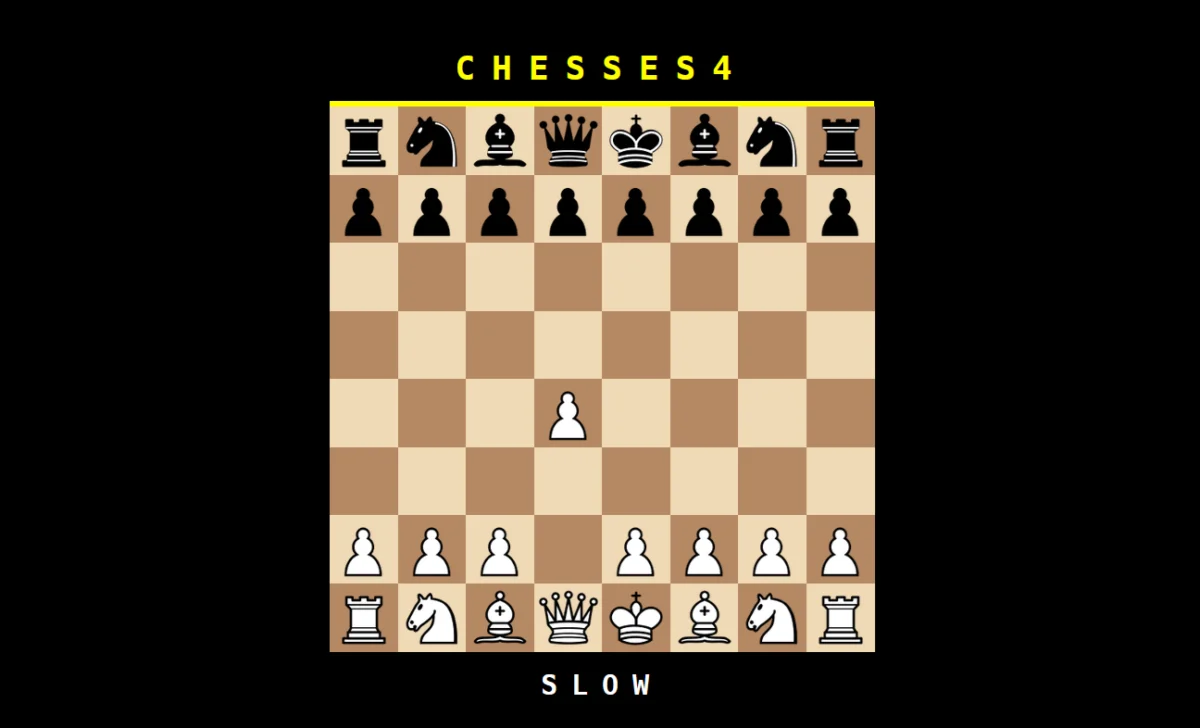
The latest release, Chesses 4, continues the trend with eight new additions. Among them are "Travelator" (a dynamic board that moves pieces against the player’s will), a Candy Crush-inspired match-three hybrid, and a game so excruciatingly slow it makes the drying of paint seem like a high-octane thriller.
Anatomy of the Variants: Why It Works
To understand the appeal of these projects, one must look past the "insanity" of the design and analyze the mechanical implications. Barr’s work functions as a series of game-design stress tests.
Mechanical Subversion
Many of the variants serve to highlight how much of our chess expertise is muscle memory. When Barr introduces a "travelator" or a "slippery board," he forces the player to unlearn the standard geometry of the game. This creates a state of "flow" where the player is constantly adapting to a changing environment rather than relying on memorized opening lines.
The "Correspondence" Experiment
Perhaps the most intriguing addition in the latest set is "Correspondence." Unlike the previous, computer-managed variants, this is a direct, open invitation to play against Barr himself. It marks a shift from the designer as an impartial creator of chaos to the designer as a participant. It is a social experiment as much as a game, testing how the public engages with an author who has spent years "attacking" their favorite hobby.
Implications for Game Design and Theory
Pippin Barr’s Chesses project is more than just a series of web-based jokes. Within academic game design circles, these variants are viewed as "ludic critiques."
Challenging the "Sacred Cow"
In game design, certain games are treated as untouchable. Chess, Go, and Tetris are often held up as pinnacles of design that should not be tampered with. Barr’s work serves as a reminder that games are merely sets of rules—and rules are meant to be broken, bent, and recontextualized. By applying the "game jam" philosophy to a thousand-year-old tradition, he democratizes the act of creation.
The Role of the "Non-Player"
Barr’s foundational goal—making chess accessible to the non-player—is a vital piece of the broader "indie" gaming movement. By removing the pressure of "playing correctly," he encourages a spirit of playfulness. If a user can experience the joy of moving a piece without the crushing weight of grandmaster-level theory, the game becomes a sandbox rather than a lecture hall.
Official Responses and Public Reception
The reaction from the gaming press and the chess establishment has been, predictably, one of bemused frustration. While mainstream chess websites rarely acknowledge these variants, the indie gaming community has embraced them as essential digital artifacts.
- The "Aggrieved" Player Perspective: Many long-time chess players find the project fundamentally disrespectful. The argument is that by "breaking" the game, Barr creates a trivialization of a high-skill pursuit.
- The Designer’s Defense: In interviews and on his personal blog, Barr remains unbothered by these critiques. He views the rigidity of competitive chess as a barrier to authentic human expression. For Barr, the "insanity" of his variants is a reflection of the inherent chaos of modern life—a far more relatable experience than the cold, calculated environment of a Grandmaster tournament.
A Call for New Targets: Why Not Monopoly?
As we look at the 36 variants currently available, the question arises: is it time to move on? There is a legitimate argument that the "chess" well has run dry. While the variations are clever, the shock value has inevitably diminished over five years of releases.
If Barr were to pivot his attention, he would find a far more fertile ground in other board game classics. Monopoly, for instance, is a game famously designed to demonstrate the evils of capitalism, yet it is rarely played with any sense of irony or mechanical subversion.
Imagine a "Psionic Monopoly," where players can use telekinetic influence to move their tokens, or a "Travelator Monopoly," where the board layout shifts as you pass GO. If chess has been "injured" 36 times, perhaps it is time for a new patient. Monopoly, with its reliance on chance and its long, grueling, and often frustrating play sessions, is the perfect candidate for a "Pippin Barr intervention."
Conclusion: The Enduring Value of Play
Whether one views Pippin Barr as a genius of experimental design or a nuisance to the chess-playing establishment, his impact is undeniable. He has turned a digital browser window into a laboratory for curiosity.
By forcing us to reconsider the rules of the world’s most famous game, he reminds us that games are not meant to be static, immutable objects. They are living things. They require the touch of the creator—and sometimes, they require the touch of the disruptor—to stay relevant.
As we look toward the potential for a Chesses 5 or a pivot to other board game classics, one thing remains clear: the majesty of chess will survive the assault. If anything, the "grievous injuries" inflicted by Professor Barr have only highlighted why the original game remains so resilient, so perfect, and perhaps, so overdue for a little bit of healthy, digital chaos.