

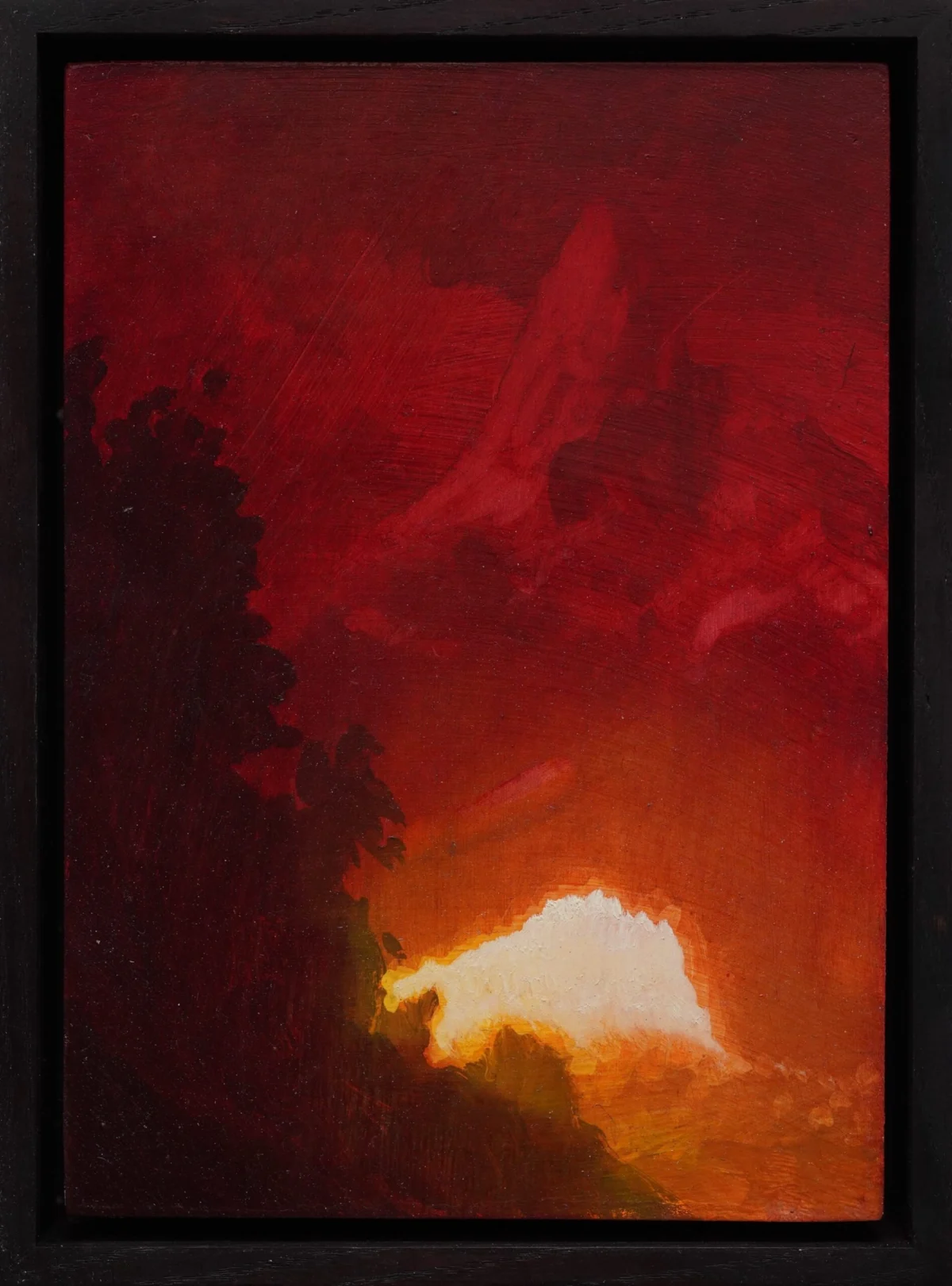
Scottish artist Andrew McIntosh has long been recognized for his ability to manipulate the viewer’s perception of the natural world. Known primarily for a palette defined by the melancholic beauty of soft blues, cool grays, and muted oranges, his latest body of work marks a dramatic, sanguine departure. In his current exhibition, I Hope This Transmission Finds You Soon, McIntosh has traded his signature atmospheric restraint for a saturated, visceral crimson. These new oil paintings continue his exploration of otherworldly landscapes, casting familiar geological forms—mountains, valleys, and crags—in a haunting, uncanny light, punctuated by the presence of mysterious, glowing orbs.
Main Facts: A Shift to the Sanguine
The exhibition, currently on display at the School Gallery in Folkestone, U.K., presents a collection of works that challenge the viewer’s spatial and emotional orientation. By flooding his canvases with varying shades of red, McIntosh creates a sense of urgency and displacement. The mountains, which appear to be lifted from the rugged topography of the Scottish Highlands or the Swiss Alps, are rendered strange by the addition of luminous, floating spheres that seem to hover between the physical world and a state of metaphysical intrusion.
"These works sit somewhere between memory and invention—familiar landscapes interrupted by something I don’t fully understand," the artist explains. This statement serves as the conceptual anchor for the entire collection. McIntosh is not merely painting a mountain; he is painting the intersection of human perception and the inexplicable. The orbs, which appear in almost every piece, act as visual disruptions, suggesting that the landscape is not just a setting, but a participant in a dialogue with an unseen, possibly extraterrestrial or extradimensional, force.

Chronology: The Evolution of an Aesthetic
To understand the gravity of this new collection, one must examine the arc of McIntosh’s career. His earlier works were characterized by a certain romanticism, a nod to the sublime tradition of 19th-century landscape painting. He often depicted empty buildings and vast, lonely terrains that invited the viewer to contemplate solitude.
- Early Career: McIntosh established a reputation for technical precision, often utilizing soft, layered pigments to create a sense of deep, receding space.
- The Transitional Phase (2020–2024): During this period, the artist began experimenting with "interruptions"—geometric shapes and light anomalies—within his otherwise realistic landscapes.
- The Current Era (2026): With I Hope This Transmission Finds You Soon, the transition is complete. The subtlety of the past has been replaced by the bold, aggressive saturation of red, signaling a move toward a more Gothic, challenging aesthetic.
This evolution is not merely stylistic; it is a deepening of his thematic inquiry into how we perceive the "known" world when it is suddenly rendered unrecognizable by the inexplicable.
Supporting Data: Technical Composition and Scale
The works within the exhibition demonstrate a wide range of scale, highlighting the artist’s versatility with the medium of oil on linen and board.

- "Whitney" (2026): At 170 x 130 centimeters, this is the centerpiece of the exhibition. The sheer scale of the work forces the viewer into a confrontational relationship with the crimson landscape.
- "K2" & "Gasherbrum" (2026): Measuring 38 x 43 centimeters, these smaller pieces compress the intensity of the larger works into a more intimate, jewel-like format.
- "Matterhorn" (2026): The smallest work in the collection (20 x 15 centimeters), this piece on board serves as a concentrated study of light and color, proving that the tension of the series is just as effective in miniature as it is on a grand scale.
The technical proficiency involved in layering red—a color notorious for its difficulty in maintaining luminosity without turning muddy—speaks to McIntosh’s mastery of his medium. The light captured within the glowing orbs is achieved through careful glazing, allowing the underlying layers to contribute to the overall luminescence of the canvas.
Official Responses and Literary Inspiration
The School Gallery has framed the exhibition not just as an artistic endeavor, but as a philosophical meditation on the nature of reality. The gallery’s curation explicitly links the exhibition to Cormac McCarthy’s 1985 magnum opus, Blood Meridian. By invoking the violence, the vast, unforgiving landscapes, and the philosophical nihilism of McCarthy’s Western, the gallery suggests that McIntosh’s landscapes are not peaceful retreats, but sites of profound struggle.
The inclusion of the following excerpt from Blood Meridian in the exhibition notes provides a lens through which to view the work:

"The truth about the world … is that anything is possible. Had you not seen it all from birth and thereby bled it of its strangeness it would appear to you for what it is, a hat trick in a medicine show, a fevered dream, a trance be populate with chimeras having neither analogue nor precedent, an itinerant carnival, a migratory tent show whose ultimate destination after many a pitch in many a mudded field is unspeakable and calamitous beyond reckoning."
This quote acts as a manifesto for the show. McIntosh’s paintings strip away the "strangeness" that we have "bled" from the world through familiarity, revealing the underlying absurdity and potential terror of existence.
Implications: The Landscape as a Site of Potentiality
The implications of this body of work extend beyond the art world and into the realm of speculative inquiry. By placing recognizable mountains (such as the Matterhorn or the actual K2) into an impossible, red, orb-filled space, McIntosh is asking the viewer to reconsider their relationship to the natural world.

The Disruption of the Familiar
In our daily lives, we treat landscapes as static, permanent fixtures. They are the backdrop of our existence. By injecting these "chimeras" (the orbs) into the frame, McIntosh suggests that the world is a much more volatile and unpredictable place than we admit. The landscapes are not merely scenery; they are the stage for an "itinerant carnival" of forces that we are ill-equipped to understand.
The Role of Communication
The title, I Hope This Transmission Finds You Soon, implies that the paintings themselves are a form of signal. If the landscapes are the "transmissions," what is the message? The orbs suggest an intelligence—or at least an intention—that is fundamentally alien to human experience. It forces the viewer to confront the idea that there is a vast, invisible layer of reality operating alongside our own, one that is indifferent to our presence.
The Gothic Western Connection
The connection to Blood Meridian is particularly telling. McCarthy’s work is famously concerned with the cruelty of the landscape and the persistence of violence. In McIntosh’s hands, this violence is rendered aesthetic. The crimson palette could be interpreted as the blood of the earth, or the heat of a dying sun, or perhaps the raw, unadulterated energy of a universe that does not care for human definitions of beauty or peace.

Conclusion: A Must-See for the Modern Viewer
I Hope This Transmission Finds You Soon is an exhibition that demands engagement. It is not designed for passive consumption; it is designed to unsettle. By forcing the viewer to look at the world through the lens of the "fevered dream," Andrew McIntosh has successfully captured the anxiety of the modern age—the feeling that, at any moment, the reality we rely on could shift, revealing something entirely new, entirely strange, and entirely beyond our control.
The exhibition remains on view at the School Gallery in Folkestone, U.K., through May 30. For those unable to attend, the artist’s ongoing projects can be followed via his social media channels, where he continues to document the process of creating these complex, dream-like visions. Whether one views these works as a literal exploration of the unknown or a metaphorical dive into the subconscious, there is no denying the power of McIntosh’s vision. He has turned the landscape into a mirror, and in his red, glowing, and craggy world, we are forced to look at our own precarious place in the vast,, unknown expanse.










No comments yet. Be the first to join the conversation!