

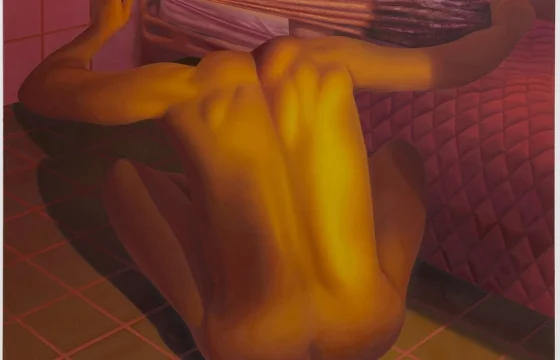
In the quiet, contemplative confines of the project space at Lyles & King in New York, a profound dialogue between biology and abstraction is currently unfolding. Through April 4, the gallery is hosting a solo exhibition of new paintings by Kate Meissner, an artist whose recent work marks a significant shift in both thematic focus and emotional resonance. Following the seismic personal event of becoming a mother for the first time last year, Meissner has turned her lens inward, producing a series of works that grapple with the radical, often overwhelming, metamorphosis of the human form during pregnancy and childbirth.
Main Facts: A New Chapter in Meissner’s Practice
Kate Meissner’s latest exhibition is not merely a collection of paintings; it is a visual manifesto on the "elasticity" of the human body. Known for a rigorous approach to form and color, Meissner’s latest output utilizes the canvas as a site of physiological inquiry. The works on display at Lyles & King serve as a bridge between the clinical realities of gestation and the primal, often visceral, experience of mammalian biology.
The exhibition underscores the artist’s technical prowess, blending fine-tuned aesthetic sensibilities with a raw, honest exploration of the body’s capacity for change. By stripping away the societal veneer often placed upon motherhood, Meissner invites the viewer into a space that is simultaneously intimate and universal. She posits that the body is not a static vessel but a fluid, ever-changing landscape capable of extreme structural adaptation.
Chronology: From Yale to the Present
To understand the weight of Meissner’s current project, one must examine the trajectory of her career, which has been characterized by steady, critical acclaim and a consistent evolution of style.
- Early Life and Education: Born in 1995 in Sacramento, California, Meissner’s interest in the visual arts was fostered early. She eventually pursued formal training, culminating in a Master of Fine Arts from Yale University—a program widely regarded as a crucible for some of the most influential contemporary painters of the last several decades.
- Formative Years in Los Angeles: Relocating to Los Angeles allowed Meissner to cultivate a studio practice that thrives within the city’s dense, eclectic art ecosystem. It was here that she began to establish her signature visual vocabulary, one that balances structure with an underlying, chaotic energy.
- Institutional Recognition: Her work has moved rapidly from project spaces to the permanent collections of prestigious institutions. Notable acquisitions include pieces held by the Denver Art Museum in Colorado, the Xiao Museum of Contemporary Art in Rizhao, China, The Mer Collection in Madrid, and the Abroms-Engel Institute for the Visual Arts in Birmingham, Alabama.
- The 2023 Inflection Point: The most significant shift in her timeline occurred last year with the birth of her first child. This transition from "artist-as-observer" to "artist-as-subject" triggered the series currently on view at Lyles & King. The exhibition represents the culmination of a year spent processing the biological and existential shifts inherent in the maternal experience.
Supporting Data: The Anatomy of Transformation
Meissner’s work is underpinned by an intense focus on the "animalistic" nature of the body. In her artist statement, she describes the paintings as a meditation on the mammalian reality of human life. This is supported by several stylistic choices within the exhibition:
The Aesthetic of Elasticity
The canvases feature distorted figures and fluid lines that suggest a body constantly in flux. By eschewing rigid anatomical realism, Meissner captures the sensation of the body stretching—both literally, as in the growth of a pregnancy, and figuratively, as in the stretching of the psyche during the postpartum period.
Institutional Validation
The inclusion of Meissner’s work in museums across three continents indicates that her exploration of the body resonates beyond the domestic sphere. The acquisition of her pieces by the Denver Art Museum and the Xiao Museum suggests that curators view her work as a significant contribution to the discourse on contemporary figurative painting. Her representation by Lyles & King, a gallery noted for its rigorous and thoughtful program, further cements her status as an artist whose work warrants serious critical engagement.
Official Responses and Curatorial Context
The critical reception of Meissner’s work has been marked by an appreciation for her ability to navigate the complex terrain of the "body in pain" and the "body in joy." Lyles & King has positioned this exhibition as a highlight of their spring calendar, emphasizing the project space’s role in showcasing artists who are currently pushing the boundaries of their respective mediums.
In discussions surrounding the exhibition, gallery representatives have highlighted Meissner’s unique ability to merge the private act of motherhood with the public, often clinical, language of contemporary art. While the art world has historically debated the "maternal" as a subject—often relegating it to the domestic or sentimental—Meissner’s work is deliberately aggressive, intellectual, and formalist. She refuses to allow the work to be reduced to "mommy art," instead grounding it in the science of physiology and the history of painting.
Implications: The Future of Maternal Discourse in Art
The implications of Meissner’s latest exhibition are twofold: they reflect a shifting landscape in contemporary art and suggest a new way forward for artists exploring the physical body.
Reclaiming the Maternal Narrative
Meissner’s work challenges the traditional art-historical perspective that has long kept the experience of childbirth at arm’s length. By centering the mammalian, instinctual, and physical aspects of the process, she creates a space for a more honest dialogue about the body. She is not presenting a polished, filtered version of motherhood; she is presenting the labor, the transformation, and the raw, untethered nature of the human animal.
The Evolution of Contemporary Figurative Painting
Furthermore, the exhibition signals a broader trend in painting: the movement away from conceptual detachment toward a more integrated, bodily experience. As viewers look at the works in the Lyles & King project space, they are forced to confront the limits of their own physical understanding. The "elasticity" Meissner explores is not just a feature of pregnancy; it is a metaphor for the human condition—our ability to endure, to shift, and to reform ourselves in the face of monumental change.
A Lasting Impact
As the exhibition nears its close on April 4, the discourse it has generated continues to expand. Meissner’s transition into this new phase of her practice proves that the most powerful art often stems from the most profound personal transformations. By turning the spotlight on her own physiological history, she has opened a door for a deeper, more visceral exploration of what it means to inhabit a body.
For collectors, critics, and the general public, the exhibition stands as a testament to the fact that the human body remains the most fertile territory for artistic exploration. As Meissner continues her work in Los Angeles, her trajectory suggests that this meditation on maternity is merely the beginning of a broader investigation into the biological architecture of our lives.
Conclusion
Kate Meissner’s exhibition at Lyles & King is a vital contribution to the current conversation on the human form. Through her skillful application of paint and her unflinching honesty regarding the realities of pregnancy and birth, she has succeeded in elevating a personal milestone into a sophisticated exploration of the mammalian experience.
The exhibition remains open until April 4, and for those who seek to understand the intersection of biology and fine art, it is a mandatory viewing experience. Meissner does not merely paint the body; she maps its metamorphosis, reminding us that beneath the surface of our civilized existence lies a primal, elastic, and endlessly fascinating capacity for transformation. In an art world that often favors the cerebral, Meissner reminds us that the most profound insights are often found in the blood, bone, and breath of our own physical reality.










No comments yet. Be the first to join the conversation!