

By Crystal Bell
April 13, 2026
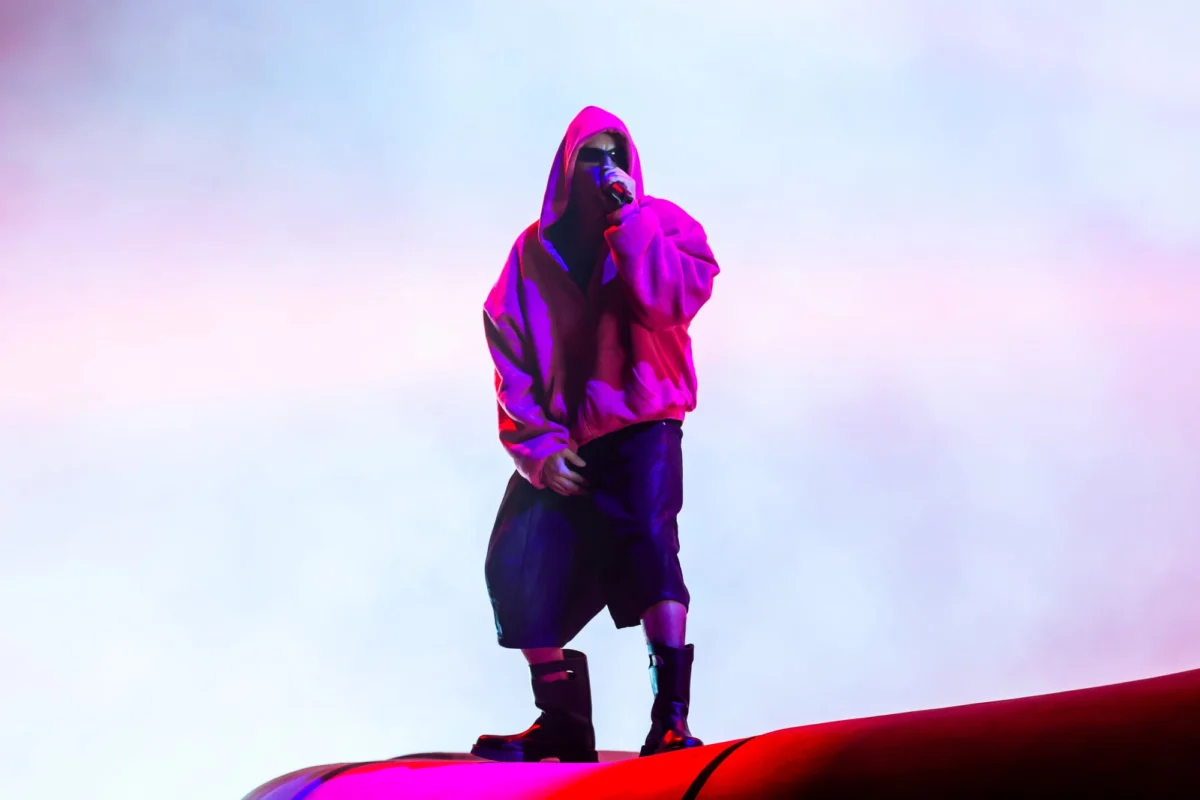
At the 2026 Coachella Valley Music and Arts Festival, the traditional boundaries of the "headlining spectacle" were not merely pushed—they were entirely dismantled. Justin Bieber, the 32-year-old pop titan, did not descend from a levitating platform or emerge from a sea of pyrotechnics. Instead, he walked onto the Coachella stage wearing a hoodie, sat down at a desk, opened a laptop, and began a performance that felt less like a stadium concert and more like an intimate, deeply surreal deep-dive into his own YouTube search history.
For 90 minutes, the global superstar invited a field of 100,000 attendees—and millions streaming online—to bear witness to a meta-narrative of his own existence. By projecting his formative digital footprints onto massive screens, Bieber transformed the main stage into a bedroom sanctuary, forcing a reckoning with what it means to grow up in the public eye.
The Chronology of a Digital Life
The set was structured as a chronological odyssey through the life of a digital native. Midway through the Saturday night performance, Bieber steered the energy toward the past. He began streaming grainy, low-resolution clips of his early career: snippets of "Baby," "Favorite Girl," and "Never Say Never."
The most resonant moment occurred when he pulled up the 2007 YouTube video of a 12-year-old Bieber singing Ne-Yo’s "So Sick." Uploaded nearly two decades ago, the clip served as a stark reminder of a pre-algorithmic era. Back then, YouTube was a platform for organic discovery, a place where a kid with a webcam could accidentally capture the world’s attention. By duetting with this younger, floppy-haired version of himself, Bieber wasn’t just performing a medley of hits; he was curating his own archive.

As the set progressed, the tone shifted from nostalgic to confrontational. Bieber wove in moments of his "present" internet life, including reciting his own viral paparazzi "standing on business" rant and playing unrelated meme clips. The stage became a browser window with too many tabs open—a chaotic, messy, and profoundly human portrait of a man who has lived entirely online.
Supporting Data: The Anatomy of Modern Pop Stardom
To understand the weight of Bieber’s performance, one must look at the trajectory of the creator economy. Justin Bieber stands as one of the last true pop superstars whose mythology was built on the foundation of early social media. Unlike the current generation of stars, whose fame is often accelerated by TikTok algorithms and hyper-specific niche content, Bieber’s rise was a singular event.
Data from the past two decades suggests a shift in how fans interact with celebrities. In 2009, engagement was community-driven, centered on fan forums and early YouTube comment sections. By 2026, engagement has become fragmented, siloed, and highly individualistic. Bieber’s decision to perform in a "sparse" style—relying on his voice and the raw archival footage rather than elaborate choreography—highlights a pivot in fan expectations. While critics initially labeled the set "underwhelming" compared to the high-production value of other headliners, those who stayed tuned recognized the subversive power of his restraint.
The Contrast of Spectacle
The festival circuit has long demanded a specific type of excess. On the same stage, headliners like Sabrina Carpenter utilized multi-million dollar sets, dozens of costume changes, and complex, cinematic staging to satisfy the "viral moment" requirement of modern festival culture.
Bieber’s refusal to participate in this arms race was a bold, if divisive, artistic choice. By choosing a hoodie over couture and a laptop over a troupe of dancers, he stripped away the armor of the "pop star" label. This created an emotional friction. It forced the audience to look at the man, not the spectacle. When Bieber looked directly into the camera—not at the crowd, but at the digital lens—it felt like a FaceTime call with a friend, bridging the gap between the physical desert and the digital ether.

Implications: The Living Archive
The implications of this performance reach far beyond the music industry. Bieber’s Coachella set provides a blueprint for how celebrities in the future will navigate their own digital legacies. We live in an era where every mistake, every triumph, and every awkward phase is immortalized in digital amber.
For many former child stars, this constant availability of their younger selves is a source of trauma or professional embarrassment. Bieber, however, chose to reclaim that narrative. By smiling at his younger self, harmonizing with the audio of his childhood, and laughing at the absurdity of his own memes, he signaled a transition from being a product of the internet to being the curator of his own history.
This performance marks a maturation in the "online" celebrity. It suggests that the future of pop stardom may not lie in bigger screens or louder bass, but in the ability to bridge the gap between the person we were when we first clicked "upload" and the person we have become since.
Official Responses and Fan Reaction
Social media discourse following the set was as fragmented as the internet itself. While some fans expressed confusion over the lack of traditional "concert" elements, the consensus among long-term supporters was one of profound emotional catharsis.
"It felt like watching him finally make peace with the kid in the video," noted one prominent culture critic on X (formerly Twitter). The set sparked a trend of retrospective posts, with fans sharing their own "digital history"—the old accounts, the deleted posts, and the forgotten memes that defined their own adolescence.

Bieber’s management has remained quiet regarding the specific staging choices, but the intimacy of the performance spoke volumes. By allowing his guests—The Kid LAROI, Dijon, Tems, Wizkid, and Mk.gee—to occupy the stage with him in a casual, jam-session style, he further reinforced the idea that this was not a curated product, but a living, breathing, and occasionally messy experiment in vulnerability.
Conclusion: The New Standard for Digital Intimacy
Justin Bieber’s 2026 Coachella performance was an exercise in radical transparency. In an age where digital identity is often carefully curated and filtered, Bieber chose to present the raw, unedited, and deeply fragmented version of his life.
By inviting the world to watch him watch himself, he invited us all to reflect on our own digital histories. He proved that the most powerful thing an artist can do in a world of infinite, algorithmically-driven content is to turn off the noise and look at the screen—and the person behind it—with genuine curiosity.
As the lights dimmed over the Indio desert, it was clear that the performance was not just about the music. It was about the act of living long enough online to see yourself become a memory, and having the courage to invite the world to look back with you. Justin Bieber didn’t just headline Coachella; he logged into the history of the internet, and in doing so, he finally closed the browser tabs that had been haunting him for nearly twenty years.












No comments yet. Be the first to join the conversation!